
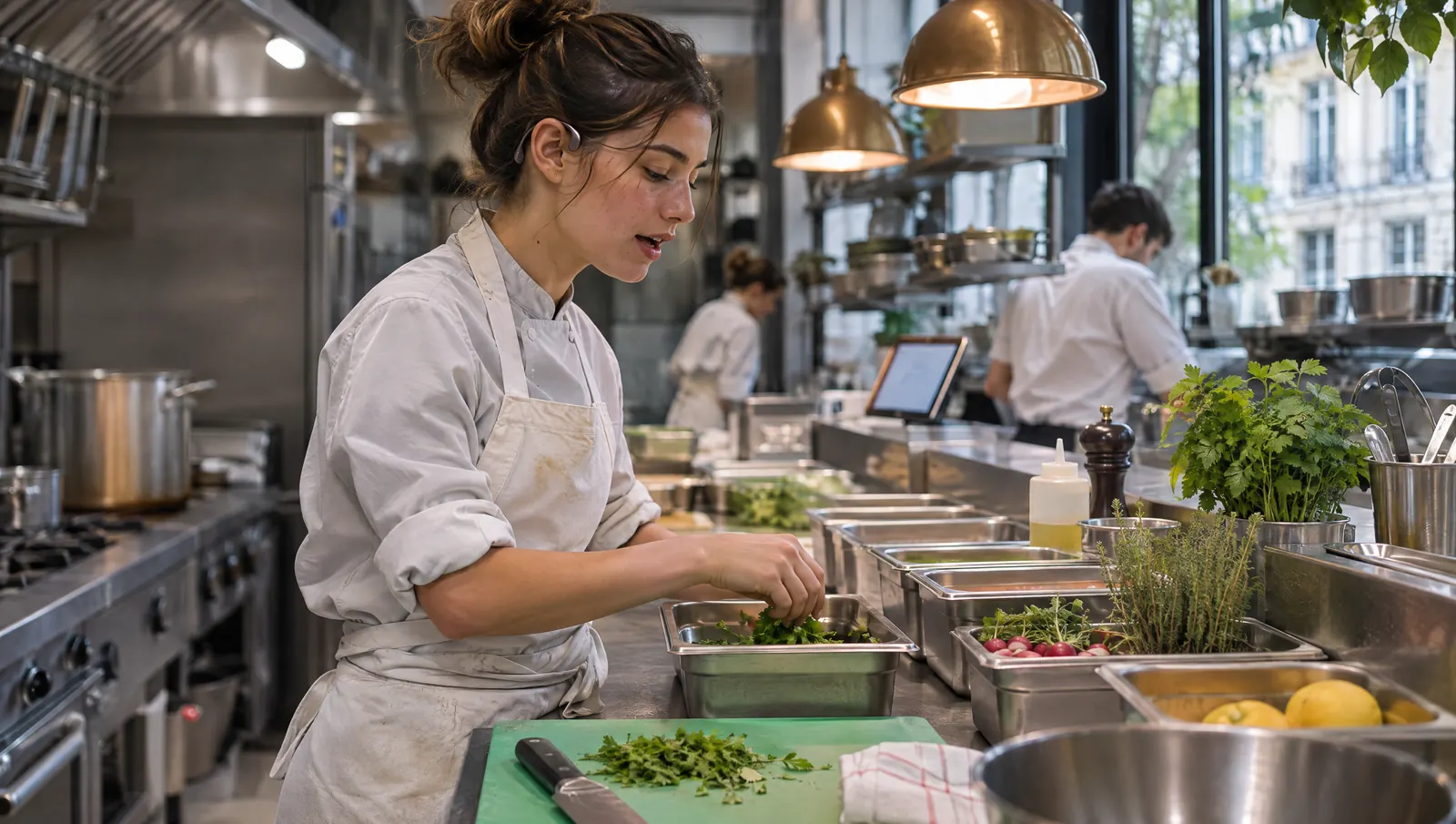
Tsuno San is the work companion for kitchen, prep, dishwashing and cleaning teams. You ask it for a procedure, your next task, a checklist, a routine check or an issue report, and it answers from what your business has written in Tsuno. There is only one San, on screen and by voice. It acts within the person's permissions, prepares every action and waits for confirmation, and it never judges anyone.
Tuesday, 6:50 a.m., before opening
Ines has been a commis for nine days. Her hands are in a tub of vegetables, the sous-chef is on the phone with a supplier, and the head chef does not arrive until 8. She has three questions and nobody to ask.
She asks quietly: "What's left on the opening checklist?" San answers in one sentence: three items, the walk-in, the prep fridge temperature log, labeling yesterday's containers. Then: "How do I clean the slicer?" The restaurant's own sheet appears on the tablet, with its steps and its last update date. Ines has not interrupted anyone.
At 7:20, a colleague asks her whether today's sauce contains sesame. She asks San. It does not answer from memory: it shows the recipe sheet or, if it does not have one, says so and tells her to check with the chef. That is exactly what you want from it.
(Ines and her restaurant are fictional, like every character in this article.)
What exactly is Tsuno San?
One San, on screen and by voice
San is not another app. It is a way of talking to Tsuno, the environment the team already uses: procedures, tasks, checklists, routine checks, equipment, information about the business. You can use it by typing, on screen, or by voice when your hands are full. The result is the same, with the same rules.
Voice is never mandatory. Someone who does not want to wear anything on their ear, who is hard of hearing or who prefers to read must be able to do everything without speaking.
It only knows what your business has written
San does not make up a procedure. It searches what your team has written and approved. When there is no sheet, it says so. That honesty is deliberate: "I don't know, here is who to ask" beats a plausible wrong answer. We go deeper in why an assistant must be able to say "I don't know".
Three names, three statuses
We would rather be precise about what exists:
- San Voice, the voice interaction, is available in demo.
- San Audio, exploring a hands-free experience, is under exploration and testing.
- San 360, a broader vision of operational support, is under exploration and testing.
On the voice side, the hardware is kept simple: a small dedicated Android device and a light earpiece. Each person opens their session with the business code and their own PIN. No personal account to create, no app to install on your own phone.
What about your usual AI assistant?
Tsuno can also be queried from the AI assistant you already use (ChatGPT, Claude, Mistral), with exactly the same permissions as in Tsuno. San is the door designed for the floor and the kitchen; your usual assistant is often the door from the office.
What can you ask San?
San is built for the questions that interrupt the work, or the manager. They are nearly always the same:
- Find a procedure. "How do I clean the slicer?", "How much product goes in the floor cleaner?" San shows the business's own sheet.
- Check your tasks. "What's my next task?", "What's left for this morning?"
- Work through a checklist. Opening, closing, cleaning: what is done, what is left, in order.
- Get guidance through a routine check. A temperature reading, a delivery check. A good tool repeats the number it heard before saving it; that is the rule we are building on.
- Report an issue. "The dishwasher is leaking." San prepares the report, summarizes what will be created, and the person confirms.
- Find information about the business. Where a piece of equipment is kept, who to call, when a delivery is due, as long as it is written in Tsuno.
For a new hire, that list changes the first shift. The question they would not dare ask the same colleague three times, they can ask San. We describe that moment in "What do I do now?": making a new hire useful from the first shift.
Who is San designed for?
Teams whose hands are busy
Line cooks, prep cooks, dishwashers, opening and closing crews, cleaning staff. These are the people with gloves, flour or water on their hands at the exact moment they need information. A screen makes them stop, wipe their hands and search. Voice saves them that detour. See why talk to your tools when your hands are full.
New hires, seasonal staff, non-native speakers
Restaurants bring in many people on short contracts, and some of them do not read the local language fluently. Being able to ask again without embarrassment, at your own pace, already helps. Language deserves its own article, honest about the limits: non-native speakers in the kitchen: understanding without shame.
Managers and owners
The intended benefit for a manager is simple: fewer interruptions for questions whose answer is already written down. For an owner of several locations, it means the same procedure, reached the same way, everywhere. San replaces neither the manager nor training. To structure learning on the job, Tsuno Compétences takes over: San gives the information when it is needed, Compétences organizes the progression.
Where San belongs, and where it does not
San's voice mode is designed for the back of house, not the dining room. In front of guests, someone talking into an earpiece creates two problems: perception ("is it listening to me?") and the privacy of the people sitting nearby.
| Area or moment | San by voice | San on screen | Why |
|---|---|---|---|
| Prep, mise en place | Yes | Yes | Busy hands, frequent questions |
| Dish pit | Yes | Possible | Wet hands, screens are impractical |
| Walk-in, storeroom | Yes | Possible | Gloves, cold, no tablet nearby |
| Opening, closing | Yes | Yes | Long checklists, often done alone |
| Cleaning, maintenance | Yes | Yes | Procedures and dilutions to look up |
| Peak service | Best avoided | Quick, if needed | Noise and pace leave no room for a conversation |
| Dining room, counter, in front of guests | No | Out of guests' sight | Perception, and bystanders nearby |
The guardrails that are not up for negotiation
A work companion is only accepted if it is predictable. These are the rules around San. We go through them one by one in what San never does.
- It acts within the person's permissions. San only sees and does what the person can already see and do in Tsuno. A commis cannot use San to approve time off or open a manager-only screen.
- Every action happens in two steps. San prepares and summarizes, the person confirms. Nothing runs without confirmation, and it is logged.
- On critical topics, it shows instead of summarizing. Allergens, temperatures, safety: the design principle is that San displays the business's approved sheet, or says it does not have one and refers you to a person. We explain why in allergens: why no tool should answer from memory.
- It does not judge people. San does not assess anyone, does not score or rank employees, and does not analyze emotions or stress. On that last point, we have no choice anyway: under EU law, the AI Act (Regulation (EU) 2024/1689, Article 5) has banned systems that infer people's emotions in the workplace since February 2, 2025, except for medical or safety reasons.
- It does not record sensitive data about an employee. Health, pregnancy, disability, religion, opinions: Tsuno refuses to record them (GDPR, Article 9) and offers to log dated, observed facts instead.
- Some actions are out of its reach. Payroll, invoicing, permanent deletions and legal acts are excluded from what the AI can do.
The doctrine behind these rules fits in one line: Tsuno brings the facts together. People decide. Our Trust and data page gathers what we publish on the subject.
A microphone at work: what the law and employee representatives say
Putting a voice tool in a kitchen involves more than buying equipment. In France, several rules apply, and it is better to know them before rolling out.
The GDPR and the guidance of the CNIL, the French data protection authority, govern how voice and employee data are processed: a clear purpose, informing the people concerned, proportionality. We review them in a microphone at work: what the law says in France.
In French companies with at least 50 employees, the Labor Code requires that the works council (CSE) be informed and consulted on the introduction of new technologies (Article L2312-8) and, before they are put in place, on any means of monitoring employees' activity (Article L2312-38). A voice assistant can fall under both. Our position is to raise it before anyone asks: should you consult employee representatives before using a voice assistant? Outside France, check your local equivalent.
San or a general-purpose assistant: what is the difference?
A general-purpose assistant can talk about anything. San knows little, but what it knows is yours. The difference shows the moment you ask a work question.
| Criterion | General-purpose assistant | Tsuno San |
|---|---|---|
| Where the answer comes from | General knowledge | The business's procedures, tasks and information |
| Missing data | Often filled in | Flagged as missing |
| Permissions | Those of whoever holds the account, unrelated to your organization | The person's Tsuno permissions, no more, no less |
| Actions | None, or outside your system | Prepared, summarized, confirmed, logged |
| Critical topics | Answered like any other question | Shows the approved sheet or refers to a person |
| Judging people | Can produce an opinion if asked | Refuses to assess or rate an employee |
The line between the two is not always sharp, and it deserves its own article: conversational assistant or job assistant: where is the line? For the wider question of whether talking to your data is worth it, see talking to your restaurant: gimmick or new interface?
What is still being tested, and why we say so
Tsuno was born at Kajirō Sushi, the restaurant group of its founder. It was built in a kitchen and is used there every day. San follows the same path: we test it in the kitchen before we sell it.
In practice, some things work and others do not yet work as well as we want. The open issues are known to the teams trying it:
- Noise. Under an extraction hood in the middle of service, voice is put to a hard test. We recommend using it outside the rush, and the screen is always there.
- Response time. In a kitchen, a few seconds of waiting feel long. It is our first priority.
- Pause, resume, exit. Saying "pause" to talk to a colleague, or going back to Tsuno without logging out: these are requests from the floor that we are working on.
- Connectivity. A walk-in or a basement gets poor signal. Keeping a critical procedure readable without a connection is what a good tool should do, and it is something we are working on.
We would rather you saw this list before the demo than after it.
Common mistakes when introducing an assistant like San
- Making voice mandatory. Part of the team will not want to wear an earpiece. They must be able to do everything on screen.
- Plugging it into an empty binder. San only answers from what is written. Without up-to-date procedures, it will often say "I don't know". That is why Tsuno is rolled out with La Mise au carré: we arrive with content and structure it with you.
- Telling the team after the fact. The first objection is not technical, it is the fear of being listened to. Explaining the rules before day one, and consulting employee representatives where the law requires it, keeps that fear from blocking everything.
- Judging it on a demo. A good demo tells you nothing about real use. The real test is whether the team still uses it when nobody is pushing them.
- Asking it to assess someone. It will refuse, by design. For a review, start from dated facts, not from a machine's opinion. See AI should not judge your employees.
What to measure
- Voluntary use at 2 weeks and 2 months, once the launch buzz is over: how many people still ask questions without being reminded.
- Manager interruptions for questions whose answer is written down, logged over one week before rollout and then during.
- The share of questions with no sheet. Every "I don't know" from San points to a gap in your procedures. It is a to-do list, not a failure.
Where Tsuno and San come in
San relies on what Tsuno already holds: your procedures, tasks, checklists, routine checks and equipment. It makes them reachable at the moment of the task, within each person's permissions, with confirmation before any action. San Voice can be seen today in a demo, on your own routines: prep, opening, cleaning, closing. San Audio and San 360 remain exploration tracks, and we will not present them any other way until they have proven themselves in a kitchen. Details are on the Tsuno San page, and you can request a demo in a few clicks.
Meet us at Sirha Lyon 2027
Tsuno San is a candidate for the Sirha Innovation Awards 2027. We will be at Sirha Lyon, at Eurexpo, from January 21 to 25, 2027, in the Start-up Village, stand S.57. You can ask San a first-day question there, and try to trip it up on an allergen. The details are in Tsuno at Sirha Lyon 2027.
Every article on this topic
This guide is the entry point to the topic. The 37 articles that go deeper are grouped below by use.
Understanding San and what it knows
- Why an assistant must be able to say "I don't know": why a plausible wrong answer is worse than admitting ignorance, and what the assistant does instead.
- General voice assistant or a companion that knows your workplace?: the 8 criteria that separate a consumer smart speaker from a companion tied to your sheets and permissions.
- What San knows about your restaurant, and where it gets it: where San's answers come from and why it does not guess what your workplace has not written down.
- Why voice alone is not enough: the four conditions (up-to-date sheets, permissions, a trail, sign-off) without which voice is useless.
- San on screen, San by voice: when to use which: a moment-by-moment guide to choosing voice or screen depending on the station.
- The story of San: born in a kitchen, not an office: the kitchen idea behind San, born at Kajirō, and the rules it keeps from it.
- Tsuno San FAQ: every question about the frontline team assistant: short answers on availability, data, hardware, employee representatives and pricing.
Welcoming and onboarding people
- "What do I do now?": making a new hire useful from the first shift: what to prepare so a new hire finds their task and their sheet without waiting for the chef.
- Non-native speakers in the kitchen: understanding without shame: how to let people ask again without an audience, in their language, with the original instruction in view.
- Back from leave: “what changed since my last shift?”: the dated list of changes that affect your station when you come back from leave, and nothing more.
- Onboarding a multilingual team: a manager's guide: the manager's method for onboarding people who do not all speak French.
- Mixed languages in the kitchen, a reality software ignores: why a good tool learns house slang instead of correcting the team.
- Seasonal staff and extras: ready from the first shift: access, handbook, short station sheets and a buddy ready before a seasonal worker arrives.
- Translating a safety instruction: why the original must stay visible: the three precautions that stop a translation from betraying a number or a negation.
Guided shift routines
- Reporting a breakdown without leaving your station: how a breakdown report is dictated at the station, confirmed, then seen by the manager.
- HACCP checks with busy hands: no more greasy pen: why a reading spoken at the moment it is taken keeps the real time and the person.
- A closing checklist guided step by step: how the next step, a logged "done" and picking up where you left off make a first solo close manageable.
- The morning opening, guided step by step: the order, the written priorities and what to do if a fridge drifts at 6.45 am.
- Swapping a shift without calling the boss: the criteria (skills, rest, hours) that make a shift swap clean.
- Finding the procedure nobody ever wrote down: how to get knowledge held in one head dictated, reviewed, signed and dated.
- A wrong step in a checklist: flag it, fix it, for everyone: the path of a correction, from the flag to a dated version the whole team receives.
- An outdated procedure is more dangerous than a missing one: why an outdated sheet gets followed with confidence, and the three habits that prevent it.
Where San fits, and its limits
- Where San belongs in a restaurant, and where it does not: a map of the restaurant zones where voice helps and those where the screen, or nothing, is better.
- Kitchen noise, and why voice is not always the answer: what helps in the noise, when to switch to the screen and how to protect hearing.
- No network? What a field tool must keep doing: what must keep working without a network (checks, checklists, critical procedures) and what can stop.
- An assistant that is wrong once in twenty: which mistakes are acceptable?: the monthly count of misses and the difference between a tolerable re-ask and a critical error.
- Hygiene of shared equipment in restaurants: who cleans what and when for tablets, probes and earpieces that change hands.
- HACCP software, scheduling tool, assistant: where does each one stop?: where each tool stops (till, scheduling, HACCP, assistant) to avoid entering things twice.
- San beyond restaurants: bakeries, services, vineyards, culture: what San could bring to the bakehouse, a client site, the vineyard or a museum.
Testing before you adopt
- Why we test in the kitchen before we sell: our method for trials in a real kitchen and what we ask of the teams.
- How to test a voice assistant in a kitchen: the protocol of thirty real questions, allergen traps and two months of use.
- Gadget or tool? The 60-day test: the five measures to track for 60 days before you sign.
- The real cost of a voice tool in a restaurant: every cost line beyond the subscription, from hardware to exit.
- Why we show our failed trials: the typical mistakes of a voice assistant and why you should see them in a demo.
- Why we do not do avatars or cute voices: why a work assistant stays brief, neutral and without a persona.
- Sirha 2027: come and ask San your first-day question: the idea behind stand S.57: ask San the question a new hire asks you on day one.
- Sirha 2027: bring a page from your binder: what we look at together on one page of your binder: voice, writing, gaps.
The four other reference guides
- AI for frontline managers: analyse, advise, reassure: the four useful roles of AI for a frontline manager.
- MCP: connecting your AI to your business, explained for frontline trades: connecting your AI assistant to your tools without opening doors.
- The future of work in hands-on jobs: what will change in hands-on jobs and what will stay human.
- AI, voice and privacy at work: the guide: the legal and design rules for an acceptable voice AI at work.
Before a rollout, also read What San never does, Allergens: why no tool should answer from memory, A microphone at work: what the law says in France, Should you consult employee representatives before using a voice assistant? and, on the fear of monitoring, Management software or surveillance: where is the line?.
Key takeaways
Tsuno San is a single assistant, on screen and by voice, that gives frontline teams access to what their business has written, within their permissions and with confirmation. It judges no one, shows its sources on critical topics, and is tested in the kitchen before it is sold.
Frequently asked questions
What is Tsuno San?
It is the intelligent voice assistant for frontline teams, connected to the Tsuno environment. You ask it for a procedure, your next task, a checklist or a routine check, and it answers from what your business has written and approved.
Do you have to talk to San to use it?
No. There is only one San, usable on screen or by voice. Voice is an option for moments when your hands are busy, never a requirement: anything you can do by speaking must stay possible without speaking.
Can a manager use San to monitor or rate their team?
No. San does not assess anyone, does not score or rank employees, and does not analyze emotions or stress. It acts within the permissions of the person using it and brings facts together; decisions stay with people.
Can San answer a question about allergens?
For allergens, temperatures and safety, the design principle is that San does not answer from memory: it shows the business's approved sheet, or says it does not have one and refers you to a manager.
Are San Audio and San 360 available?
Not yet. San Voice, the voice interaction, is available in demo. San Audio, the hands-free experience, and San 360, a broader vision of operational support, are under exploration and testing.
Where can I see Tsuno San in person?
In a demo on request, or at Sirha Lyon 2027, at Eurexpo, from January 21 to 25, 2027, in the Start-up Village, stand S.57. Tsuno San is a Sirha Innovation Awards 2027 candidate.
Keep reading
Future of work
10 changes in the restaurant of tomorrow
Information at the station, dated procedures, checks logged during the task, AI for managers: ten changes already under way, and what can go wrong with each.
Future of work
A companion, not a supervisor
A good frontline tool helps the person doing the work first: answer, remind, report. Once it makes numbers about them for someone else, it turns into control.

Future of work
Conversational assistant or job assistant: where is the line?
A conversational assistant answers anyone with no context; a job assistant knows your location, acts within your permissions and asks for confirmation.