
A consumer voice assistant can be handy in a kitchen: a timer, grams to ounces, a general knowledge question. But it does not know your recipes or who is talking to it, and a smart speaker on the shelf listens to a room where the team works and talks. A work companion needs something else: a personal session, your permissions, your sources, a clear refusal and a confirmation before it acts. So keep the speaker for timers, and a tool that knows your workplace for everything else.
Thursday, 11:05 am, during prep
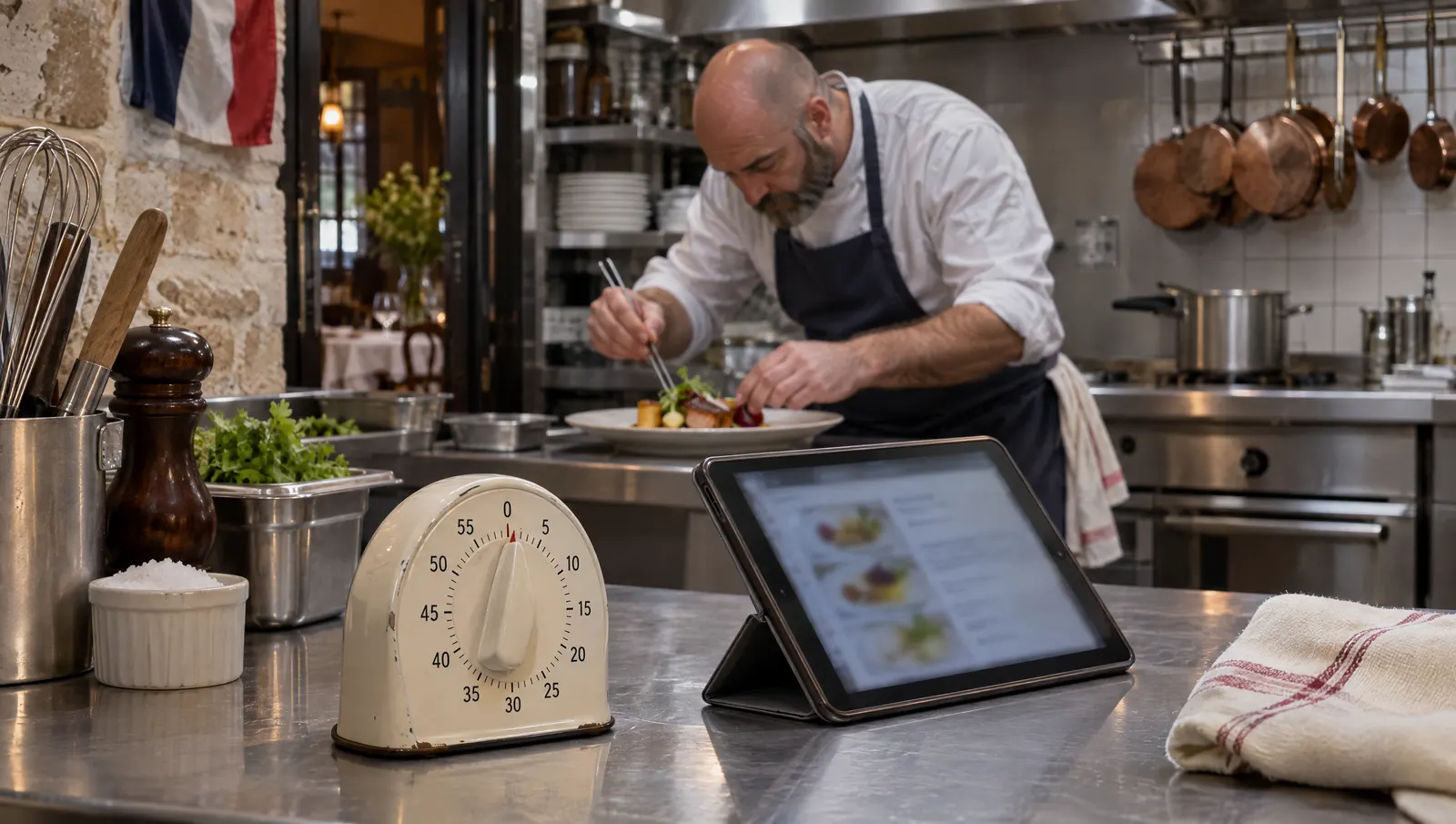
Antoine is plating test dishes for the daily special. On the shelf sits a smart speaker bought last year "for the music". He calls out: "Timer, twelve minutes." Perfect, nothing to fault.
Mehdi, a line cook in his first week, is making the sauce. A guest flagged a tree nut allergy when booking. He asks the speaker: "Does romesco sauce contain nuts?" It answers confidently, quoting a classic recipe. Except the house version is not the classic recipe, and the sheet the chef approved is not in the speaker. Mehdi has an answer, not the right source.
A little later, Gaëlle, the general manager, stops near the shelf to talk to Lise about her schedule and a personal appointment. Nobody gives the speaker a thought. Yet there it is, listening for its wake word, in the room where the team talks.
(Fictional scene and characters.)
What a consumer voice assistant does well
For some things, it is actually very good.
- Timers, especially when you need several at once.
- Conversions: grams, ounces, Celsius, Fahrenheit, spoons and cups.
- General knowledge: where a dish comes from, when a product is in season, how to spell a word on the specials board.
- Small everyday help that touches neither your guests nor your team.
For these uses, it is often faster than any business software. If that is all you need, a wind-up timer or a consumer assistant will do, and there is no need to go further.
What it does not know, and cannot know
It does not know your recipes
A consumer assistant answers from general knowledge. It does not know your sauce contains hazelnuts, that the slicer comes apart in a set order in your kitchen, or that the walk-in must be logged before 10 am. When it does not know, it tends to fill the gap with a plausible answer. In a kitchen, plausible is not enough, especially on allergens. We explain why in allergens: why no tool should answer from memory.
It does not know who is talking
A kitchen speaker answers anyone who says its wake word. It cannot tell the manager from the new hire who started Monday, or an employee from a delivery driver passing through. So it has no way to apply permissions: whatever one person can hear, so can everyone else.
It does not know your team or your rules
It does not know who is on the opening shift, which tasks are left, or what was reported yesterday. It cannot draft anything in your system, nor keep a record of what it was asked.
What about privacy?
A speaker listens to the room, not just to the person
The CNIL, France's data protection authority, explains it in its guide to how voice assistants work (2017): the speaker is always listening for its wake word and, in principle, records nothing until it hears it. But false activations happen, when the device thinks it heard the word. And most devices send requests to their maker's servers, which may keep a written and audio history.
At home, that is a personal choice. In a kitchen, it is different: the room is shared by employees who chose nothing. People talk about schedules, absences, sometimes health or private matters.
A voice is not ordinary data
In its white paper "À votre écoute" (September 2020), the CNIL points out that a voice is a biometric characteristic that can identify a person, and that these devices can become intrusive. It sets out good practices for organizations deploying voice assistants in shared spaces, starting with transparency. A device with a microphone in the workplace puts obligations on the employer: informing staff and, in France, consulting the works council in some cases. See a microphone at work: what the law says in France.
What a work companion must have
If the assistant is to go beyond the timer, here is what to demand, from us and from any vendor.
- A personal session. Each person identifies themselves before talking to the tool. With San, everyone opens their session with the business code and their own PIN, on a small dedicated Android device with a light earpiece.
- The person's permissions. The open session decides what the tool can show: San acts within the Tsuno permissions of whoever is speaking, no more, no less.
- Answers from your sources. Procedures, tasks and checklists come from what the business has written and approved, not from general knowledge.
- A safe refusal. When the procedure does not exist, the tool says so and points to a manager. On allergens, temperatures and safety, this is San's design principle: show the approved sheet, or say it does not have it.
- Confirmation before any action. San reads back a summary of what it will do and waits for a yes before running it, then the action is logged.
- A place at the back, not in the dining room. Voice belongs in prep, at the dish station, in the stockroom, at opening and closing. In front of guests, it has no place: that is our rule of use.
A good tool goes further on listening too: it should only hear the person talking to it, when they are talking to it, and keep nothing from the room. Ask any vendor that exact question, us included, and ask to see it in a demo.
The 8-point comparison
| Criterion | Consumer voice assistant | Work companion (like San) |
|---|---|---|
| Timers, conversions | Very good | Not its job |
| General knowledge | Very good | Not its job: it starts from your business |
| Where the answer comes from | General knowledge | Your business's procedures, tasks and checklists |
| Who is talking | Anyone in the room | One person, identified by their session |
| Permissions | No link to your organization | The person's permissions in Tsuno |
| Missing sheet or critical topic | A plausible answer | Says so, shows the sheet or points to a manager |
| Actions | None in your systems | Drafted, confirmed, recorded |
| Privacy of the space | Listens to the room for its wake word, data held by the maker | Personal session, back of house only, published rules |
This table does not single out a good tool and a bad one: the two simply do different jobs. The broader line between a chat assistant and a job assistant is covered in conversational assistant or job assistant: where is the line.
Common mistakes
- Letting the speaker answer work questions because it answers fast. A quick answer about a standard recipe is not an answer about your recipe.
- Installing it without telling the team. A microphone in a workroom gets introduced, explained and written down, before day one.
- Putting it in the dining room or at the counter. Guests' conversations do not belong in a device.
- Expecting a work companion to do everything. San is not there for music or the weather. Keep a timer next to it; that is fine.
- Making voice mandatory. Some people dislike talking to a machine or are hard of hearing: everything must stay doable on screen. See why talk to your tools when your hands are full.
What to measure
- Over one week, the questions asked out loud in the kitchen, sorted into two columns: general knowledge or timers on one side, questions about your business on the other. The second column tells you whether you need a work companion.
- The number of answers given "from memory" on an allergen, a temperature or a dosage, without opening a sheet. The goal: no answer without a source on those topics.
- The team's comments about the device in the room, written down as they are said. Discomfort nobody voices ends with the device unplugged.
Where Tsuno and San fit in
San is the work companion for kitchen, prep, dish and cleaning teams. It answers from what your business has written in Tsuno, within the person's permissions, with confirmation before any action. San Voice, the voice interaction, is available in demo. San Audio, the hands-free experience, and San 360 are under exploration and testing. We publish our rules on the Trust and data page, and the Tsuno San page presents the assistant. The simplest way to judge is to try it with your own documents: a procedure, a checklist, a recipe sheet. The same facts are also available from your usual AI assistant at the office, as we explain in San and MCP: one memory, many ways to talk.
Further reading
To know when voice really helps, read why talk to your tools when your hands are full. For the underlying difference, see conversational assistant or job assistant: where is the line. For the legal framework in France, a microphone at work: what the law says in France. And for San as a whole, the pillar page Tsuno San: the work companion for frontline teams.
Key takeaways
A consumer voice assistant makes a good timer and a good dictionary, but it talks about cooking in general and listens to the whole room. As soon as the question is about your business, you need a work companion that knows who is speaking, answers from your recipes and waits for your go-ahead before acting.
Frequently asked questions
Can you use a smart speaker in a restaurant kitchen?
For a timer, a unit conversion or a general knowledge question, it can help. But it knows nothing about your recipes or how your team is organised, and it keeps listening for its wake word in a room where staff work and talk.
Can a consumer voice assistant tell you the allergens in a dish?
It can describe a standard recipe, not yours. On allergens, only your business's approved recipe sheet counts. A good tool shows that sheet, or says it does not have it and points to a manager.
Do smart speakers record conversations?
According to the French data protection authority (CNIL), a smart speaker listens constantly for its wake word and, in principle, records nothing until it hears it. False activations can still happen, and most devices send requests to the maker's servers, which may keep a history.
What should a voice work companion have that a consumer assistant does not?
A personal session, the person's permissions in the business's own tool, answers drawn from approved procedures, a clear refusal when the procedure is missing, confirmation before any action, and use limited to the back of house, not the dining room.
Do you need to tell employees before putting a voice assistant in the kitchen?
Yes. A device with a microphone in the workplace involves employee data. Under EU data protection law, staff must be clearly informed, and in France the works council may need to be consulted in companies with 50 or more employees.
Keep reading

AI and tools
12 questions to ask before connecting an AI to your business
Rights, confirmation, logs, data sent out, exclusions, leavers: 12 questions to ask a vendor before connecting your AI, and the answers to demand.
AI and tools
Give your AI the same rights as you, no more
An AI connected to your business should see and do what the person can already see and do, nothing more. That is what earns the trust of your teams.

AI and tools
San and MCP: one memory, many ways to talk
Procedures, tasks, logs and incidents stay in one place. San by voice, Tsuno on screen or your AI assistant: same permissions, same rules.