
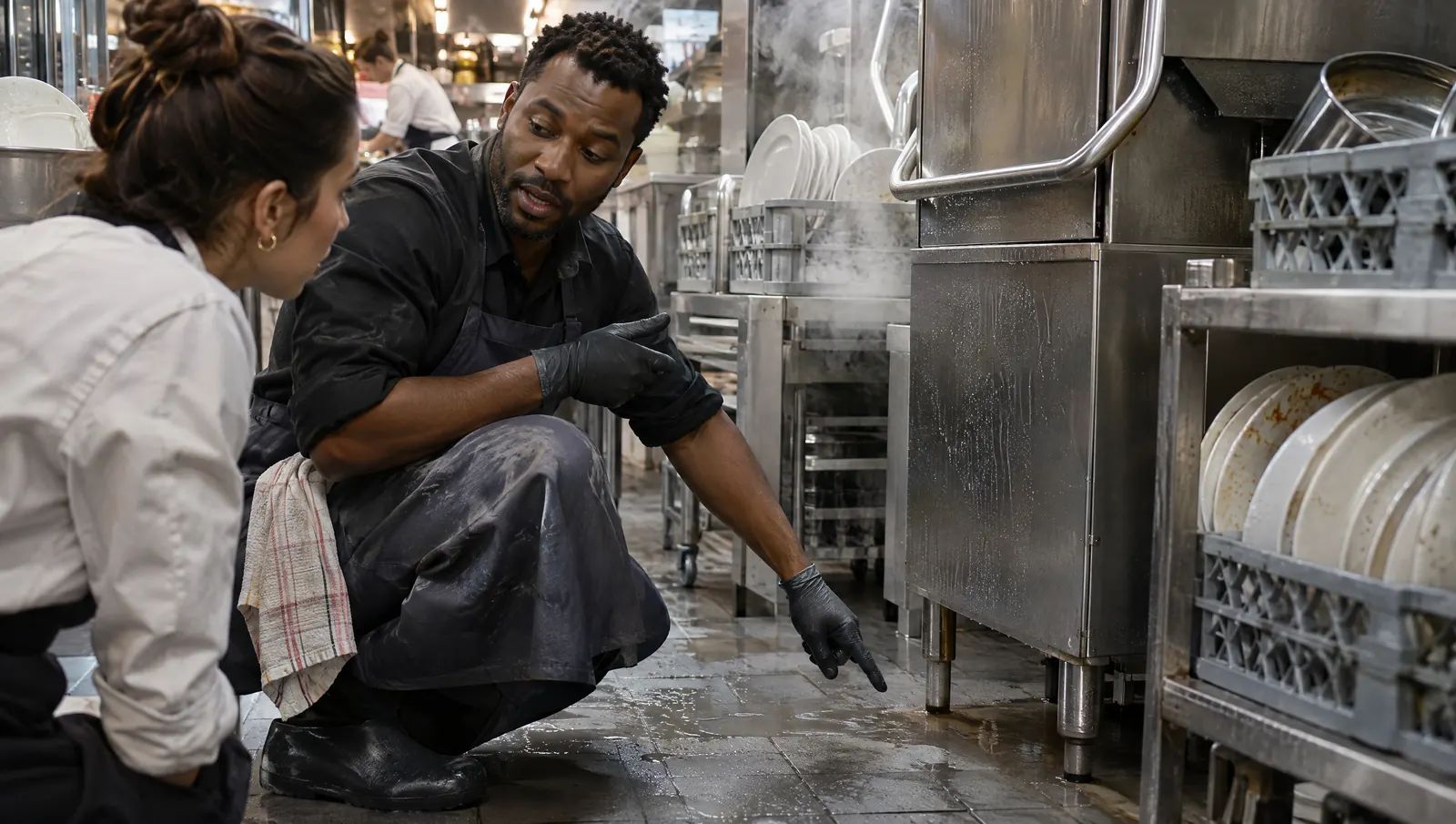
A breakdown should be reported the moment it is spotted, from your own station, without handing it to a colleague who happens to walk by. With San, the dishwasher says what is happening, San drafts the report (equipment, time, what was observed), the person confirms and the manager finds it in Tsuno. San does not diagnose the fault and gives no dangerous repair instructions; its job ends at putting into writing what it is told.
Saturday, 8:15 p.m., at the dish station
The dining room is full. Ousmane has been loading racks for an hour when he sees the water. A puddle is spreading under the dishwasher, slowly, on the inlet side. The machine is still running. His gloves are soaked, the stack of plates keeps growing and three pans are waiting.
Maëlle, the line cook, walks past with a tub. He stops her with a nudge of the elbow: "Can you tell Nadège the machine's leaking?" Maëlle says sure. She has four tickets going. At 8:40 she remembers, but Nadège is at the pass in the middle of the rush, so not now. At 11 p.m. everyone is cleaning down. Nobody brings it up again.
Sunday, 9 a.m., the opening shift finds the floor wet all the way to the storeroom. Nadège asks how long it has been leaking. Ousmane is off today. Maëlle vaguely remembers. The repair technician will ask the same thing, and nobody will be able to answer.
Now replay the evening with San. At 8:15, Ousmane says quietly: "The dishwasher's leaking underneath, inlet side, it's still running." San replies: "I'm drafting a report: dishwasher, dish station, 8:15 p.m., leak under the machine on the inlet side, machine running. Shall I save it?" Ousmane says yes. He goes back to his racks. Nadège sees it in Tsuno when she checks her actions, with the exact time and the name of the person who saw it.
(Scene and characters are fictional.)
Why a report gets lost between two people
The messenger has a service to run
Handing a breakdown to a colleague means giving them one more job at the worst possible moment. They have tickets, things in the oven, guests waiting. The message comes second, whenever it comes. Nobody is to blame: the chain is badly designed.
A breakdown said is not a breakdown written
Spoken messages lose the details that matter later. "It's leaking" becomes "something's up with the machine". The time disappears, so does the side of the leak, and the fact that the machine was still running. Yet that is exactly what the technician will ask.
Leaving your station costs more than staying quiet
To go and tell the manager, the dishwasher has to take off his gloves, cross the kitchen and wait until the manager is free. In the middle of service, the stack of plates wins. Many breakdowns are not reported because reporting is too heavy a gesture, not because nobody saw them.
The next day, nobody knows since when
Without a record, you rebuild from memory. Since when? Who saw it? Was the machine switched off? These questions often decide what gets repaired, what gets thrown away and what you tell the technician. We break this pattern down in why restaurant incidents keep repeating despite reports.
What changes when you report from your station
Whoever sees the breakdown describes it and the tool puts it in writing; that same person then approves it, with no go-between.
- Describe what you see. One sentence is enough: the equipment, what is happening, whether it is still running. No technical vocabulary needed: "it's leaking underneath" is a good description.
- San drafts the report. It picks up the equipment, the station, the time and the facts described. If it is unsure which machine you mean (two dishwashers, two walk-ins), it asks rather than guesses.
- San reads it back in one sentence. The person hears what will be saved before it is saved.
- The person confirms or corrects. Without a "yes", nothing is sent. The confirmed action is logged under that person's name.
- The manager finds it in Tsuno. The report joins the site's actions, with its time and its author, instead of depending on a colleague's memory.
- A photo afterwards, if it helps. Voice is there so you do not have to leave your station; a photo is taken on screen, when you have two seconds and dry hands. A good tool lets you add it later without redoing the report.
The order of things makes all the difference. The report is made in ten seconds, at the moment the breakdown is seen. The details come later, with no risk of the main fact getting lost.
What San does not do when equipment breaks down
In front of a broken machine, an assistant that sounds confident can do real damage. Here are the limits we set for it.
- San does not diagnose electrical or gas faults. It does not say "it's probably the heating element" or "it's the seal".
- It gives no dangerous repair instructions: no taking things apart, no opening panels, no touching the electrical board.
- It can show a procedure the business has written and approved, for example where the water shut-off valve for the dish station is, if that sheet exists in Tsuno.
- If the sheet does not exist, it says so and refers you to a manager. It is the same principle as in why an assistant must be able to say "I don't know".
- Gas smell, smoke, sparks: follow the posted safety procedure and alert a manager. You ask an assistant nothing until you are safe.
Which breakdown, which first move
| Situation | First move | What San drafts | What San does not do |
|---|---|---|---|
| Water leaking under a machine | Alert someone, make the floor safe if you can | Report: equipment, station, time, side of the leak, running or not | Explain how to take it apart |
| Walk-in door not closing properly | Report it, keep an eye on the temperature | Dated report, plus a reminder of the temperature check if a sheet requires one | Decide what happens to the food |
| Breaker trips, machine cuts out | Do not keep resetting it, alert someone | Report with what was observed before the cut-out | Give electrical instructions |
| Gas smell, smoke | The business's safety procedure, a manager | Nothing until everyone is safe | Replace an emergency procedure |
| Minor fault (handle, caster, light tube) | Note it before you forget | Simple report, to deal with outside service | Decide on the manager's behalf whether it is urgent |
Look closely at the right-hand column: the report gives the manager what they need to decide, and the decision stays with them.
Common mistakes
- Having whoever walks past carry the report. They have their own service. The fact should be written by the person who saw it, when they saw it.
- Waiting until the end of service to tell the whole story. By 11 p.m., the time, the order of events and half the details are gone.
- Calling the same equipment three different names. "The machine", "the dishwasher", "the back pot wash": if the team does not agree on names, no tool will find the right one. Agree once.
- Asking an assistant for a diagnosis. Diagnosis is the technician's job. The team's job is to describe precisely what it sees.
- Reporting with no follow-up. A report that nobody reads teaches the team that reporting is pointless. The next day, the manager should be able to say what was done.
What to measure
- The time between when the breakdown is seen and when it is written down. With a messenger, it is counted in hours. From the station, in seconds.
- The share of reports that state the equipment, the time and whether the machine was running. That is what the technician asks for.
- The number of breakdowns discovered at opening with no report from the night before. If it falls, reporting has become light enough to actually happen.
Where Tsuno and San come in
Tsuno keeps the site's reports and actions with their date and author, and the manager finds them where they follow their day. San adds a way in for the moments when you cannot leave your station, with the same two-step rule as everywhere else. It stays within the person's permissions: a dishwasher reports, he does not touch what is reserved for the manager.
Ousmane's scene, soaked gloves and all, is what drives San Audio, the hands-free mode, which is still being explored; the voice exchange itself (San Voice) can already be seen in a demo. Adding a photo on screen afterwards is part of what we are building for this flow. To see a report made for real, the Tsuno San page presents the assistant, and the modules are detailed on the features page.
Further reading
For everything San does, read the pillar page Tsuno San: the work companion for frontline teams. On why voice helps when your hands are full, see why talk to your tools when your hands are full. For the same logic applied to food safety checks, read HACCP checks with busy hands: no more greasy pen. And for the lines San never crosses, what San never does.
Key takeaways
A breakdown gets lost when it is passed from mouth to mouth in the middle of service. Saying it from your station, having it written and confirming it in ten seconds is enough for it to reach the manager in one piece, without San pretending to fix it.
Frequently asked questions
How do you report an equipment breakdown in a kitchen without leaving your station?
By saying it straight away to a tool that writes it down for you. With San, you describe the breakdown quietly, San drafts the report with the equipment, the time and what is happening, you confirm, and the manager finds it in Tsuno.
Why do breakdowns reported verbally so often get forgotten?
Because the message goes through someone who has their own service to run. They forget, shorten it or pass it on too late, and the next morning nobody knows how long the machine has been leaking or who saw it.
Can San tell me how to fix a dishwasher?
No. San does not diagnose electrical or gas faults and gives no dangerous repair instructions. It can show a procedure the business has written and approved; otherwise it refers you to a manager.
Is the report sent as soon as I speak?
No. San drafts the report and reads it back in one sentence. It is only saved once the person confirms, and that action is logged under their name.
What should I do if I smell gas or see smoke?
Follow the business's safety procedure immediately and alert a manager. An assistant is not an emergency system: you ask it nothing until you are safe.
Is voice reporting with San available today?
San Voice, the voice interaction, is available as a demo. The fully hands-free experience, San Audio, is being explored and tested.
Keep reading
Hygiene and compliance
HACCP checks with busy hands: no more greasy pen
A useful temperature check is logged when you read the thermometer, not that evening from memory. Saying it aloud keeps the real time, the person and next steps.
Hygiene and compliance
A closing checklist guided step by step
Closing alone for the first time is manageable when the tool gives the next step, logs each "done" and picks up exactly where you left off.
Hygiene and compliance
Allergens: why no tool should answer from memory
On allergens, no tool should answer from memory: it shows the dish's approved, dated sheet, or says it has none and refers you to the person in charge.