
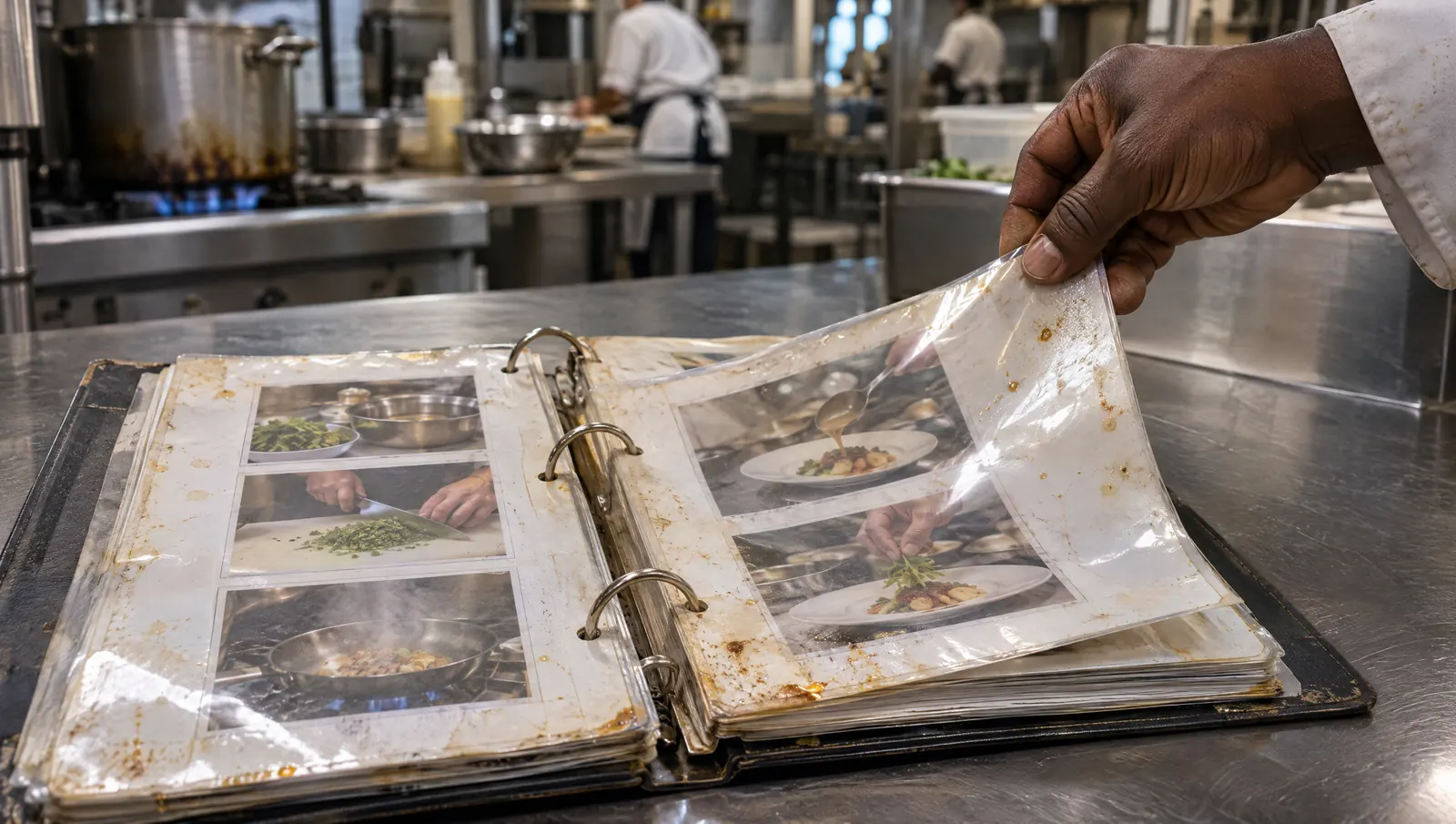
At stand S.57 at Sirha Lyon 2027 (Start-up Village, Eurexpo, January 21 to 25), bring one page from your procedures binder, on paper or as a photo. We will read it with you and talk about it honestly: what passes on well by voice, what has to stay written, and what the page is missing for a new hire to follow it alone. We will not turn it into a digital procedure in front of you. What we will give you is a grid to audit the other pages yourself once you are home.
Tuesday, January 12, 3:20 p.m., after the lunch rush
Lunch service is over. Rodrigue, chef of a neighborhood bistro, sets the red binder from the shelf above the range down on the stainless steel counter. The pages sit in plastic sleeves between photos of the dishes, warped by steam, stained with brown stock at the corners. He finds the page headed "Cooling stocks and sauces", lifts the sleeve and slides the sheet out, the rings creaking.
"This one's coming to Lyon."
Maëlys, his sous-chef, takes it from him and reads it out. The text is six lines long. "Cool quickly in the blast chiller. Cover. Label. Store in the walk-in." She looks up.
"Quickly meaning how long? What if the blast chiller is full? And who does it at night, when you're off?"
Rodrigue does not answer straight away. He knows. He has done it for fifteen years. The page does not say.
Why a binder page does not pass itself on
It was written by someone who already knew
A procedure the chef wrote for himself skips the steps he does without thinking. It works as a reminder for an expert, not as instructions for a beginner. That is why new hires keep asking Maëlys's questions.
It describes the task, rarely the exception
"Cool, cover, label" is what happens when everything goes right. What a commis really needs is the day the blast chiller is full or the probe shows an odd reading. That is exactly where the page goes quiet.
It ages without telling anyone
A laminated page looks official forever. The chiller may have been replaced, the recipe too. We covered that risk in an outdated procedure is more dangerous than a missing one.
What we will do with your page on the stand
Nothing spectacular, on purpose. We put it on the table, read it with you and ask three questions.
What passes on well by voice, usually: the next step, where something is kept ("where's the cling film?"), what is left to do, a quick check. Things you ask with your hands full, in the middle of a task.
Other lines have to stay written and readable. Allergens above all: an assistant should show the sheet, not paraphrase it, as we explain in why San shows the sheet instead of answering. Then dosages and dilutions, critical thresholds, machine safety steps, anything you check by rereading. Voice can lead you there, it does not replace the page. Why voice alone is not enough goes into that split.
Then there is what the page is missing. It is often the most useful part of the conversation, and it relies on the grid below.
If you also want to hear San Voice as a demonstration, it answers from a separate demonstration environment, on a fictional venue, never on your documents. For that visit, prepare your first-day question instead.
Getting your page ready before you travel
- Pick a page you actually use, not the cleanest one. A stained page has seen service.
- Photograph it flat, or bring it if you have a spare copy.
- Cover employee names and personal phone numbers. A supplier's or engineer's number can stay.
- On the back, note the last time someone got it wrong, and how.
- Run the grid on it yourself on the way. We will compare readings.
The grid for auditing a binder page
Take one page, a pencil, and answer each line yes or no. A page with four "no" answers will not be rescued by any tool, digital or otherwise.
| Element | The question to ask | If it is missing | Example fix |
|---|---|---|---|
| Who | Does the page say which station does it, and who covers when that person is off? | Everyone assumes someone else does it | "Hot station. If absent: sous-chef." |
| When | Is the timing precise (slot, trigger, frequency)? | It gets done too late or not at all | "As soon as cooking ends, before evening service." |
| Threshold | Is there a value you can check, rather than an adverb? | "Quickly" means something different to everyone | The temperature and time from your food safety plan, written out |
| What if | Is the most likely problem covered? | The new hire improvises or waits | "Chiller full: tell the sous-chef, never put hot food in the walk-in." |
| Who to call | Is there a person or contractor to reach, and in what order? | Nobody answers, nobody knows | "1. Sous-chef. 2. Chef. 3. Refrigeration engineer." |
| Date and owner | Do we know who signed off the page, and when? | Nobody dares correct it | "Approved by Rodrigue, January 2027." |
| Readable in 30 seconds | Can you read it standing at the station without rereading? | People stop reading it | One step per line, a photo of the expected result |
The first four lines are the ones Rodrigue's page was missing. They almost always are.
Common mistakes when reworking a binder
- Scanning everything at once. You get a digital binder with the same gaps. Sorting comes first, as shown in how to replace procedure binders without creating a digital graveyard.
- Rewriting alone in the office. The page must be reread by the person who does the task, at the station.
- Fixing the wording but not the threshold. A well-written page that still says "quickly" is still wrong.
- Leaving allergens to someone's memory, or a tool's. They are shown on an approved sheet.
- Keeping two versions. Once the new page exists, the old one leaves the binder the same day.
What to measure
- Pages audited with the grid, per week. Set a pace you can keep without giving up your evenings: regularity is what moves the binder forward.
- The share of pages that have all four of who, when, threshold and what if. That is the number that matters to a new hire.
- Repeat questions on a page you have already fixed. If they do not drop, the page is still unclear.
Where Tsuno and La Mise au Carré fit in
A binder page does not become a clear procedure by magic, on a stand or anywhere else. If your whole binder needs reworking, that is what La Mise au Carré is for: an on-site engagement in your restaurants, run by restaurant operators who use Tsuno in their own. It starts from what you already have. Your documents are extracted, a person validates every sensitive match, then everything is imported and reviewed on the floor. The order is deliberate: checklists first, then task timing, skills, scheduling, labor cost and setup. No duration is announced in advance, and the timeline is set once we have seen your material.
To test without commitment, the trial with three non-sensitive operational documents is described on the setup page. Once procedures are in Tsuno, Tsuno San can help people find and follow them by voice, within each person's rights. It does not fill in a threshold nobody wrote down.
Further reading
- The other way to prepare your visit, judging San on a real question: come and ask San your first-day question.
- Sorting into four piles before digitizing anything: replacing procedure binders.
- When the know-how only lives in the chef's head: finding the procedure nobody ever wrote down.
- Who carries the blame when the page is wrong: who is responsible if a procedure is wrong.
- The overall picture of the tool: Tsuno San, the work companion for frontline teams.
- The most common questions, answered: the Tsuno San FAQ.
Key takeaways
A binder page stands or falls on four points: who, when, threshold, what if. Bring one to stand S.57 and leave with what you need to audit all the others.
Frequently asked questions
What should I bring to the Tsuno stand at Sirha Lyon 2027?
One page from your procedures binder, on paper or as a photo on your phone, with no employee names or personal phone numbers. Stand S.57, Start-up Village, Eurexpo, January 21 to 25, 2027.
Will Tsuno turn my binder page into a digital procedure on the stand?
No. On the stand we read your page with you and talk it through: what works well by voice, what has to stay written and what is missing. Nothing is uploaded or converted live.
How can I tell whether a kitchen procedure is complete?
It should say who does it, when, with which threshold or value, and what to do if the result is wrong. It should also carry a date and the name of the person responsible for it.
Which procedures can be passed on by voice?
Short steps, the next step, where something is kept, what is left to do. Allergens, dosages, critical thresholds and machine safety steps must stay readable on a sheet you can show.
What is Tsuno's La Mise au Carré?
An on-site engagement run by restaurant operators who use Tsuno: it starts from your documents, a person validates every sensitive match, then everything is imported and reviewed on the floor, starting with checklists.
Keep reading

Pass it on without repeating
A wrong step in a checklist: flag it, fix it, for everyone
A wrong step is flagged from the checklist itself, becomes a proposal the manager approves, then a dated new version the whole team receives.

Pass it on without repeating
Back from leave: “what changed since my last shift?”
Back from time off, you learn what changed in scraps or through a mistake. A good tool lists what affects your station, dated and sourced, and nothing else.
Pass it on without repeating
Finding the procedure nobody ever wrote down
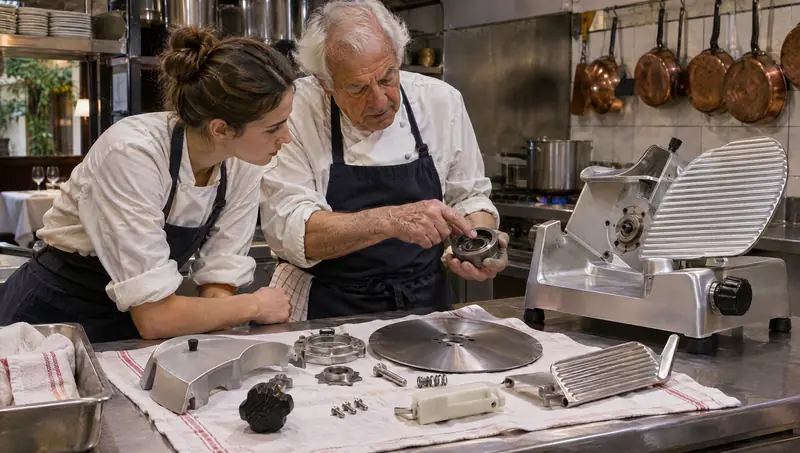
Slicer teardown, a hidden water valve: this know-how lives in one head. Have it dictated, filmed, checked, signed and dated, and it can be found at the station.