
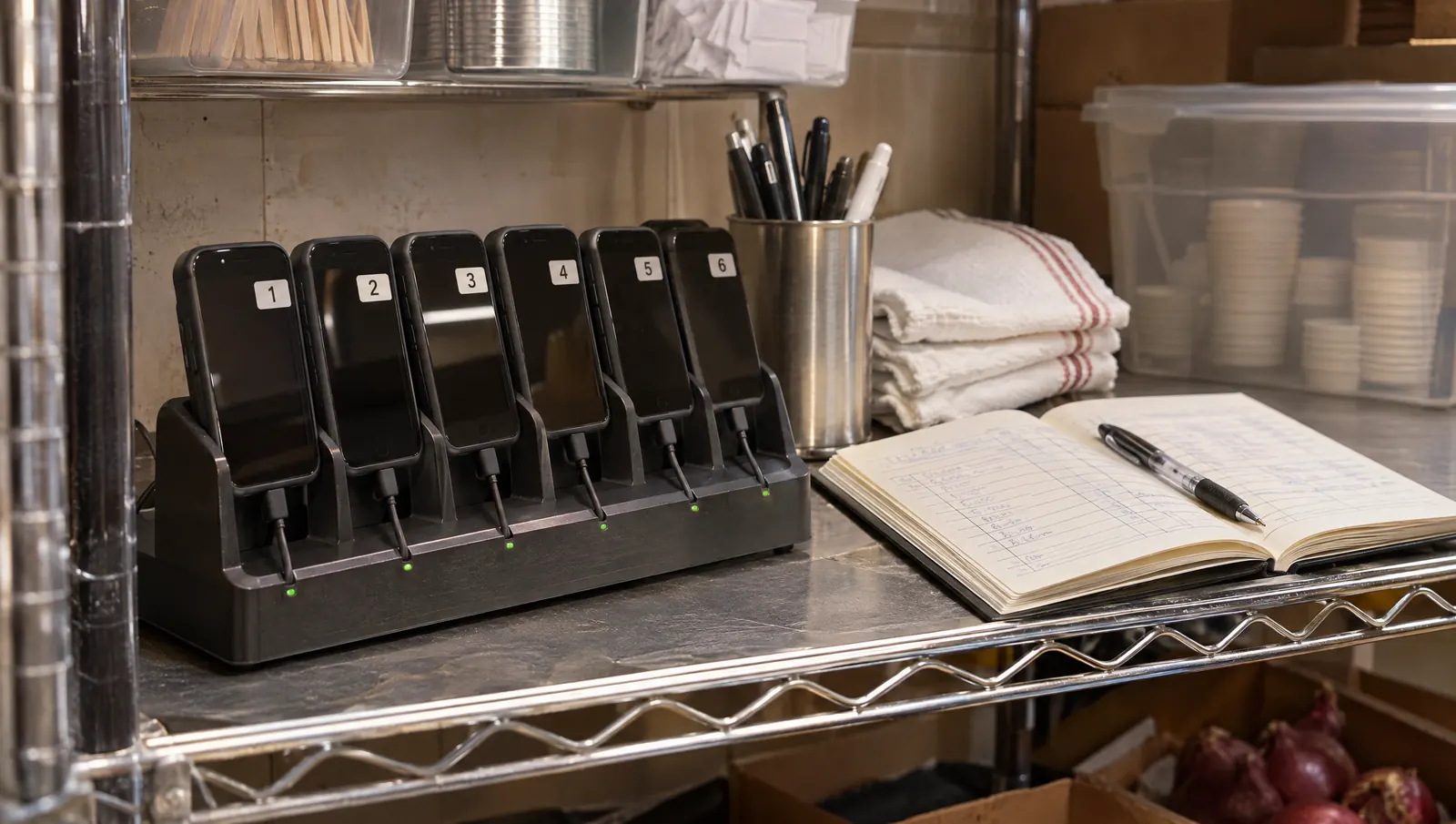
The real cost of a voice tool in a restaurant adds up the subscription, the hardware your team carries (devices, earpieces and their replacements), charging and storage, hygiene, writing the procedures, training, the time of an internal lead, a works council consultation where the law requires one, and the cost of leaving. What you might win back, manager time and faster onboarding, gets measured on a pilot. Nobody can promise it to you in advance.
Monday 6 October, 10 am, in the storeroom
Jean-Luc runs two restaurants. He has a proposal to equip his kitchen with a voice assistant and thinks the price looks reasonable. He asks Ambre, his manager, what she makes of it.
Ambre does not look at the quote. She goes down to the storeroom, points at the shelf above the boxes of napkins and asks her questions out loud. "Where do we charge them? Who puts them away at night? And the one that ends up in the sink at the dish station, how do we replace it? Earpieces, one each? And the station sheets, what's actually in them, when nobody has written anything for two years?"
She opens a logbook, draws two columns, "what we pay" and "what it takes from us", and starts filling them in. The second column fills up faster than the first.
(Jean-Luc, Ambre and their restaurants are fictional.)
Why a voice tool is not priced like software
The hardware lives on people
Software runs on a tablet mounted on the wall. A voice tool is worn: it rides in an apron pocket, gets dropped, gets wet, goes to the laundry with the chef's jacket. Its cost does not stop at purchase. It lasts as long as the team wears it.
Earpieces are not for sharing
Anything worn against the ear should belong to one person. So the need follows the number of people equipped, not the number of workstations. We explain why in hygiene of shared equipment in restaurants.
Voice only knows what you gave it
A voice assistant does not read the chef's mind. It answers from the procedures, checklists and sheets that exist. If the white stock recipe was never written down, it has nothing reliable to say. Content is often the heaviest hidden cost.
Employment law sets a mandatory step
In France, from 50 employees upward, a voice tool linked to tasks can require consulting the works council, the CSE (Labour Code, articles L2312-8 and L2312-38). The file takes time and sets the rollout calendar; other countries have their own rules. See should you consult employee representatives before using a voice assistant.
The total cost grid
Every row is filled in with your quotes, your wages and your own observations. None of them is filled in with a market average.
| Item | Question to ask | The trap |
|---|---|---|
| Subscription | What does it cover: sites, people, features, support? | Comparing prices without comparing what is included |
| Devices | Buy or rent? Who owns them at the end? | Counting one device per station instead of one per person equipped |
| Earpieces | One per person? How long do they last, how are they replaced? | Planning to pass them between colleagues |
| Breakage and loss | Who pays, how quickly is a device replaced? | Finding out the answer the day of the first drop |
| Charging and storage | Where, by whom, at what time? | Charging on the pass, or nowhere at all |
| Hygiene | What cleaning, what product, what covers during the trial? | Leaving cleaning to "everyone" |
| Content | Do your procedures exist? Who writes or imports them? | Plugging voice into empty or outdated sheets |
| Training | How many people, how long, during which services? | Assuming people learn to talk to a tool in two minutes |
| Internal lead's time | How many hours a week during the pilot, then after? | Giving the role to someone whose schedule is already full |
| Consultation and notice | Company headcount, file, timeline, written notice to staff? | Announcing the tool before the consultation |
| Exit | Data you can export, hardware to return, timeline? | Only looking at the exit when you are leaving |
Under the grid, add a row nobody invoices: actual use. A device sleeping in a drawer costs as much as one in use, and gives nothing back.
How to fill in the grid without making up numbers
- Count the people to equip, not the stations. Start with volunteers: forcing voice on the whole team inflates both the bill and the resistance. See impose or offer voice to your team.
- Ask for the hardware price separately from the subscription, with the replacement rule in writing.
- Take stock of your content. List what exists in writing, what is up to date, and what only lives in the chef's head.
- Value the lead's time and the training time at each person's fully loaded hourly cost, using your own wages.
- Check the headcount of the company, not the site, to know whether a works council consultation applies.
- Calculate over twelve months. Setup weighs most at the start, breakage and replacement weigh later.
- Add the cost of leaving, even if you do not plan to.
What you might win back, and how to check it
Two gains come up in every conversation. They are plausible, and they can be checked on site.
Manager time
A good share of a manager's interruptions are orientation questions: where is the sheet, what is the next step, which product for this work surface. If the tool answers them, the manager is interrupted less. To find out, count those interruptions over three services before the pilot, then over the same services during it. We break that count down in how much time a manager loses answering the same questions.
Faster onboarding
A new hire who finds the answer alone can move on without waiting for someone. Measure the time to their first task completed without help, and compare it with new hires who started before the tool.
You read both figures off your own services. To pick the right ones and stick to them, see measuring a pilot in 30 days: three numbers, not thirty. If the pilot does not move them, the tool does not pay its way in your kitchen, and it is good news to know that early. The method for testing over time is in gadget or tool: the 60-day test.
Common mistakes
- Comparing subscriptions only. Hardware, content and the lead's time often change which quote comes out ahead.
- Equipping the whole team at once. You pay for devices nobody chose to use.
- Passing earpieces around. It is a saving that gets the tool rejected.
- Forgetting the charging point. Without one, devices are flat by 11 am and missing by 7 pm.
- Plugging voice into outdated procedures. The tool then repeats a mistake faster, to more people.
- Starting the pilot before a required works council consultation. You will have to start again.
- Promising a gain to the team or a business partner before measuring it.
What to measure
- The total cost of the pilot divided by the number of people still using the tool after thirty days, without reminders.
- The number of devices and earpieces replaced, lost or broken each month.
- The time the lead actually spends each week, written in the logbook rather than estimated from memory.
Where Tsuno and San fit in
Tsuno San is the smart voice assistant for frontline teams, connected to the Tsuno environment. San Voice, the voice interaction, is available as a demo; San Audio, the hands-free experience, is still being explored and cannot be ordered. Its rules (the person's own access rights, confirmation before any action) are in what San never does.
On hardware, what we are preparing is a small dedicated Android device and a lightweight earpiece. Each person opens their session with the location code and their PIN: the device can be shared, the earpiece should stay personal. The same San also answers on screen. If your team mostly reads sheets, a well-placed tablet may be enough, with nothing to wear: see headset, earpiece, tablet: what really works in a kitchen.
On content, La Mise au carré starts from your existing documents: extraction, a person validating the sensitive points, import, then a review on the floor. We charge per location, not per employee; the amount is not published and the full quote is presented in a meeting. When the contract ends, your data exports to CSV and PDF and stays available for thirty days after your subscription ends (trust).
Further reading
For the general grid for any software, read what does restaurant management software really cost. For the pricing model that penalises busy seasons, per-employee restaurant software pricing: the seasonal staff trap. For choosing hardware, headset, earpiece, tablet. For upkeep, hygiene of shared equipment. And for going before staff representatives, should you consult employee representatives before using a voice assistant. The pillar page Tsuno San, the work companion for frontline teams describes what the tool covers. For the turnover figures to use in the calculation, see restaurant staff turnover: which French figures to use.
Key takeaways
A voice tool costs its subscription, plus the hardware your team wears, its upkeep, the procedures that have to be written and the time of the people who keep it alive. Any gain is counted on your own services, before and during the pilot, and nobody can guarantee it in advance.
Frequently asked questions
How much does a voice assistant for a restaurant cost?
There is no single price, and the advertised price only tells part of the story. Add up the subscription, the devices and earpieces, replacements, charging, hygiene, writing the procedures, training, the time of an internal lead and, in France for companies with at least 50 employees, consulting the works council.
Should you buy or rent the hardware for a voice tool?
It depends on what each option covers. In both cases, ask who pays for breakage and loss, how quickly a device is replaced, and what you return or keep when the contract ends.
Why do earpieces cost more than expected?
Because for hygiene reasons an earpiece should belong to one person: the need follows the number of people equipped, not the number of stations. Add losses, wear and disposable covers during a trial.
Does a voice tool really save a manager time?
It can save time on the where-is-it questions that interrupt them, but nobody can promise that in advance. Count those interruptions before the pilot, then during it, on the same services.
Do you need to consult employee representatives before introducing a voice tool?
In France, in a company with at least 50 employees, yes: a voice tool introduces a new technology and may allow employees' activity to be monitored (Labour Code, articles L2312-8 and L2312-38). The consultation happens before the decision to roll it out. Other countries have their own rules.
What is the most often forgotten cost of a voice tool?
Content. A voice assistant only answers well from written, up-to-date procedures. If they do not exist, someone has to write or import them, and that work often costs more than the hardware.
Keep reading

Costs and losses
Per-employee restaurant software pricing: the seasonal staff trap
Software billed per employee costs most when you hire most: extras, short contracts, summer peaks. Ask for the July invoice before you sign anything.

Costs and losses
How much time does a manager lose answering the same questions?
To find out, keep an interruption log for two weeks, sort every question into three cases and multiply by your own loaded hourly cost.

Costs and losses
Measuring a pilot in 30 days: three numbers, not thirty
Before day one, choose three measures, record their baseline and write down the decision. At day 30, you continue, adjust or stop without a debate.