
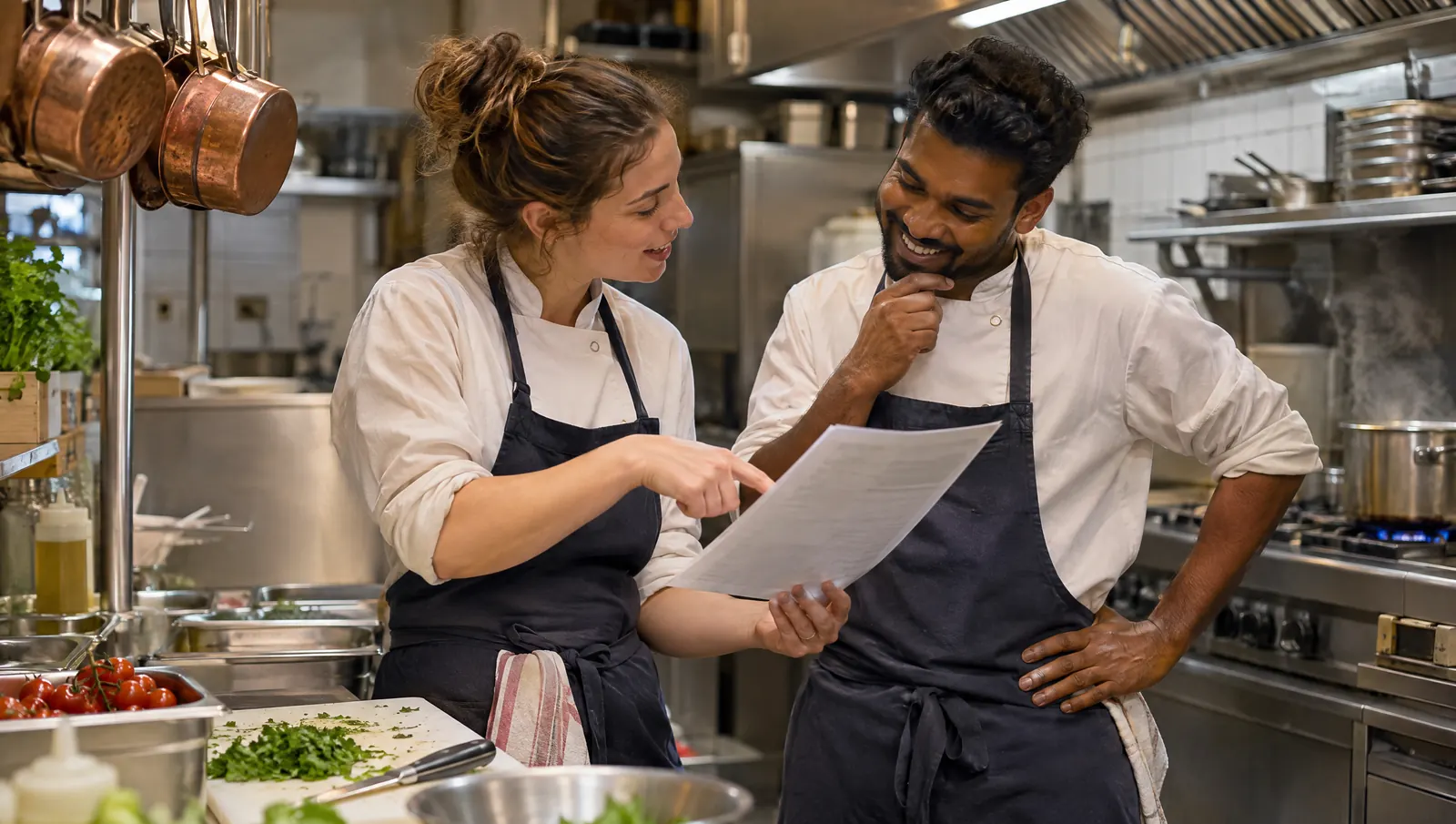
A team member who is still learning the local language understands better when they can ask again privately, in their own language, and check the original instruction. A useful multilingual tool answers in the person's language, shows the original instruction alongside, never freely translates a safety instruction without human review, and keeps the choice of language personal. It does not replace the colleague who shows the technique.
Tuesday, 9:50 a.m., at the prep station
Thanh arrived from Vietnam eight months ago. He works fast, his knife skills are excellent, and his French gets him through everyday life. (The kitchen in this story is in France; swap in English and the scene is the same in London or Toronto.) This morning, the head chef walks behind him during prep and says, without stopping: "The chicken, we're doing the marinade for twenty-four hours now, and you label it with the use-by date, okay?" Thanh nods. Three colleagues are standing nearby.
At 3 p.m., the tray of chicken is in the walk-in with no label. The chef is annoyed. Thanh had understood "twenty-four hours". He had not understood "use-by date", and he did not want to ask in front of the others. His nod meant "I heard you", not "I understood".
Nobody did their job badly. The instruction was given at the wrong moment, in the wrong form, to someone who had no discreet way to check it. (Characters and venue are fictional.)
Why people nod without understanding
Fear of being judged
Asking again in front of the team means exposing what you have not mastered. For someone working in a language that is not their own, every question can feel like proof that they "don't get it". Some also worry about their job. Silence becomes a form of protection, not a lack of interest.
Writing that shuts people out
The procedures binder, written in dense prose full of abbreviations and house jargon, is often the only written source. Reading a second language takes effort, even more so under pressure and on your feet. An instruction posted only in the local language is available to everyone, but not accessible to everyone.
The pace of service
In a kitchen, many instructions are given in passing, over the noise, between two tickets. Even native speakers miss some of them. For a non-native speaker, one unknown word in the middle of a sentence often takes the whole meaning with it.
The colleague who interprets
Often, a colleague who speaks the same language translates. That is valuable, and fragile: they are not always on shift, they sometimes simplify, and they end up being called on every service. For a safety instruction, a hallway translation has no reference version.
What a multilingual tool should do
If you give your team a tool that answers in several languages, these are the minimum rules to insist on.
- Answer in the person's language. They ask the question the way they think it, and get the answer in the language they chose.
- Show the original instruction alongside. The person sees the words the team actually uses. The chef can point to the same line. And that is also how people pick up the local language: through the words of the trade.
- Never freely translate a safety instruction. Allergens, temperatures, chemicals, dangerous techniques: the translated version must have been reviewed by a person who speaks the language, and dated. Without a reviewed version, the tool shows the original and points to a manager. It does not improvise.
- Keep the choice of language personal. It is the person's setting, not information for the team. It is not displayed to colleagues and is not used to assess anyone.
- Let people ask again as often as they need. Asking a tool the same thing three times has no social cost. The questions people ask must never be used to score or rank them.
- Hand over to a person for the technique. The tool explains and reminds. It does not show how to hold a knife or how to measure out a cleaning product.
Situation, risk, good practice
| Situation | Risk | Good practice |
|---|---|---|
| Instruction given in passing during prep | A nod without understanding | One instruction at a time, then "show me"; a written version they can check alone |
| New cleaning procedure with a chemical product | Wrong dilution, wrong contact time | Translated version reviewed by a person and dated, original alongside |
| A server asks a cook about allergens | Answer given from memory, misunderstood | The approved sheet is the reference; when in doubt, a manager answers |
| One colleague translates every instruction | Worn-out colleague, inconsistent translations | The colleague stays a support, not the only source; critical instructions have a reference version |
| Signs posted in one language only | Available but not accessible | Pictograms and photos of the expected result, reviewed versions in the team's languages |
| The person does not want their language to be visible | Embarrassment, being singled out | Private language setting, never displayed or commented on |
| Talking through a mistake | Shame, withdrawal, another mistake | One to one, on the dated fact, with the instruction in front of you |
What must not change: human mentoring
A tool can make an instruction readable. It does not create trust. What makes someone dare to ask again is, first of all, a colleague or manager who has shown that you can do it without being judged.
A few simple habits are worth more than any translation:
- Swap "did you understand?" for "show me". The first question always gets a yes. The second shows what was actually understood.
- Speak more simply, not more loudly. Short sentences, and always the same words for the same things.
- Come back the next day. A new instruction is reviewed once more, one to one, without blame.
- Recognize the skill. Thanh's French is not there yet, but he may have the best knife work on the team. Saying so matters.
These details are how a team learns that someone's language is neither a flaw to correct nor something to joke about.
Common mistakes
- Taking a nod as agreement. It often means "I heard you".
- Posting a machine translation of a safety sheet without review. One wrong word on a dilution or an allergen can have serious consequences.
- Always using the same colleague as interpreter. It is invisible extra work, and it adds up.
- Making language a public topic. Announcing in front of the team "I'll switch you to Arabic" singles the person out.
- Believing the tool is enough. If the tool replaces the buddy, the person understands the instruction but is still on their own.
What to measure
- The share of critical instructions available in a reviewed, dated translation, for each language spoken in the team.
- The number of repeated mistakes on the same instruction (the same missing label, the same badly diluted product), before and after.
- One question, one to one, at the end of the second week: "What is still unclear for you?" The number of points raised tells you whether knowledge transfer is working.
Where Tsuno and San come in
Tsuno San is the intelligent voice assistant connected to your site's procedures, tasks, checklists and information in Tsuno. We are working to let San converse in French, English, Arabic and Vietnamese. We would rather you check the real level in each language in a demo than have us promise it here.
The rules described above are the ones we are building San around: answers in the person's language, the original instruction always visible alongside, no free translation of a safety instruction without human review, and a language choice that stays personal. On allergens and safety, San should not answer from memory: it shows the site's approved sheet, or says it does not know and points to a manager.
What is already true: San only sees and does what the person can already see and do in Tsuno, every action is prepared by San and then confirmed by the person, and San does not assess anyone. Voice is never mandatory: everything you can do by speaking, you can also do on screen, which also helps people who prefer to read. Voice interaction, San Voice, is available in demo. The general data rules are on the Trust and data page; for what is kept of San's audio and text in real use, ask us in a meeting.
San is not a mentor, though. It lets people ask again without embarrassment. The rest belongs to the team.
Further reading
For the full picture of San, read the pillar page Tsuno San, the work companion for frontline teams, then allergens: why no tool should answer from memory. On the team side, see why new restaurant employees often say "nobody told me" and how to train people without turning your best employee into a full-time trainer. And on trust, why management software can quickly feel like surveillance. When the instruction concerns safety, a translation is not enough: read translating a safety instruction: why the original must stay visible.
Key takeaways
Understanding an instruction should never require admitting in public that you did not understand it. Give everyone a discreet way to ask again, keep the original instruction in front of everyone, and leave people to do what builds trust: show, come back, recognize.
Frequently asked questions
How do you give instructions to an employee with limited English?
One instruction at a time, simple words and always the same ones, the technique shown rather than explained, and a written version they can reread on their own. Ask them to show you what they will do instead of asking whether they understood.
Can you translate food safety procedures with machine translation?
Machine translation can help someone find their way. For an instruction about safety, allergens, temperatures or chemicals, the translated version must be reviewed by a person who speaks the language and dated, and the original instruction must stay visible alongside it.
How can you tell whether a non-native speaker really understood an instruction?
A nod proves nothing. Ask them to rephrase or demonstrate, watch the first time they do it, and come back to the instruction the next day, one to one and without blame.
Can a multilingual tool replace mentoring for a new hire?
No. It lets people ask again without embarrassment and reread an instruction in their language. Techniques are shown, corrected and signed off by a colleague or a manager.
Which languages does Tsuno San speak?
We are working on French, English, Arabic and Vietnamese. The real level in each language is something to check in a demo rather than take on trust from a general claim.
Should colleagues be able to see an employee's chosen language?
No. The language someone prefers for their answers is a personal setting. It should not be displayed in front of the team or used to judge anyone.
Keep reading

Team and management
Mixed languages in the kitchen, a reality software ignores
Kitchens speak a mix of slang, jargon and home languages. A good tool learns the house words, shows what it understood and never corrects anyone.
Team and management
Accents, stuttering, hearing loss: a voice tool for everyone, or for no one
A voice tool is only inclusive if everything works without speaking, it never judges how people talk, it is easy to correct and was tested with those concerned.

Team and management
Onboarding a multilingual team: a manager's guide
Prepare the arrival in their language, show before explaining, check by doing, keep the original instruction visible, offer language training, never impose it.