
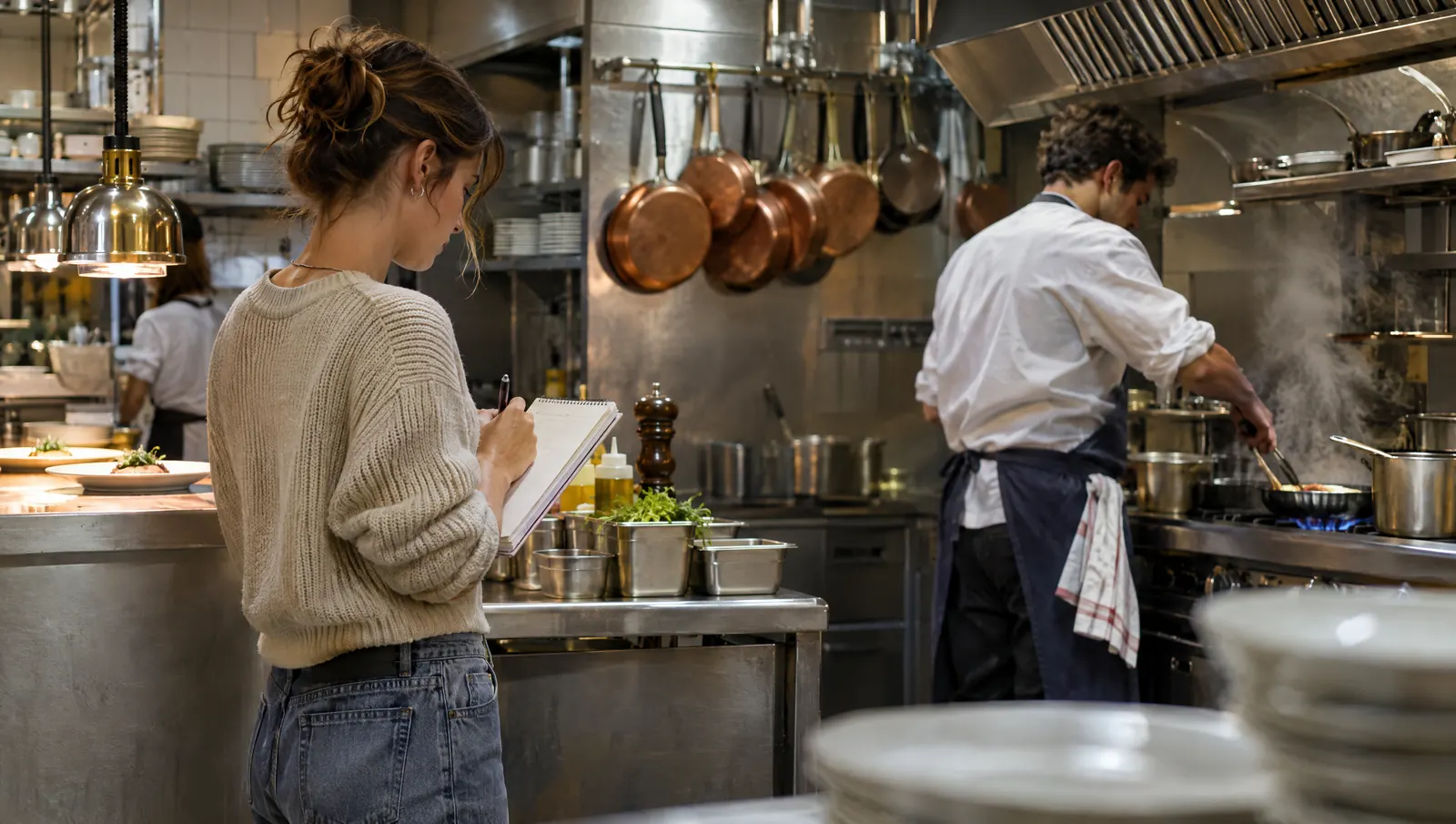
We test San in real kitchens before we sell it, because a demo in a quiet room says almost nothing about real use: noise, waiting, accents and the unexpected question only exist during service. That is how Tsuno itself was born, at Kajirō Sushi, its founder's restaurant group. These trials produce no statistics: they fill a notebook with phrases heard at the station, sheets to fix and failures we list without dressing them up.
Thursday, 11:45 a.m., fifteen minutes before service
Linh is on the product team. She stands near the dish station, out of the way, a notebook in her hand. She talks to no one: she watches.
Jordan, a cook, is finishing his prep. He asks under his breath: "What's left?" He repeats it once. The hood has just kicked up to full speed. He shrugs, walks to the tablet and reads. Linh writes down the exact phrase, the time, and one word: "hood".
Mireille, who has been cooking for twenty-five years, walks past behind her: "Do you write it down when it fails, too?" Yes. Especially when it fails.
(Scene and characters are fictional.)
Why a demo is not enough
A meeting room has no extractor hood
A demo happens in a quiet room, with someone who knows what to ask and speaks clearly. A kitchen is the opposite: noise, busy hands, three-word phrases thrown out between two tasks. A tool that shines in the first can disappoint in the second, and that is not the team's fault.
The question nobody planned for
We imagine questions. Teams ask different ones, in their own words, with their abbreviations and their own names for a station or a product. Back at the office, nobody had expected people to ask "how cold is the bottom fridge?" instead of naming walk-in number 2.
Day twenty is not day one
On day one, everyone tries it out of curiosity. By day twenty, only the people it actually helps are left. That is the day that matters, and no demo shows it.
A habit that started at Kajirō
Tsuno grew out of something we ran into while building the Kajirō Sushi group: passing on know-how, supporting new hires and keeping the same standards across several locations is a daily challenge. The tools were built in the kitchen, for that kitchen, and they are used there every day.
That origin has an advantage: you cannot fool yourself for long. If the team does not use a feature, you see it the next morning at the pass. It also has a limit, which we would rather state: a sushi restaurant group is not every kitchen. That is why we also look for pilot sites elsewhere, with other trades, other noise and other teams.
One more thing these trials are not. What we observe at Kajirō does not follow a measurement protocol. So we draw no measured gain from it, and nobody should use it to estimate their own. When we publish a figure, it will come with its written protocol.
The questions we ask ourselves during a trial
While the team works, Linh keeps the same seven questions in mind, from one trial to the next.
- Noise. Where and when does voice get through? At what point in service does it stop getting through at all?
- Response time. How long a wait makes someone give up and turn to the screen or a colleague?
- Short sentences. Does the answer fit in one sentence? Does the team's question sound like the one we imagined?
- Accents. Whom does the tool understand less well? Did anyone give up because they had to repeat themselves?
- Voluntary use. Who still uses it when nobody asks them to? And why did the others stop?
- Refusals. When San says it does not know, which procedure is missing?
- Trust. What worries the team, in their own words, and has that worry eased after two weeks?
What we watch, and what can change next
| Question | How we observe it | What can change next |
|---|---|---|
| Noise | Standing back, at several points in service | Recommend the screen at that moment, rethink where voice belongs |
| Response time | We note when someone gives up | It is our first product priority |
| Short sentences | We write down exact phrases, without rewording them | Shorten answers; rewrite an overlong procedure with the team |
| Accents | We ask each person whether they feel understood | Something we are working on; the screen always remains available |
| Voluntary use | After two weeks, with no reminders | Understand why some people stopped before drawing conclusions |
| Refusals | The list of questions with no procedure behind them | Fill the gaps in procedures with the site |
| Trust | Objections, written down as they were said | Write the rules down and explain them before day one |
What we change after a trial
At the end of a trial, we go through the notes with the team, not just with the manager. Then we sort what we saw into three groups, because they do not call for the same response.
- A content problem. A procedure that is missing, outdated or too long. San only answers from what is written down: the site has to write it, and we help with La Mise au carré, our setup service.
- A usage problem. The right tool at the wrong time or in the wrong place: voice during the rush, or on the floor. We adjust our usage advice.
- A product problem. That one is ours. Being able to say "pause" to talk to a colleague, or picking up again without logging back in: these are requests from the field that we are working on.
For each point, we say what has been fixed, what we intend to fix, and what we will not fix, with the reason. We do not give dates we do not know.
Why we also show what does not work yet
A cook watching a demo where nothing goes wrong thinks straight away of Saturday night, with the hood on full and three tickets coming in at once. They would rather know where the tool stumbles before buying it than find out in the middle of a rush.
That is why we are preparing a series, "Test bench" (Banc d'essai), that will show San in real working situations, including when it hesitates, gets something wrong or says it does not know. It will be published on this blog. The rule will be the same as for everything else: no figure without a protocol, and no feature presented as done before it is.
What we ask of pilot sites
A kitchen trial commits the site as much as it commits us. Here is what we ask, and why.
- A volunteer team. No one has to wear an earpiece, and anyone who prefers the screen keeps exactly the same access.
- A team informed before day one. What the tool does, what it does not do, what is noted during the trial. In France, in companies with 50 or more employees, the works council (CSE) must be informed and consulted on new technologies (Labour Code, Article L2312-8) and on means of monitoring employees' activity (Article L2312-38). Elsewhere, check your own local rules.
- Written procedures. Without them, San will often say it does not know, and the trial will mostly measure an empty binder.
- A point person on the team. Not necessarily the manager: someone who works the station and will say plainly what gets in the way.
- Agreed observation times. We come at times set with you, standing back, and we agree together on what gets noted.
- A check-in after two weeks. With the team, to talk about what helps, what gets in the way, and what has been dropped.
- The freedom to say it does not help. A trial that ends with "not for us" teaches us as much as any other.
Before involving a team, you can also start smaller: the trial based on three non-sensitive operational documents. We set up an isolated environment, show it to you, then delete it on the agreed date. The steps are on the Setup page.
Common mistakes, on both sides
- Testing on a Saturday night. You judge the tool at the worst possible moment, and so does the team.
- Testing with the chef alone. They ask questions they already know the answer to. New hires ask the ones that matter.
- Mistaking launch enthusiasm for use. The first week proves nothing.
- Hiding the failures. For a vendor, that means losing the team's trust at the first rush.
- Promising a fix date you do not know. Better to say "we are working on it" than to miss a deadline.
What to measure if you are a pilot site
- Voluntary use after two weeks and after two months: how many people still ask questions without being reminded.
- The list of questions with no procedure behind them. Every refusal from San points to a gap in your procedures.
- The objections still around after two weeks, written down as they were said.
Where Tsuno and San fit
Tsuno San is the intelligent voice assistant for frontline teams, connected to the Tsuno environment: procedures, tasks, checklists, routine checks, equipment and workplace information. Its rules (the person's own permissions, confirmation before any action) are set out in what San never does.
San Voice, the voice interaction, is available in demo. San Audio, the hands-free experience, and San 360, a broader vision of operational support, are under exploration and testing. That is exactly where kitchen trials matter most. The Tsuno San page presents the assistant.
Tsuno San is a candidate for the Sirha Innovation Awards 2027. We will be at Sirha Lyon, at Eurexpo, from January 21 to 25, 2027, in the Start-up Village, stand S.57: the details are in Tsuno at Sirha Lyon 2027.
Further reading
For the big picture, read the pillar page Tsuno San, the work companion for frontline teams, and our thinking on the future of work in hands-on jobs. To evaluate a tool yourself, see how to choose restaurant software without being fooled by a perfect demo. And to understand why a refusal from San is useful information, read why an assistant must be able to say "I don't know".
Key takeaways
Jordan's extractor hood taught us more about San than ten demos in a meeting room. We keep testing with real teams, saying what does not work yet and publishing no figure without a written protocol.
Frequently asked questions
Why test a voice assistant in a kitchen rather than in a demo?
Because a demo in a quiet room says almost nothing about real use. Noise, waiting, accents, unexpected questions and the fatigue that sets in after a few weeks only show up during service, with a real team.
Where was Tsuno designed?
At Kajirō Sushi, its founder's restaurant group. Tsuno was built in the kitchen there and is used every day. What is observed there is not a measurement protocol: Tsuno draws no figures from it.
What do you watch for when trialing a voice assistant in a kitchen?
Where and when voice gets through, how long a wait people will tolerate, whether answers fit in one sentence, which accents are understood less well, who still uses it without being reminded, and which questions have no procedure behind them.
What does Tsuno ask of a pilot site?
A volunteer team informed before day one, written procedures, a point person on the team, observation times agreed together, a check-in after two weeks, and the freedom to say the tool does not help.
Is Tsuno San available?
San Voice, the voice interaction, is available in demo. San Audio, the hands-free experience, and San 360, a broader vision of operational support, are under exploration and testing.
Can I try Tsuno without involving my team?
Yes, with the trial based on three non-sensitive operational documents: Tsuno sets up an isolated environment, shows it to you, then deletes it on the agreed date. No personal data goes in.
Keep reading
Future of work
A companion, not a supervisor
A good frontline tool helps the person doing the work first: answer, remind, report. Once it makes numbers about them for someone else, it turns into control.

Future of work
Conversational assistant or job assistant: where is the line?
A conversational assistant answers anyone with no context; a job assistant knows your location, acts within your permissions and asks for confirmation.

Future of work
Our red lines: the ethics of AI at work
Workplace AI is judged by what it refuses to do, even when a big customer asks. Our principles, four real dilemmas, and what we choose not to sell.