
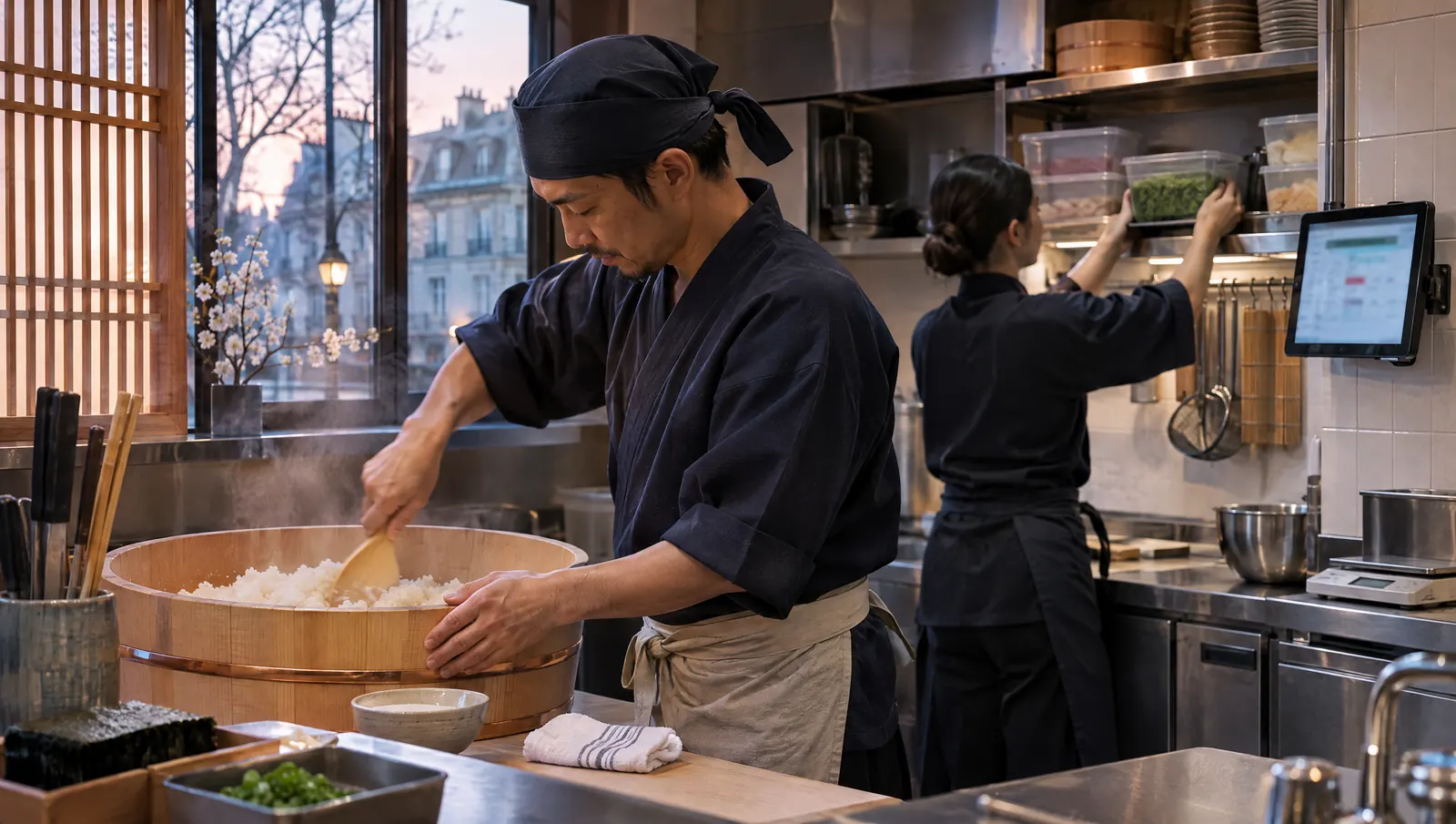
San was born from a simple idea that came from the kitchen, not from an office: when your hands are on a chopping board, you should not have to lift them to tap a screen. Tsuno itself was born at Kajirō Sushi, its founder's restaurant group, because as the business grew people had to keep repeating themselves, checking up and chasing information. San continues that story, and this article also covers what we set aside along the way and where it really stands.
A scene every restaurant owner knows
Anyone who runs a kitchen has seen the following scene a hundred times.
A Tuesday, 6:40 am, before opening. Bérénice is making the sushi rice, her hands wet with vinegar. Next to her, a new hire is putting containers away and hesitates: "Where does this one go? And what date do I put on the label?" Bérénice stops, wipes her hands, walks to the tablet on the wall, searches, finds it, comes back. The rice has waited. Ten minutes later, the new hire has another question.
Nobody did anything wrong. The information existed somewhere. It just was not where the hands were.
(Scene and characters are fictional.)
Where does Tsuno come from?
From a restaurant group, not a software idea
Tsuno was born at Kajirō Sushi. The problem showed up as the group grew: passing on know-how, supporting new hires and holding the same standards across several sites is a daily challenge.
We learned it the hard way. At Kajirō, we closed a restaurant for lack of written processes. Our first training handbook was full of duplicates and unfinished pages, and nobody read it. So we changed the order: checklists first. That is still the method we use at home, and the one we come and set up for others through La Mise au carré.
Built in the kitchen, used every day
Tsuno's tools were built in the kitchen, for that kitchen, and they are used there every day. Hence a line we are happy to repeat: we sell what we use. What that origin teaches us, and where it falls short, is in why we test in the kitchen before we sell.
Where does the idea of San come from?
Hands first
Writing procedures down does not solve everything. Written information is finally somewhere, but not necessarily in the right place. To read it, you have to stop, wipe your hands, take off a glove and search a screen. In a kitchen, that detour costs more than it seems, because it breaks the task and leaves a preparation waiting. In the end you ask a colleague, who then has to stop too.
That is the idea behind San: ask out loud for what is already written, without leaving your station. "What's my next task?", "How do we clean the slicer?", "What's left on the opening checklist?" We go into this in why talk to your tools when your hands are full.
One San, on screen and by voice
San does not add to the team's apps: it is how you talk to Tsuno, the environment the team already uses: procedures, tasks, checklists, routine checks, equipment, site information. You can use it on screen or by voice, under the same rules. Voice is an option, never an obligation: someone who prefers to read must be able to do everything without speaking.
Answer only from what is written
Kitchens learn to distrust "I think it's like this." San answers from what the site has written and approved, and says when it does not know. What it knows, and where it gets it, is covered in what San knows about your restaurant, and where it gets it.
What did we choose not to build?
Part of San's story is the things we ruled out. They say as much about it as what it does.
| What we kept | What we ruled out | Why |
|---|---|---|
| A plain voice, short answers | A friendly voice that plays buddy | San is a work tool, not another colleague |
| No face | An animated avatar | We do not give a face to something that is not a person |
| Lining up facts | Scoring or judging an employee | Tsuno lines up the facts, people decide |
| Leaving emotions alone | Analysing mood or stress | Banned in the workplace under EU law since 2025 |
| Back of house: prep, dish, storeroom | Voice on the floor, in front of guests | Image, and the privacy of nearby guests |
| Prepare, summarise, wait for a yes | Act alone | Nothing runs without confirmation, and it is logged |
| Voice as an option | Mandatory voice | The screen keeps exactly the same access |
No avatar, no voice that makes small talk
A cook asking a question in the middle of prep wants an answer, not a chat. An animated face or a bubbly voice would make San look like a character. We would rather it look like what it is: a way to reach a sheet.
No judging people
San does not assess anyone and does not score an employee in place of their manager. It does not analyse emotions, which the EU AI Act has banned in the workplace since 2 February 2025. The monthly leaderboard the app shows to keep teams engaged is never passed to the assistant. These rules, along with the refusal of sensitive data, are gathered in what San never does.
Where does San stand today?
Here are the exact statuses, as the San page shows them.
- San Voice, the voice interaction, is available in demo.
- San Audio, the exploration of a hands-free experience, is under exploration and testing.
- San 360, a broader vision of operational support, is under exploration and testing.
On the voice side, the hardware is minimal: a small dedicated Android device and a lightweight earpiece. Each person opens their session with the site code and their PIN.
The open issues are known to the teams trying it: noise under the hood in the middle of service, response time, being able to say "pause" to talk to a colleague, and poor network coverage in the walk-in. We would rather you hear about them before the demo than after.
Finally, what we observe at Kajirō does not follow a measurement protocol. We draw no figures from it, and nobody should use it to estimate their own gains. When we publish a numerical result, it will come with its written protocol.
At Sirha Lyon 2027
Tsuno San is a candidate for the Sirha Innovation Awards 2027. We will be at Sirha Lyon, at Eurexpo, from 21 to 25 January 2027, in the Start-up Village, stand S.57. The programme is in Tsuno at Sirha Lyon 2027.
Common mistakes with a tool "born on the floor"
- Taking the origin story as proof. A tool born in a kitchen starts with an advantage, not with a result. Ask what was measured, and how.
- Assuming one kitchen stands for all kitchens. A group of sushi restaurants does not have the noise, the teams or the products of every other kitchen.
- Buying the vision instead of what exists. Ask for the exact status of each feature: available, in demo, or under exploration.
- Judging it on a demo in a quiet room. Ask instead whether the team still uses it when nobody is pushing them to.
- Forgetting the content. An assistant connected to an empty binder will mostly say it does not know.
What to measure
- Voluntary use after two weeks and after two months: how many people still ask questions without being reminded.
- Manager interruptions for questions whose answer is already written, counted over a week before rollout and again during it.
- The list of questions with no sheet behind them: each one points to a procedure to write.
Where Tsuno and San fit in
Tsuno brings together what a team needs at the station: procedures, tasks, checklists, routine checks, equipment, site information. San makes them available at the moment of the task, on screen or by voice, within each person's rights and under the two-step rule. The Tsuno San page presents the assistant, and a demo takes a few clicks to request.
Further reading
For the big picture, read the pillar page Tsuno San, the work companion for frontline teams. On the question of people, see AI should not judge your employees. And for how we put San to the test before selling it, why we test in the kitchen before we sell.
Key takeaways
San comes from a kitchen where the information existed but was never where the hands were. We made it plain and bound to each person's rights, and we state exactly what is available and what is not yet.
Frequently asked questions
Where was Tsuno San born?
Tsuno was born at Kajirō Sushi, its founder's restaurant group, out of a problem seen on the floor: the bigger the business grew, the more people had to repeat themselves, check up and chase information. San continues that story: asking for information without leaving your station.
Why a voice assistant for kitchen teams?
Because in a kitchen your hands are busy at the exact moment you need information. Lifting your hands off a board to tap a screen breaks the task. Voice stays optional: anything you can do by speaking must remain possible on screen.
Why does San have no avatar and no friendly chatty voice?
Because San is a work tool, not a character. It answers briefly, from the site's own sheets, and it does not try to pass itself off as a colleague.
Is Tsuno San available today?
San Voice, the voice interaction, is available in demo. San Audio, the hands-free experience, and San 360, a broader vision of operational support, are under exploration and testing.
Does Tsuno publish figures from its use at Kajirō?
No. What Tsuno observes in its own group does not follow a measurement protocol, so Tsuno draws no figures from it. Any numerical result will be published with its written protocol.
Where can I see Tsuno San?
In a demo on request, or at Sirha Lyon 2027, at Eurexpo, from 21 to 25 January 2027, in the Start-up Village, stand S.57. Tsuno San is a candidate for the Sirha Innovation Awards 2027.
Keep reading
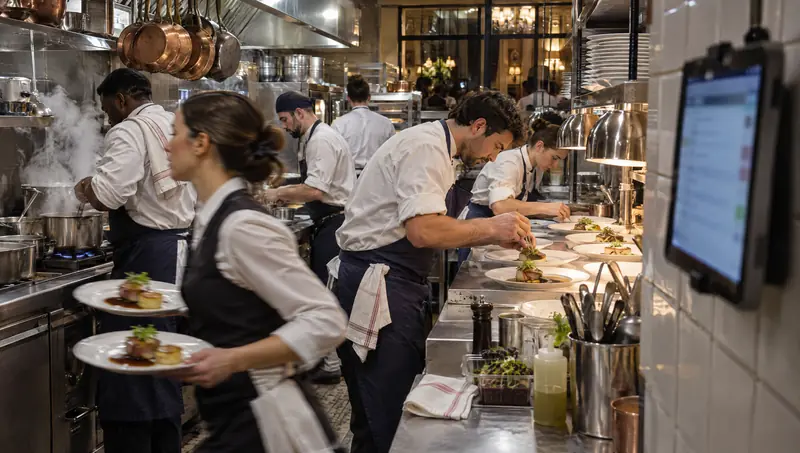
Future of work
10 changes in the restaurant of tomorrow
Information at the station, dated procedures, checks logged during the task, AI for managers: ten changes already under way, and what can go wrong with each.
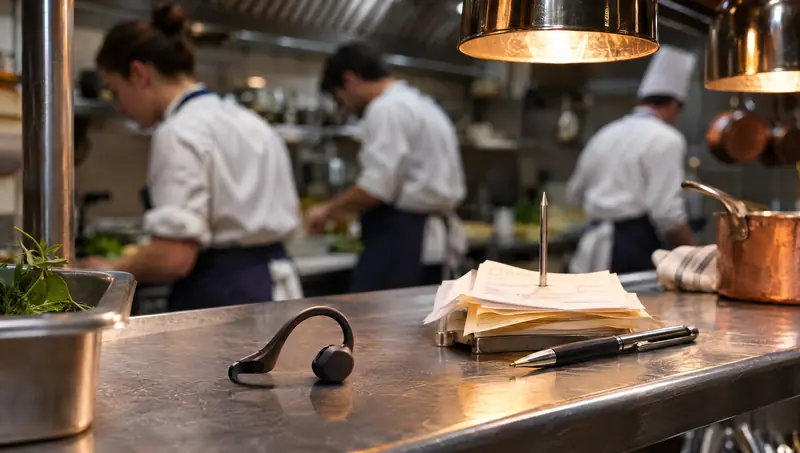
Future of work
5 reasons to adopt a voice assistant, and 5 reasons not to
A voice assistant helps when hands are full and know-how is written down. It disappoints mid-rush, front of house, with no procedures or a team not on board.
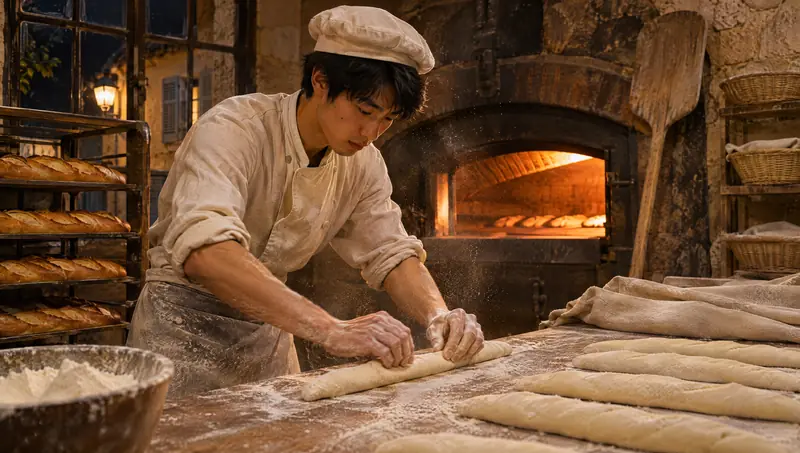
Future of work
A work assistant for bakeries, from the bakehouse to the shop
In a bakery, a voice assistant helps when it repeats what the baker wrote, in the bakehouse at night or at the counter by day, and points to the approved sheet.