

This glossary defines 38 AI-at-work terms the way a restaurant owner runs into them: from a vendor, in a contract, or in front of employee representatives. Each entry gives a short definition, a kitchen example and, where one exists, the article that goes further. Terms are grouped by use, then listed alphabetically. Legal entries refer to EU law and, where stated, to France.
A tip before you start: when a salesperson uses one of these words, ask for the kitchen example. If they do not have one, be wary of the word.
The assistant and its answers
Agent
An AI that chains several actions on its own to reach a goal, without anyone approving each step. In the kitchen: "order whatever we are short of for Saturday", carried out end to end with no review. The difference from an assistant is covered in AI that analyses and AI that acts.
AI model
The engine that understands the question and writes the answer, often supplied by a different company from the software vendor. In the kitchen: it is the van's engine, not the delivery round. Ask who supplies it and where that company is based.
Conversational assistant
A general-purpose assistant such as ChatGPT, Claude or Mistral. It writes well, but does not know your place until it is connected to it. In the kitchen: it can draft a menu board, it has no idea how you dilute your degreaser. See why a general AI does not know your restaurant.
Fact types
Recorded fact (a timestamp), declared fact ("it's done"), attached proof, dated observation, AI inference, missing data: six kinds that should never be blended. In the kitchen: "temperature check ticked" and "temperature check ticked with a photo of the probe" do not carry the same weight. The six types are described on the Trust and data page.
Hallucination
An invented answer, given with the same confidence as a correct one. In the kitchen: the tool quotes a slicer-cleaning step your sheet does not contain. The fix is a tool that shows its source and can say "I don't know": why an assistant must be able to say it.
Memory
What a tool keeps from one time to the next. The word covers two things worth separating: the business's own content (sheets, tasks, history) and the history of conversations. In the kitchen: knowing walk-in fridge 2 already alarmed on Tuesday is not the same as remembering what the line cook asked on Tuesday. See one memory, many ways to talk.
Source
The document or fact an answer rests on, and that you can open. In the kitchen: "63 °C core temperature, reheating sheet, approved in March" rather than just "63 °C". See what San knows about your restaurant, and where it gets it.
Voice assistant
An assistant you ask by voice and that answers by voice. Useful when your hands are full, less so when the kitchen is roaring. In the kitchen: asking the target chilling temperature while holding a hotel pan. See why talk to your tools when your hands are full.
Work assistant
An assistant connected to a venue's content (procedures, tasks, checklists, equipment) and limited to the person's permissions. In the kitchen: "what's left on closing?" gets tonight's list, not a general answer. Where the line falls: conversational assistant or job assistant.
Connecting your AI to your business
Access rights
What a person can see and do, based on their role and their venues. A connected AI should have exactly the same. In the kitchen: the line cook asking the tool does not see wages, because they do not see them in the software. See give your AI the same rights as you.
Bulk extraction
Using a connection to pull all the data out at once. A good tool caps reads. In the kitchen: asking for "every record on every employee for the last three years" should hit a limit.
Connector
The link between an assistant and one specific piece of software. In the kitchen: your management tool's connector lets you ask, from your usual assistant, which checklists were missed this week. How it works: asking your restaurant questions from ChatGPT, Claude or Mistral.
MCP
Model Context Protocol: a standard plug that lets an AI assistant connect to a company's tools. In the kitchen: like a wall socket, it says nothing about the state of the appliance; the rules of the connected software are what protect you. The guide: MCP explained for frontline trades.
Traceability
The record of who did what and when, with the state before and after. In the kitchen: knowing the "empty the grease trap" task was closed at 11:12 pm by the sous-chef, from their assistant, after confirmation. Questions to ask before connecting anything: 12 questions before connecting an AI.
Two-step action
The AI prepares an action and summarises its effect, the person confirms, then the action runs and is logged. In the kitchen: "create a task for the dish station: descale the dishwasher before Friday" shows a summary, and nothing happens before the yes. See AI proposes, a human confirms.
Voice at the station
Earpiece
The small speaker that brings the answer to your ear without blocking out the kitchen; light, open, and personal for hygiene. In the kitchen: hearing the answer without missing the ticket coming through. See headset, earpiece, tablet.
Hands-free
Using a tool without touching it or looking at it. In the kitchen: moving through prep while you keep chopping. At Tsuno, San Audio, the hands-free experience, is under exploration and testing. See what voice changes for people who work on their feet.
PIN
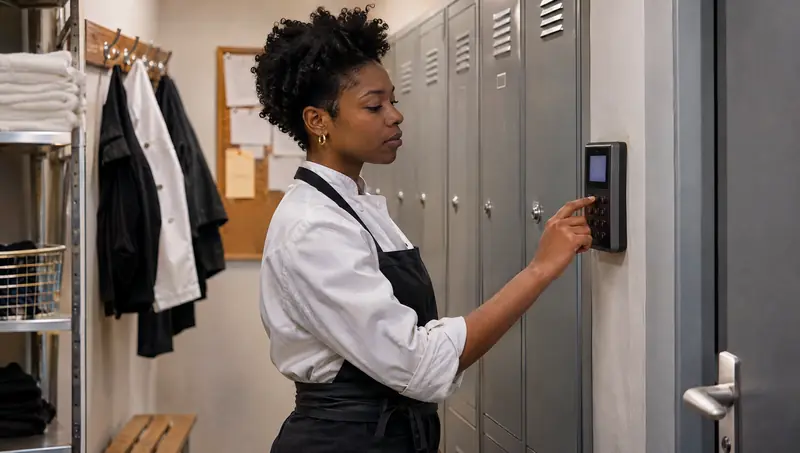
The personal code that tells the tool who is speaking. In the kitchen: two line cooks pick up the same device; each enters their own PIN and gets their own tasks. Sharing equipment is covered in hygiene of shared equipment.
Session
The period during which the tool knows who is using it. In the kitchen: the morning session belongs to the opening cook, not to whoever picks up the device at 3 pm. At Tsuno, each person opens their own with the venue code and their PIN. See San on screen, San by voice.
Shared tablet
A fixed device in the venue used by the whole team, each person with their own code. In the kitchen: the tablet by the pass where you tick the checklist and report a breakdown. In Tsuno, it only sees the venue where it is installed. See reporting a breakdown without leaving your station.
Transcription
Turning speech into text, which creates data to protect and to keep for a set period. In the kitchen: a voice note saying "the walk-in door isn't closing properly" becomes a line someone can read tomorrow morning. See voice data at work.
What the team looks things up in
Checklist
The list of points to check or do, ticked one by one, at a given moment. In the kitchen: closing, station by station. A checklist does not say how to do things; the procedure does. See why restaurant checklists often change nothing.
Local variant
An accepted exception to a standard, approved and visible as such. In the kitchen: the site with no fryer swaps fries for sautéed potatoes, and everyone knows it. See how to standardise multiple restaurants without making them identical.
Procedure
The way things are done, step by step, as the house has decided. In the kitchen: cleaning the hood: product, dilution, order of the filters. A message in a group chat is not enough: a procedure buried in WhatsApp is not a procedure.
Reference sheet
A reference page on one precise topic, with its approval date and its owner. In the kitchen: the allergen sheet for the tartare, dated from the last change of supplier. An undated sheet is a trap: an outdated procedure is more dangerous than a missing one.
Standard
The common rule every site applies the same way. In the kitchen: the portion of fries, to the gram, in every restaurant in the group. Keeping it alive: explain it once.
Temperature log and threshold
A log entry is a recorded measurement (temperature, frying oil, chilling); the threshold is the limit that triggers action. In the kitchen: in Tsuno, an out-of-range reading alerts the site's managers. See HACCP checks with busy hands.
Training and onboarding
AFEST
The French framework for workplace-based training. Article D6313-3-2 of the French Labour Code sets out its content: analysis of the work, a trainer named in advance, reflective phases separate from the work itself, assessments of what was learned. In the kitchen: learning to fillet at the station, then going over it calmly with the chef afterwards. See learning on the job.
Mentor
The person named to pass on a technique and check it has been learned. The assistant reminds; the mentor shows and signs off. In the kitchen: the station chef who corrects your knife grip. See the mentor and the assistant.
Onboarding
Bringing a new hire from day one to working independently at their station. In the kitchen: knowing by 10 am where the hotel pans live and what the first job is. Shortening it without cutting corners: reducing onboarding time.
Skill
A precise piece of know-how, signed off and dated by a manager, never a score on the person. In the kitchen: "fillet to saku block" and "saku to slices" are two skills, not one. Organising them: how to build a useful skills matrix.
Law and trust
AI Act
The EU regulation on artificial intelligence (Regulation (EU) 2024/1689), which sorts uses by risk and applies in stages; its prohibitions have applied since February 2, 2025. In the kitchen: it concerns the employer who deploys an AI tool, not only the vendor. See AI at work: what changes for employers in 2027.
Data minimisation
The GDPR principle (Article 5) that limits collection to what is needed for the stated purpose. In the kitchen: to guide a checklist, a tool has no need to record the kitchen's conversations. See a microphone at work.
DPIA
A data protection impact assessment, required by Article 35 of the GDPR when processing is likely to pose a high risk to people. In the kitchen: a microphone worn by the team all day deserves at least the question, in writing. The guide: AI, voice and privacy at work.
Emotion inference
Deducing a person's mood, stress or motivation, for instance from their voice or face. The AI Act has banned it in the workplace since February 2, 2025, except for medical or safety reasons. In the kitchen: a tool that "detects fatigue" in a line cook's voice is outside the law in the EU. See AI and emotions at work.
Processor
Under the GDPR (Article 28), the provider that processes data on your behalf and on your instructions; you remain the controller, and the contract should cover how you leave. In the kitchen: the vendor keeps your sheets, it does not own them. See your restaurant data should remain yours.
Special category data
Data protected by Article 9 of the GDPR: health, racial or ethnic origin, opinions, religion, trade union membership and sexual orientation, among others. In the kitchen: "she's pregnant, she'll be less available" is not recorded; "unavailable from the 3rd to the 14th" is. See what AI must never record about an employee.
Works council (CSE)
In France, the CSE (comité social et économique) represents employees. The Labour Code requires it to be consulted on the introduction of new technologies (Article L2312-8) and on means of monitoring employees' activity (Article L2312-38). In the kitchen: you present the voice tool to it before handing out earpieces. See should you consult employee representatives?
Six terms people mix up
| People say | And mean | The difference that matters |
|---|---|---|
| Assistant | Agent | The assistant prepares and waits for your yes; the agent goes ahead on its own |
| Source | Memory | A source can be opened and checked; memory can also mean conversation history |
| Procedure | Checklist | The procedure says how; the checklist checks it was done |
| Declared fact | Recorded fact | "It's done" from someone is not worth a timestamp or a photo |
| Voice assistant | Hands-free | Talking to a tool does not mean never touching it |
| Hallucination | Wrong sheet | A tool that invents is at fault; a tool that shows an outdated sheet reveals a sheet to fix |
The last row matters most on the floor: a tool that cites its source tells you where to fix things, as shown in who is responsible if a procedure is wrong.
Where Tsuno San fits
Tsuno San is the intelligent voice assistant for frontline teams: in this glossary's terms, a work assistant connected to the venue's procedures, tasks, checklists, routine checks and equipment. It acts within the person's permissions and always in two steps. San Voice is available in demo; San Audio and San 360 are under exploration and testing. Practical questions (data, hardware, pricing) are gathered in the Tsuno San FAQ.
Key takeaways
An AI term is only worth the kitchen example you can put behind it. In front of a vendor, two questions already sort out a lot: where does the answer come from, and who confirms before the action goes through.
Frequently asked questions
What is an AI hallucination?
An invented answer delivered with confidence: a procedure step, a figure or a rule that exists nowhere. The fix is a tool that answers from sources you can open and says when it does not know.
What is MCP, in plain terms?
MCP (Model Context Protocol) is a standard plug that lets an AI assistant such as ChatGPT, Claude or Mistral connect to a company's software. The plug protects nothing by itself: the rules of the connected software, permissions and confirmation, are what protect you.
What is the difference between an AI assistant and an AI agent?
An assistant answers and prepares; a person decides. An agent chains several actions on its own to reach a goal. In a restaurant, any action that touches a team, stock or a schedule should always wait for a human confirmation.
What is special category data under the GDPR?
Article 9 of the GDPR covers, among others, health, racial or ethnic origin, political opinions, religion, trade union membership and sexual orientation. Processing it is prohibited except in specific cases. A work tool should not record it about an employee: you record dated, observed facts instead.
What is AFEST?
AFEST is the French framework for workplace-based training. Article D6313-3-2 of the French Labour Code sets out its content: analysis of the work, a trainer named in advance, reflective phases separate from the work itself, and assessments of what was learned.
Can AI analyse employees' emotions?
Not in the European Union: the AI Act has banned emotion inference in the workplace since February 2, 2025, except for medical or safety reasons. A tool that promises to measure a team's stress or motivation is outside the law in the EU.
Keep reading

AI and tools
12 questions to ask before connecting an AI to your business
Rights, confirmation, logs, data sent out, exclusions, leavers: 12 questions to ask a vendor before connecting your AI, and the answers to demand.
AI and tools
Give your AI the same rights as you, no more
An AI connected to your business should see and do what the person can already see and do, nothing more. That is what earns the trust of your teams.

AI and tools
AI proposes, a human confirms: the two-step rule
In day-to-day operations, AI should never act alone: it prepares and summarizes, a person reads and confirms. Why it matters, how it works, and the traps.