
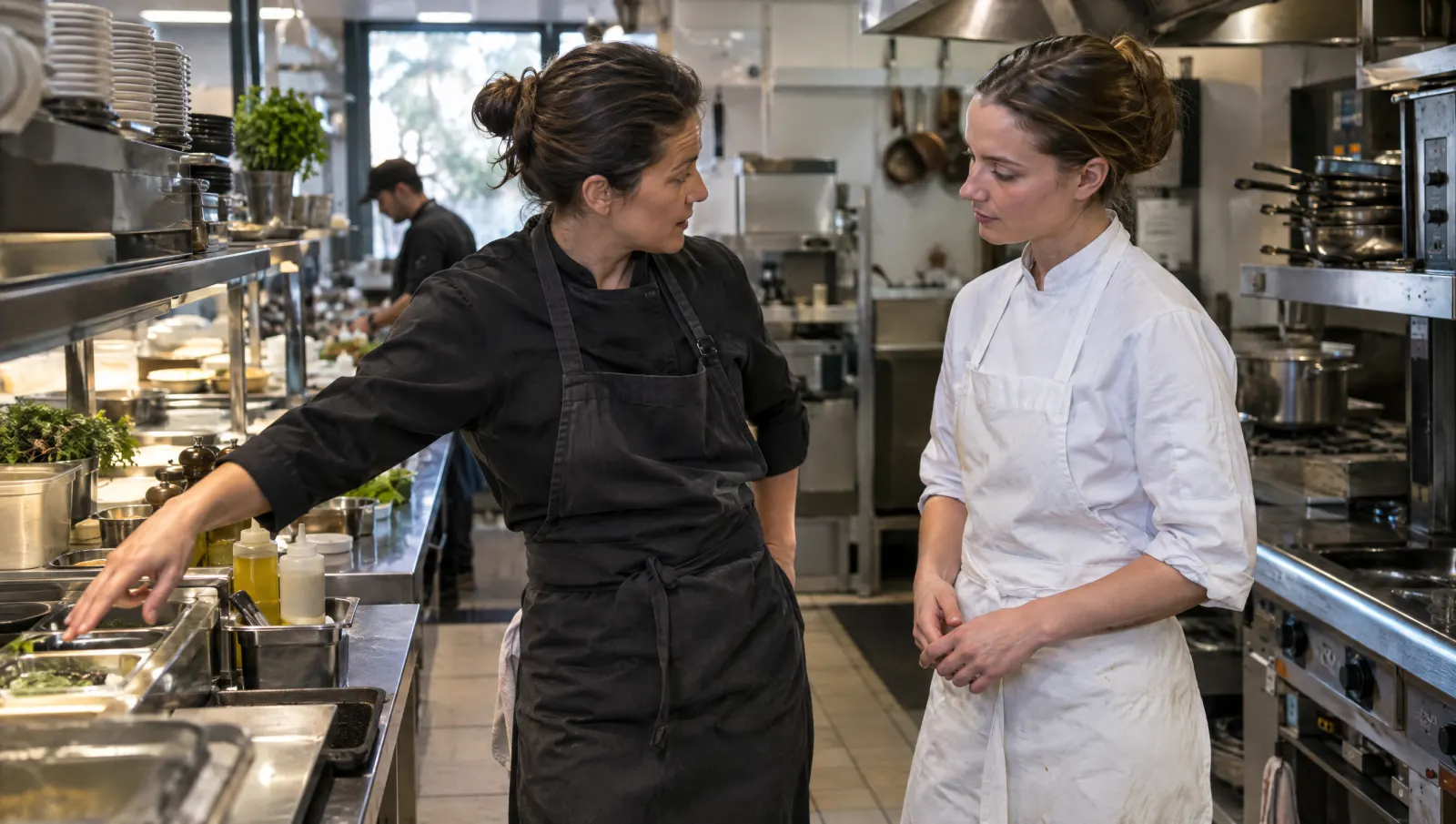
Reducing onboarding time does not mean shortening training. It means removing everything that does not need a person: explanations already given a thousand times, access to set up, instructions to track down. The time freed goes where it counts, watching the real technique, with someone who corrects and signs off.
Monday, 10 a.m., a new line cook arrives
A new line cook starts at the group's second restaurant. The manager is out on a delivery. The station lead shows her the locker room and says "follow me and watch". She does not know what time she finishes, or whether she is allowed to touch the slicer. At 11:30, the rush begins. She stands against a wall while everyone runs around.
On Tuesday, someone else shows her the same cut a different way. On Wednesday she asks which of the two is right. Nobody answers. Onboarding drags on, not because the craft takes long to learn, but because everything has to be rebuilt each time.
Why onboarding drags on
Nothing is ready before day one
Schedule, uniform, access, instructions, go-to person: each is decided when the new hire shows up. The first day is lost to organizing instead of learning.
Every go-to person trains in their own way
With no shared path, the same task is explained two ways. The new hire has to arbitrate alone, and retains neither.
Information and learning get mixed up
The rules, the hours and basic food safety can be read beforehand. The technique is learned by doing it. When everything is delivered verbally, the expert's time is wasted on what could be read.
Sign-off is vague
"He looks good" does not say which technique is mastered. The new hire is left alone too early, or too late, and the length of onboarding depends on the go-to person's mood.
A first-week path (example to adapt)
| Day | Before arrival or in the morning | Practice with the go-to person | Sign-off |
|---|---|---|---|
| Before day 1 | Schedule, uniform, access, instructions readable in advance | ||
| Day 1 | Welcome, tour of the restaurant, food safety rules | Watching a typical day for the role | New hire's questions noted |
| Day 2 | Rereading the instructions for the first three tasks | First task done with the go-to person | Date and name of the observer |
| Day 3 | Second task; first task redone alone | Techniques mastered or to redo | |
| Day 4 | Third task in a service setting | Go-to person's feedback | |
| Day 5 | 15-minute check-in with the manager | One task done independently, go-to person nearby | Factual review: mastered, to redo |
How to build it in six steps
- Write the typical day for the role: tasks, times, durations. The manager has an incumbent of the role review it.
- Choose the first three tasks, the most frequent and least risky, with their written instruction and, if possible, a photo.
- Prepare the day-one kit: schedule for the week, access, uniform, go-to person's name, who to contact if running late. A checklist ticked off the day before.
- Separate what is read from what is shown. Food safety, rules, culture: read beforehand or on the first day. Technique: at the station, with the go-to person.
- Set one sign-off criterion per task, observable: "done alone, without correction, in the expected time". The go-to person records the date.
- Review at the end of the week with the new hire: what is mastered, what remains, what was missing from the path. Each gap improves the next path.
Common mistakes
- Compressing by cutting practice. The apparent gain is paid back in mistakes during service.
- Handing the new hire to the busiest person. A go-to person with no time set aside cannot observe.
- Having the new hire read a very long handbook on day one. Attention is saturated; break it up by role. See the real problem with restaurant onboarding manuals.
- Not reviewing the path after each arrival. The same questions keep coming back, a sign that an instruction is missing.
What to measure
- The number of days between arrival and the first task done alone and signed off, by role.
- Go-to person hours spent on a new hire in the first week.
- The number of identical questions asked by successive new hires, which point to an instruction that needs writing.
Where Tsuno comes in
Tsuno prepares what can be prepared before arrival: the role's typical day, tasks with time and duration, instructions, training modules (recipes, food safety, service, culture). What used to be repeated to every new hire is written once and passed on through checklists, training and onboarding. Sign-off on the technique stays human: a go-to person observes and confirms. Tsuno connects facts (tasks done, modules completed) without judging the person. You can see the modules on the features page.
Going further
The cost of not doing this is detailed in restaurant turnover: the hidden cost of lost knowledge. To know when a new hire is independent, read how to know when a new restaurant employee is actually ready. For teams trained consistently from one location to the next, see how to stop training new hires differently at every location. And the framework: how many times should you repeat an instruction before changing the system?.
Key takeaway
A short onboarding is a prepared onboarding: everything that can be read is ready beforehand, everything that must be shown is done at the station with a go-to person, and every task has a dated sign-off criterion.
Frequently asked questions
What is the difference between shortening onboarding and rushing it?
Rushing means cutting observation and sign-off. Shortening means removing what does not need a person: reading prepared before arrival, instructions already written, access ready. The time freed goes to watching the actual technique.
What should be prepared before a new hire's first day?
Their role, their typical day, the instructions for their first three tasks, the name of their go-to person, their access, their uniform and their first-week schedule. Nothing should be decided in front of them.
How do you know a new hire has understood and not just watched?
Ask them to repeat the technique alone in front of the go-to person, then explain why it is done that way. The sign-off is recorded with the date and the name of whoever observed.
Is an onboarding handbook enough?
No. A handbook informs; it does not train. It has to be tied to the role's tasks and to a sign-off in the field, otherwise it is read once and forgotten.
Can you train several new hires as a group?
Yes for shared content (food safety, culture, safety), as long as observation of the technique stays one-to-one with a go-to person for each role.
Keep reading
Pass it on without repeating
Restaurant turnover: the hidden cost of lost knowledge
The cost of a departure goes beyond hiring: training, mistakes, the time of your go-to people and unwritten know-how. How to see it and reduce it.

Pass it on without repeating
"Nobody told me": why new restaurant hires keep saying it
When a new hire says "nobody told me," the instruction was rarely missing: it was verbal, partial or given by someone else, and nobody can trace it.

Pass it on without repeating
A procedure buried in WhatsApp is not a procedure
An instruction posted in a group chat gets lost in the stream. Here is what turns a message into a procedure, plus a one-page template you can copy.