
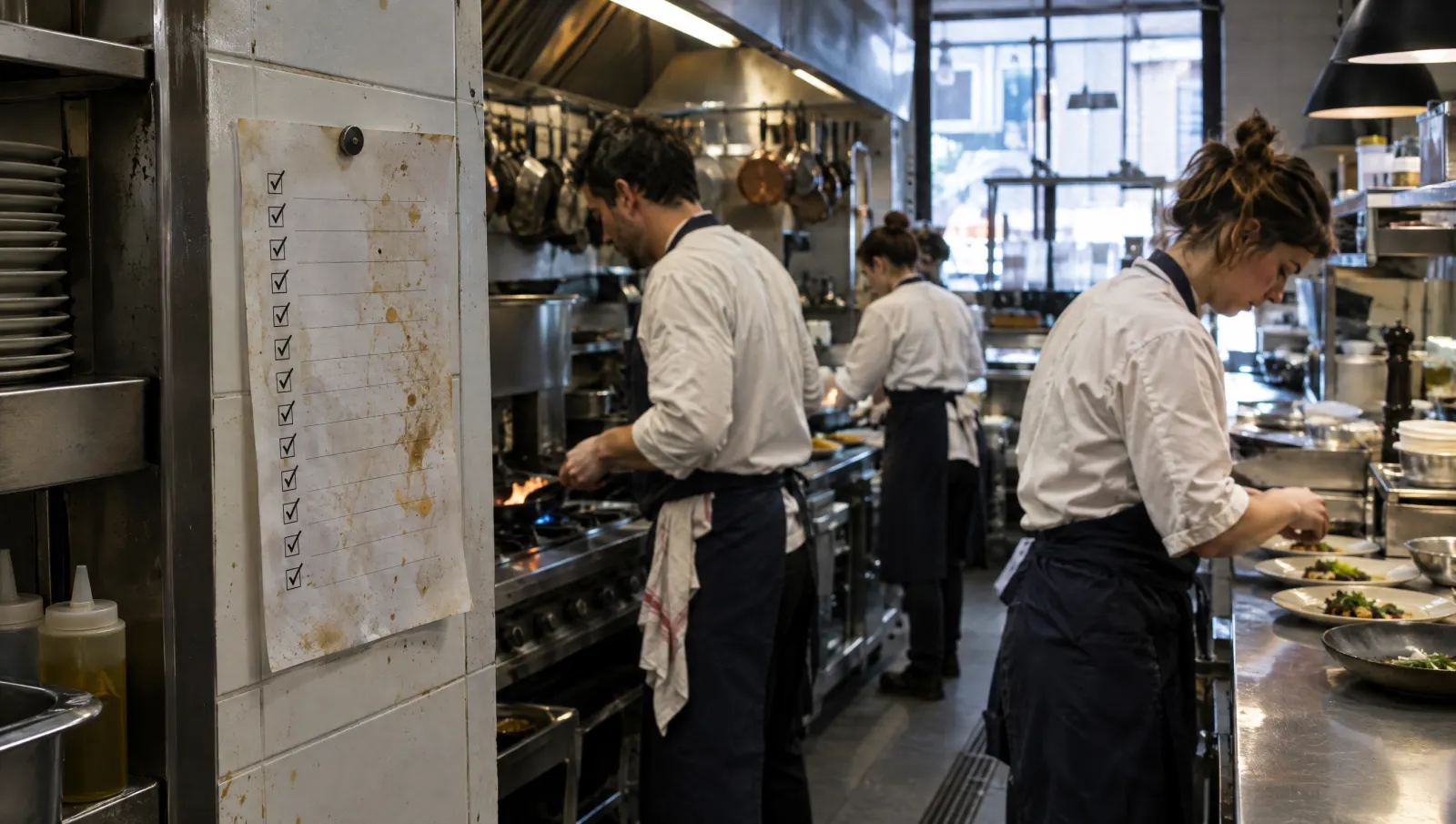
A checklist changes something when someone reads it, when each line points to a specific task at a specific moment, and when an empty box triggers a reaction. If any of those three conditions is missing, the list becomes a ritual: you tick it to feel at ease. It protects neither food safety, nor quality, nor your time.
Ticking is not doing
On a Friday night, the floor manager of a fictional restaurant finds her closing checklist fully ticked. Everything is signed at 11:15 p.m. The next morning, the opening commis finds that the ice machine was not emptied and a walk-in door was left ajar. The list was complete. The tasks were not.
There were forty lines. That night, three people left at 10:30 p.m. and let the last one sign for everyone. Nobody lied: the list asked for no real time, no name per line and no follow-up in case of an omission.
Five flaws that drain a checklist
- It is too long. The more lines there are, the less each one weighs. Critical tasks drown among decorative boxes.
- It has no moment. "Clean the dish station" with no time gets ticked at the end, along with everything else.
- It has no owner. A list signed collectively commits nobody.
- It has no proof where proof is needed. A temperature with no recorded value is a box, not a check.
- It produces no follow-up. An anomaly scribbled in the margin never reaches the manager, nor the next action.
Bad line, good line
| Bad line | Why it fails | Version that works |
|---|---|---|
| "Kitchen clean" | Subjective, nobody knows where to stop | "Hot station work surface: degreased, sanitized, dried" (hot station, 10 p.m.) |
| "Fridges OK" | A box can hide a breakdown | "Fridge 2 temperature reading: ___", signed with a name |
| "Check use-by dates" | Vague, impossible to verify | "Expired products removed from the bottom shelf" (receiving, before service) |
| "Everything put away" | No moment, no role | "Dry storage: opened products resealed and dated" (sous chef, before leaving) |
| "Closing done" | Ticked for everyone, by one person | One line per role, each person signs their own |
How to rewrite a checklist that works
- Start from incidents, not from the general idea. List the last five real problems (a fridge left open, a missing prep item). Every line should prevent one of them.
- Cut without mercy. For each line, ask: what happens if we forget it? If the answer is "nothing," remove it.
- Tie each line to a role and a time. Not to "the team."
- Choose the proof according to the risk. A recorded value, a photo, a simple signature, or nothing for tasks with no stakes.
- Decide the follow-up in advance. If the box is not done, who is told? Who decides? Where is the action recorded? Write it down once.
- Review in a short meeting every week. Five minutes: a line that has never served any purpose goes out, a missing line comes in.
To understand why the same instruction keeps coming back even though it is already on a list, see how many times to repeat an instruction before changing the system. If the problem is concentrated in the evening, the closing checklist and fake compliance covers that case. For the morning, read the opening checklist people actually use.
Test one list for a week
Do not rewrite all your lists at once. Take the one that worries you most, for example the morning prep, and follow it for a week.
- Monday: do the rewrite with the chef and one team member, not alone in your office.
- Tuesday to Saturday: review the list each morning, in five minutes, with the person who signed it. You are not looking for someone to blame, you are looking at which lines were done without difficulty and which never made sense.
- Sunday: remove the useless lines, tighten the ones that got in the way, and only then decide whether to extend this to your other lists.
This test week teaches you more than ten meetings, because it shows where the list does not fit the real rhythm of service.
Common mistakes
- Adding a line after every incident. The list grows, attention drops.
- Asking for a collective signature. You lose track of who did what.
- Punishing empty boxes. The team will learn to tick rather than to report.
- Never removing a line. A list that is never rewritten no longer reflects the work.
What to measure
- The share of lines ticked at the time the task actually happens. You read it from the signature time, not from the completion rate.
- The number of noted anomalies that led to a visible action. An anomaly with no action is a list that does not listen.
- The number of lines removed or rewritten in the month. A living list moves.
Where Tsuno comes in
In Tsuno, checklists are tied to a typical day: tasks per role, with a time, a duration and a signature. An anomaly becomes an incident or a task, with its history, rather than a scribbled margin note. Food safety readings are taken by hand or by sensor. Tsuno connects the facts (what was done, signed, and when); it never judges the person who signed. If a line is never done, we look at the process, the schedule or the training. See the features.
Key takeaways
A checklist works when it is short, points to a role and a time, and an empty box provokes a reaction. Start again from your incidents, cut what protects nothing and decide the follow-up in advance.
Frequently asked questions
How many lines should a restaurant checklist have?
There is no ideal number, but there is a simple rule: every line should match a task whose omission has a real consequence. If you can remove a line and nothing changes, it is decoration. A short list that actually gets done beats a long one ticked off in bulk.
Why does my team tick every box at once?
Because the list is neither tied to a specific moment nor followed by a reaction when a box stays empty. Ticking in bulk is the rational response to a list nobody reads. Tie each line to a time and a person, and actually read it.
Do we need a photo for every box?
No. Keep proof for the tasks where it adds real value: a temperature reading, a check at receiving, a sensitive area. Asking for proof everywhere wears the team out and makes people lose sight of what matters.
What should happen when a box is not ticked?
Every box left undone should lead to a visible action: who saw it, what is decided, who handles it, by when. Without that, the team learns that an empty box has no consequence, and the list stops being useful.
Can a paper checklist work?
Yes, if it is short, kept in the right place, signed with a name and reviewed every day. The medium matters less than the loop: a task, a signature, a review, a reaction. A tool becomes useful when several sites have to follow the same loop.
Keep reading

Pass it on without repeating
A procedure buried in WhatsApp is not a procedure
An instruction posted in a group chat gets lost in the stream. Here is what turns a message into a procedure, plus a one-page template you can copy.

Pass it on without repeating
Explain it once: how to keep a restaurant standard alive
A living standard fits in four lines, belongs to a role, is updated in one place and is checked on the floor. Here is the full cycle, start to finish.

Pass it on without repeating
How often to repeat an instruction before changing the system?
After the third reminder for the same instruction, the problem is no longer the person but the medium. Here is how to decide and what to use instead.