
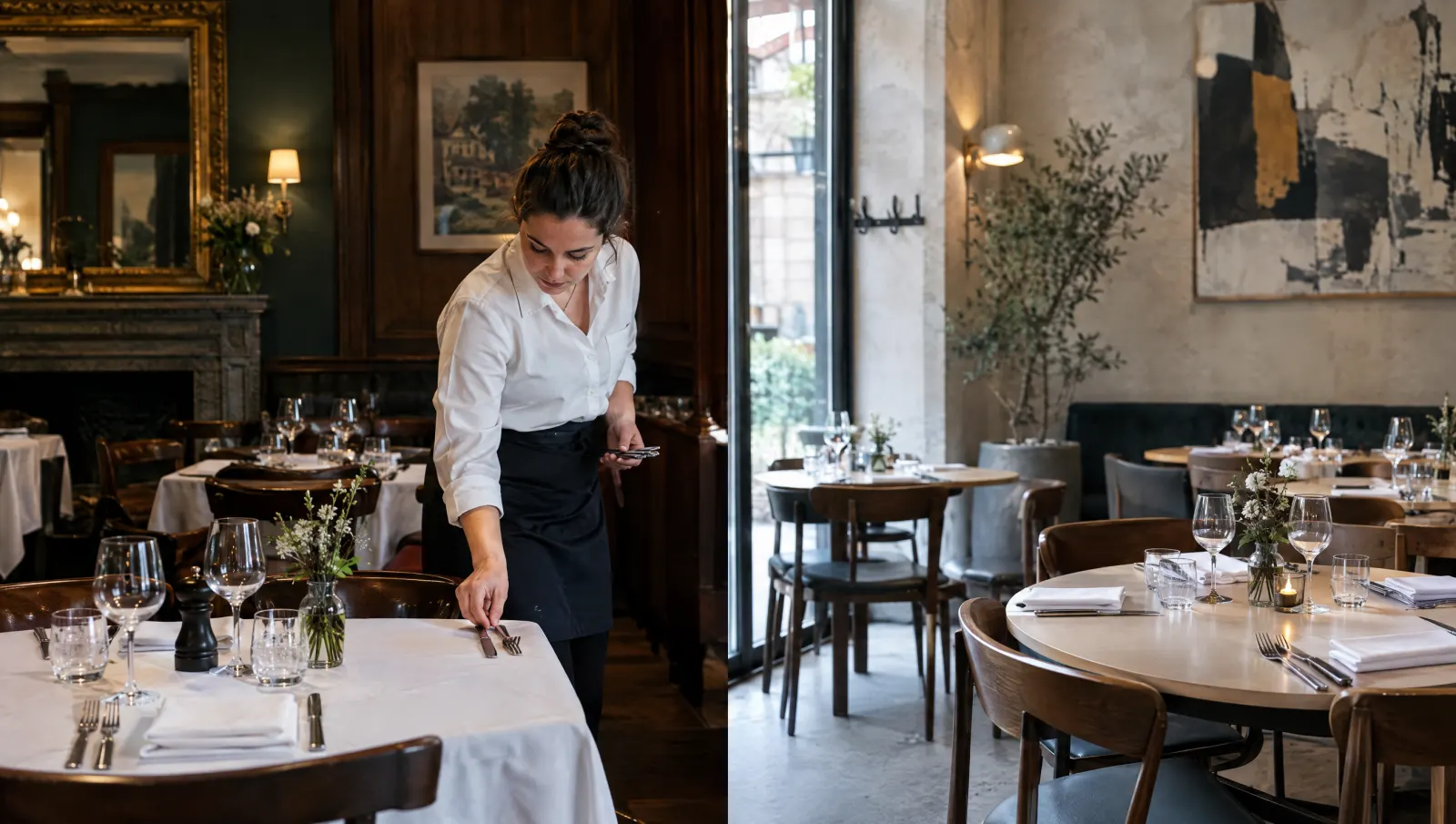
To standardize multiple restaurants without making them identical, fix what never varies (food safety, the recipe, the promise made to the guest) and document what each location is allowed to adapt. A place's identity comes from what is left free; the group's reliability comes from what is fixed. The mistake is to confuse the two.
Same dish, two plates
A guest eats the group's signature tart at the second location, on a Tuesday. Three weeks later, they order it at the fourth. The crust is thicker, the filling is different, the plating is not the same. Nobody decided to change the recipe: the fourth location's chef learned it from a former colleague, who learned it from someone else.
Meanwhile the owner has another worry: the first location's manager refuses to let anyone touch the decor of his dining room, which is the secret of his success. The two situations look like opposites. They come from the same gap: nobody wrote down where local freedom begins.
Why standardization fails in both directions
It fails by excess when everything is locked down. A manual that forbids any adaptation gets worked around in silence. Exceptions become invisible, and therefore uncontrolled.
It fails by omission when nothing is written. Each location passes things on in its own way, and the recipe drifts a little at a time.
It fails by mixing up levels. The background music is imposed with the same force as the storage temperature. Managers stop telling the essential from the incidental.
It fails by forgetting the reason. A rule without a reason is felt as a control. An explained rule is a skill.
Three levels to escape the either/or
| Level | Content | Who decides | Examples |
|---|---|---|---|
| Invariant | Does not change from one location to another | The owner | Food safety, allergens, recipe and portioning of signature dishes, guest welcome promise |
| Adaptable | May vary if justified and noted | The manager, with the owner informed | Order of prep, local supplier, delivery times |
| Free | Belongs to the location | The team | Atmosphere, decor, specials outside the shared menu |
The test: if the gap changes what the guest receives or what protects their health, it is an invariant. If it changes how the same result is delivered, it is adaptable. If it changes the soul of the place without touching anything else, it is free.
The method, step by step
1. List the brand's five invariants
Not fifty. Choose what a guest would recognize in any of your restaurants and what protects health. A one-hour workshop with the owner and two managers.
2. Write each invariant with its reason
A short paragraph: the action, the result, the reason. It is tied to a role, not filed in a general folder.
3. Collect the existing differences
Visit or interview each location: what is done differently? Note it without judging. The goal is to move from invisible habits to a list.
4. Sort each difference
For each gap: invariant violated (to correct), justified adaptation (to document), or better idea (to test for everyone). Three possible verdicts, none of them a sanction.
5. Give exceptions a home
Validated adaptations are written next to the standard, with the location concerned, the date and the reason. A new manager can then see what is local.
6. Review when a decision changes the practice
The standard is updated the moment the decision is made, not at an annual review. The date of the last change is displayed.
An example of a decision
A fictional example: one location replaces the butter in its dough with a local version that is easier to source. If the taste and texture of the dish remain those of the recipe spec, the adaptation is documented. If the dish changes for the guest, you either go back to the invariant or test the change across the whole group. The question is never "who is right?" but "what does the guest receive?"
Mistakes that make standardization unpopular
- Imposing a single manual without asking the locations about their constraints.
- Treating every difference as a fault.
- Leaving the best local ideas in the head of a single manager.
- Writing without tying to roles: nobody knows who is concerned.
- Checking compliance before explaining the reason.
What to measure
- The number of unsorted differences between locations (neither validated nor corrected).
- Recipe or method questions that come up, by location: they point to a vague standard.
- The date of the last update of key standards, compared with the decisions made since.
Where Tsuno comes in
Tsuno writes each standard and each procedure once, assigns it to a role and passes it on through checklists, training and onboarding. Local exceptions can be recorded there with their date, and every observed fact keeps its provenance. If a practice differs between two locations, that is a fact to examine, not a verdict on the manager: you look first at the procedure and the training. Tsuno does not grade teams. See the solution.
Further reading
The general topic is in how to manage multiple restaurants without being everywhere. On the life of a standard over time, read explain it once: how to make a standard live. To stop each manager from training in their own way, see how to stop training new hires differently at every location. And on task lists that have no effect, why restaurant checklists often change nothing.
Key takeaways
A consistent group distinguishes invariants, noted adaptations and local freedom. Write little, explain every rule and give exceptions a home: that is what turns a difference into a choice rather than drift.
Frequently asked questions
What is the difference between a standard and a control rule?
A standard describes the expected result and how to get there, with the reasons. A control rule checks after the fact. An explained standard is followed more often than a rule imposed without a reason.
How do you decide what must be identical in every restaurant?
Ask three questions: does it affect food safety, the recipe or the promise made to the guest? If so, it is an invariant. If not, the location may adapt it, as long as it is written down.
What if one restaurant has a better method than the group standard?
Test it, compare it against the facts, then either adopt it for everyone or document it as an exception. Do not let the best idea stay an invisible habit of a single location.
How do you tell a legitimate local difference from drift?
A legitimate difference is known, written down and justified by a constraint of the place. Drift is a gap nobody decided on, often discovered by chance.
How do you keep a standard up to date without writing endless manuals?
Write short, tie each rule to a role, and correct the text at the moment a decision changes the practice. A standard is alive when its last change has a date and a reason.
Keep reading

Multiple restaurants
How to manage multiple restaurants without being everywhere
Managing several restaurants without being everywhere means moving from presence to exceptions: a few fixed questions, written standards, dated facts.

Multiple restaurants
How to open a sixth restaurant without multiplying chaos
To open a sixth restaurant without chaos, build the framework before the team: a typical day per role, standards, onboarding and three drift signals.

Multiple restaurants
Opening a third restaurant: why your presence is no longer enough
At the third site, the founder can no longer cover the system's gaps by being there. Here is what breaks, in what order, and what to put in place beforehand.