
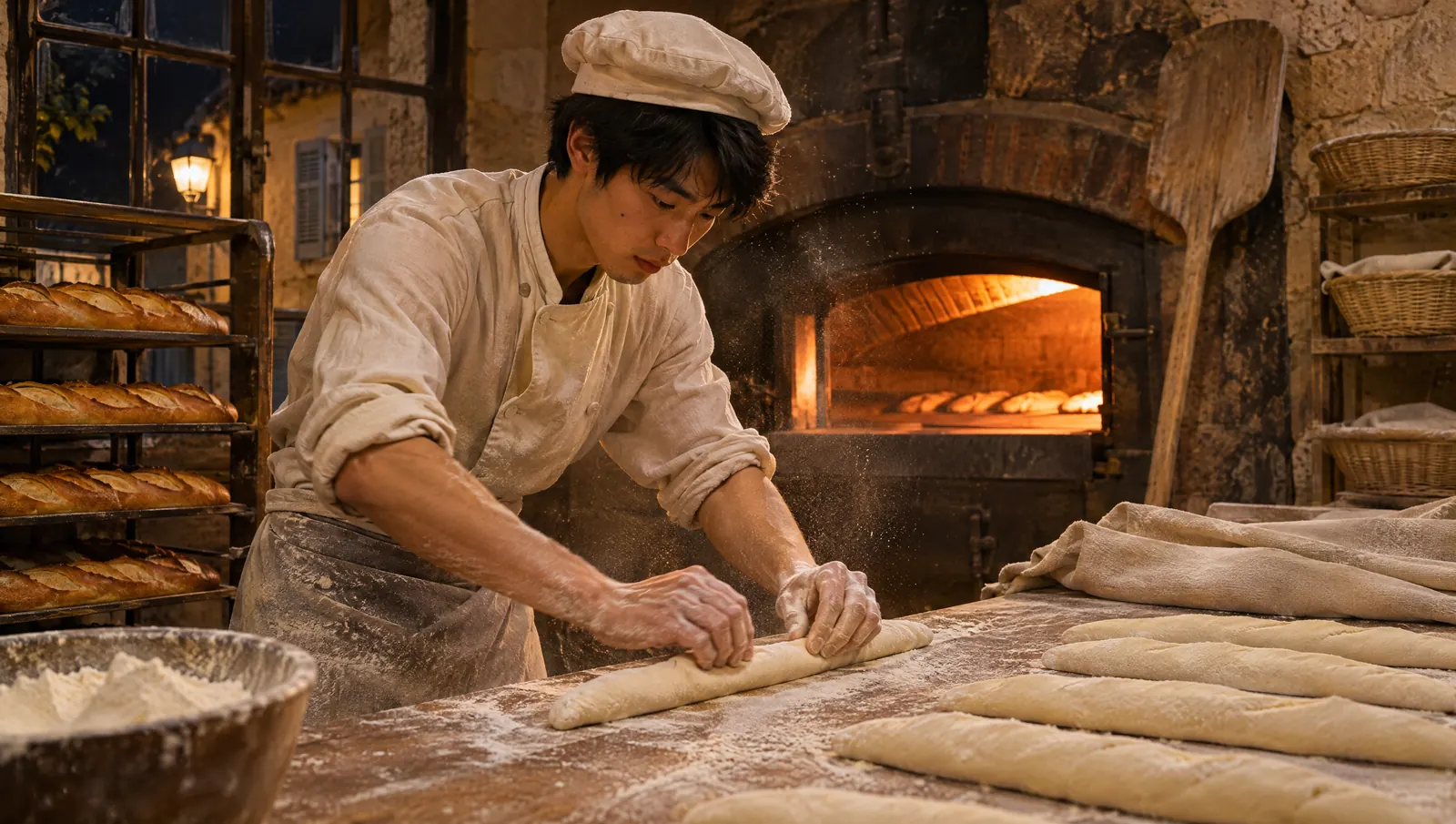
In a bakery, a work assistant earns its place when it repeats, at the moment of the task, what the baker wrote down: the mixing instruction at 3 a.m., the order for cleaning the mixer, the shop opening checklist at 6:30. At the counter, it never answers an allergen question on its own: it points to the approved product sheet. Everything it says has to come from a document the bakery owns, and it has to say which one.
One night, one morning, two teams
Tuesday, 3:40 a.m. Kenzo, a second-year apprentice, is shaping baguettes on the floured bench; the rye dough comes next. Odile, who owns the bakery, switched the flour for the rye loaf yesterday and left a note: new hydration, longer bulk fermentation. She is at the oven at the far end of the bakehouse, loading a batch. Kenzo's hands are covered in dough. To reread the note he would have to wash up, wipe the phone, find the message and come back. He hesitates, then shouts the question across the room.
Same day, 7:15 a.m. Capucine opened the shop an hour ago. A customer asks whether the seeded loaf "has sesame in it". Capucine thinks it does. She is not sure about the new seed mix that came in on Monday. Odile is asleep: she went to bed at 6. Kenzo has gone home.
(Fictional scenes and characters.)
Two moments, two people, one problem. The information exists, someone decided it, but it is not within reach when it is needed.
Why bakeries are a special case
Two teams that barely meet
The bakehouse works at night, the shop by day. Production decisions are made at 2 a.m., customer questions arrive at 7. In between there is usually a note on a whiteboard or a message in a group chat. The Tsuno Bakery page puts it plainly: bakehouse and shop barely talk, and a recipe change reaches the counter late, or garbled.
Hands that cannot touch a screen
Flour, sticky dough, hot trays, oven gloves: in the bakehouse, a phone is something you avoid. It is exactly the situation that led to San in a restaurant kitchen, covered in why talk to your tools when your hands are full.
Know-how that lives in one head
How Odile reads a dough, when she adds a little water, why the rye needs a longer rise: that is her craft. Part of it can be written down (quantities, temperatures, times, order of steps). The rest is learned standing next to her. An assistant only deals with the first part.
A clerk on the front line of food safety
Capucine answers alone, in front of the customer, about something that could make them ill. In France, decree no. 2015-447 of 17 April 2015 requires allergen information for food sold unpackaged to be shown on the product or next to it, with no doubt about which product it refers to. Wherever you trade, the principle holds: the information has to exist in writing before the question is asked.
What an assistant can bring, from bakehouse to counter
The starting rule is simple: it only knows what the bakery has written and approved, and it names the source. On that basis, here is what makes sense.
- Read back a mixing instruction written by the baker: flour, hydration, mixing time, target dough temperature, with the date of the last change.
- Say what has changed since yesterday when an instruction has been updated, instead of reading the whole sheet again.
- Walk through a cleaning routine step by step (mixer, moulder, sheeter, proofer) and say which step comes next.
- Say what is left on the bakehouse closing checklist or the shop opening checklist.
- At the counter, find the approved product sheet and tell the clerk where it is and how recent it is.
- Draft a note or a report ("oven 2 is not heating properly", "out of paper bags") that the person reviews and confirms before it goes out. That is the two-step rule.
What it must not do
- Certify that a product is "free from" an allergen. It shows the sheet, it guarantees nothing. The full reasoning is in is there sesame in it? why San shows the sheet instead of answering.
- Infer ingredients from a recipe or from habit. If the new seeded loaf has no sheet yet, the only right answer is "no approved sheet for this product".
- Make up a hydration level, a fermentation time or a temperature when the instruction is missing.
- Correct a recipe. It can flag a mismatch between two instructions; Odile decides.
- Judge Kenzo, count his questions or compare him with another apprentice. San does not assess anyone: see what San never does.
- Sign off a hygiene log on behalf of the person who did the check.
A typical day, question by question
| Time | Typical question | Expected answer | Where it is written |
|---|---|---|---|
| 2:30 a.m., bakehouse start-up | "What's left on the start-up checklist?" | Unchecked tasks, in order | Bakehouse checklist |
| 3:40 a.m., mixing | "What's the rye hydration since yesterday?" | The written value, date of the change, who made it | Production instruction approved by Odile |
| 4:30 a.m., bulk fermentation | "How long is the bulk for the baguettes?" | The written time, or "no written instruction" | Product production sheet |
| 5:45 a.m., cleaning | "After the mixer, what do I clean?" | The next step of the routine | Bakehouse cleaning procedure |
| 6:15 a.m., shop opening | "What's missing before we open?" | Display, logs, till: what is not done | Shop opening checklist |
| 7:15 a.m., at the counter | "Does the seeded loaf contain sesame?" | "Here is the approved sheet from [date]", or "no approved sheet, I can't answer" | Product sheet (ingredients, allergens) |
| 1:30 p.m., closing | "Have I finished the reset?" | Remaining tasks on the checklist | Closing checklist |
Read the last column first. Every empty cell in your own bakery is a question no assistant can answer honestly.
Getting ready in four weeks
Week 1, production instructions
Odile writes, product by product, what can be written: flour, hydration, mixing, dough temperature, bulk, proof, bake. One short dated page per product. What depends on the eye stays to be taught in the bakehouse, next to her.
Week 2, cleaning routines
One procedure per machine, in the real order, with the products used. Kenzo checks it while doing it: if he gets stuck on a step, the sheet is unclear.
Week 3, shop product sheets
Ingredients and allergens, approved by the owner, dated, one product per sheet. The new seeded loaf only goes in the case once its sheet is approved.
Week 4, opening and closing checklists
For the bakehouse and for the shop, with what must be ready by when. Capucine tests the morning one and flags what does not match reality.
Common mistakes
- Plugging in an assistant before writing the instructions. All it can say is "I don't know", which is honest but disappointing.
- Leaving allergen knowledge to the memory of the longest-serving clerk. The day she is off, nobody knows.
- Updating the recipe without updating the product sheet. Bakehouse and shop stop saying the same thing.
- Thinking voice replaces demonstration. Shaping a baguette is learned next to someone, not through an earpiece.
- Testing in the bakehouse on a heavy production night. Start on a quiet one.
What to measure
- How many questions get shouted across the bakehouse in one night, before and after the instructions are written.
- The share of products in the case that have an approved, dated sheet.
- How many times in a week the shop had to say "I don't know" about a product, and why.
Where Tsuno and San come in
Tsuno Bakery already holds what an assistant runs on: approved, dated product sheets (ingredients, allergens, selling tips, storage), updates that go from bakehouse to shops with a record of who has read them, opening and closing checklists, cleaning, temperature logs, preparation tracking. You can ask it questions in plain language, from Tsuno or from your usual AI assistant, with your own permissions.
On voice, let us be precise. San Voice, the voice interaction, is available in demo. Using it in the bakehouse and the shop is something we are working on, on the same principle as in a kitchen. Talking without touching the device, which is what matters with floury hands, is the subject of San Audio, under exploration and testing. San acts within each person's permissions, and every action goes through a confirmation, as set out in what San never does.
Further reading
The tour of other trades is in San beyond restaurants. For the basic allergen rule, read why no tool should answer from memory. If your bakery runs several shops, the group question is covered in several restaurants: what San changes for a group. And for the limits of voice in a noisy workplace, see kitchen noise and why voice is not always the answer. This trade is part of the future of work in hands-on jobs.
Key takeaways
A bakery assistant is only as good as the instructions the baker has written: start with the last column of the table. At the counter, it shows the approved sheet and never certifies anything.
Frequently asked questions
What can a voice assistant do in a bakery?
Help people find what the baker wrote without letting go of the dough: a mixing instruction, the order of a cleaning routine, what is left on the shop opening checklist. It repeats an existing instruction, it never makes one up.
Can an assistant tell a customer whether a loaf contains an allergen?
It should never certify that a product is free from an allergen. It points to the product sheet the bakery approved and dated, and the clerk shows it or reads it to the customer. If there is any doubt, the customer is told so.
Can the assistant change a recipe or a hydration level?
No. A recipe belongs to the baker who wrote and approved it. The assistant can read it back, flag a missing instruction or draft a note, but the decision and the change stay with a person.
Is Tsuno San already available for bakeries?
Tsuno Bakery exists: product sheets, updates from bakehouse to shops, opening and closing checklists, hygiene logs. San Voice is available in demo. Using it in the bakehouse is something we are working on, and hands-free use (San Audio) is under exploration and testing.
What should a bakery prepare before using an assistant in the bakehouse?
Written instructions from the person who knows: mixing, bulk fermentation, baking, cleaning the mixer, opening the shop. An assistant can only repeat well what has been written clearly, dated and approved.
Keep reading
Future of work
San beyond restaurants: bakeries, services, vineyards, culture
Bakehouse, client site, vine row, gallery: wherever people work on their feet, the need is the same. What San could bring there, and what changes.
Future of work
10 changes in the restaurant of tomorrow
Information at the station, dated procedures, checks logged during the task, AI for managers: ten changes already under way, and what can go wrong with each.
Future of work
5 reasons to adopt a voice assistant, and 5 reasons not to
A voice assistant helps when hands are full and know-how is written down. It disappoints mid-rush, front of house, with no procedures or a team not on board.