
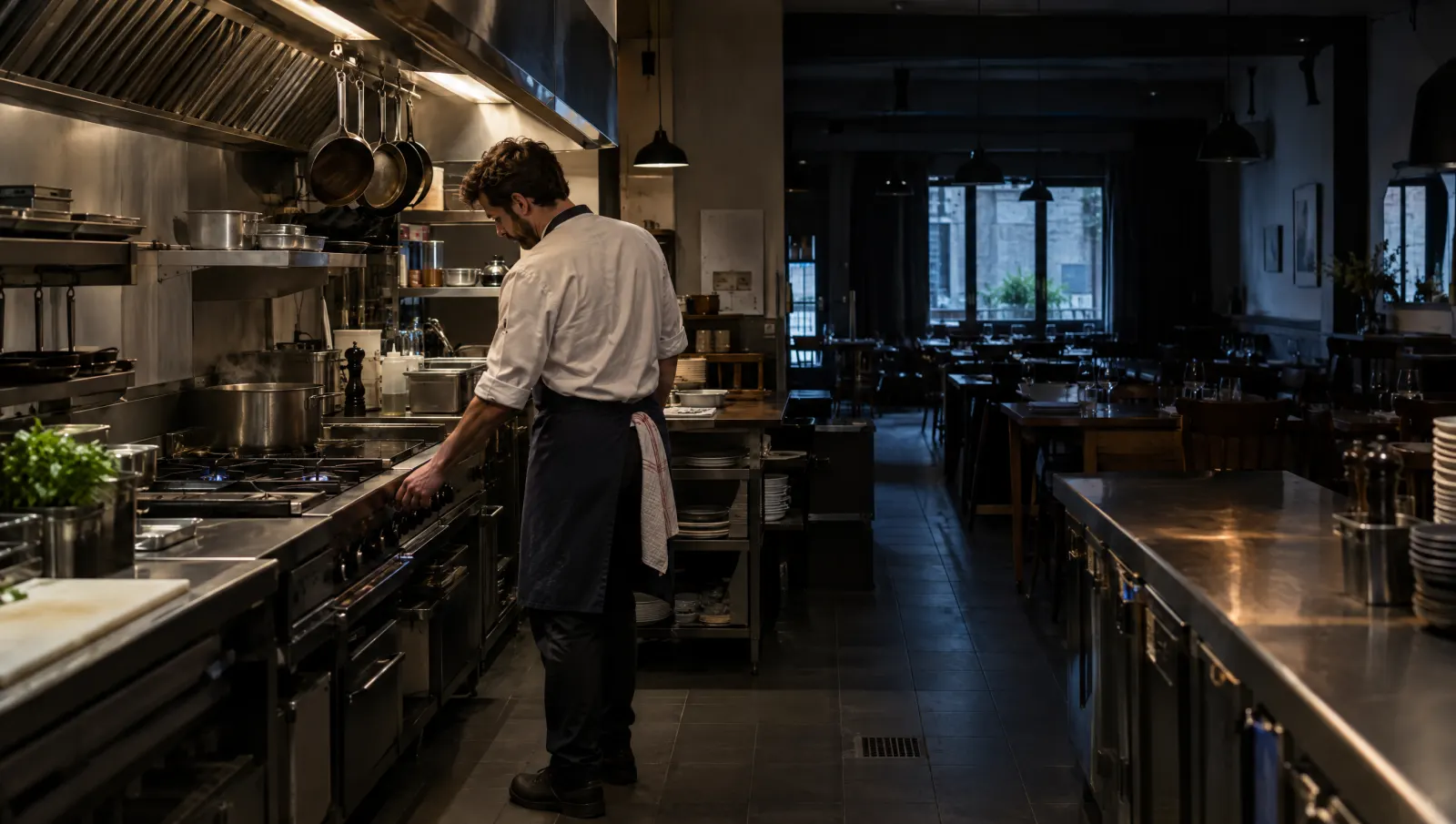
A good opening checklist is short, arranged in the order you walk through the site, assigned to a station and limited to what can go wrong before the first guest arrives. It exists to prepare the shift, not to document the business. Each line should be checkable in a few seconds and signed by the person who did it.
Nine o'clock, the key turns, the chef is not there
A cook opens the restaurant at the first site. He switches on the lights, plugs in the hood, opens the walk-in without looking at the display. He moves straight on to prep, because that is what he does every day. The paper checklist taped by the entrance has many lines, a good share of them about the dining room. He ticks it in three seconds, top to bottom, after his coffee.
At 11:30, the combi oven is not preheated: the line "turn on equipment" was ticked, but nobody had specified which equipment, or at what time. The problem was not the list itself: it mixed dining room and kitchen tasks, did not say who does what, and did not give an order.
Why opening checklists do not work
- They mix stations. A single list for kitchen, floor and bar forces everyone to read lines that are not theirs, so they skim all of them.
- They bundle different actions under a vague verb. "Check equipment" says neither what, nor how, nor what to do if something is down.
- They do not follow the real route. A list sorted by category (hygiene, safety, dining room) sends the person from one end of the restaurant to the other.
- They do not state the consequence. What does the cook do if the walk-in shows an abnormal temperature? If the answer is not written down, he ticks and hopes.
- They never age. Items stay in place after the equipment has changed, which teaches everyone that the list is not read.
Building a list that holds up
- One list per station. Kitchen, floor, bar, dish pit: each person sees only their own tasks.
- Take tasks out of "spare time." Each line has a target time and an estimated duration, so the manager can tell whether opening is realistic.
- Sort by walking order. Entrance, cold storage, kitchen, pass, dining room, patio.
- Write precise verbs. "Start preheating the combi oven" rather than "equipment."
- Mark the sensitive points. Cold storage temperature, allergens of the day, products to use first: they require a reading or a photo, the others a simple signature.
- Plan the way out. For each sensitive point, an "if abnormal" line: who to notify, which instruction applies.
- Review with the people who open. Every month, they suggest two removals and one addition, never more additions than removals.
Kitchen opening checklist template (adapt to your site)
| Order | Task | Target time | Proof |
|---|---|---|---|
| 1 | Disarm the alarm, check delivery access | on arrival | Signature |
| 2 | Take the temperature of each cold unit | within 10 minutes | Entered value or sensor |
| 3 | Start preheating the combi oven and the plancha | before prep | Signature |
| 4 | Read the information for the day (allergens, bookings, products to use up) | before 10:00 | Signature |
| 5 | Take out the day's preparations and check the use-by dates | before 10:00 | Signature, photo if in doubt |
| 6 | If a cold unit is abnormal: call the manager, isolate the products | immediately | Tracked action |
Set the times according to your own service. What matters: six lines, one station, one order.
Adapting the list to the type of service
Opening a brasserie is not the same as opening a dinner-only restaurant. For lunch service, prep must be finished before the last-minute deliveries arrive, so reading the information for the day comes first. For a venue that opens in the evening, the list can give more room to checking the previous day's preparations. If several teams hand over to each other, add a handover line: what was left, what remains to be done. Keep the same base across all your sites, and customize only the lines that really change with the layout of the premises.
Common mistakes
- Adding an item after every incident. The list becomes a graveyard of past mistakes.
- Having the manager tick from a distance. A tick sent by message is not a check.
- Mixing regulatory hygiene with nice-to-haves. What is mandatory must be distinguishable from what is desirable.
- Measuring the completion rate. A completion figure rewards how fast people tick, not how good the opening was.
Three things to watch
- The number of opening tasks that were ticked and then redone or caught up during service.
- The signing time of tasks compared with the target time: a series signed in the same minute signals bulk ticking.
- The anomalies found at opening (cold storage, breakdown, stockout) and what happened to them the same day.
Where Tsuno comes in
With Tsuno you write the typical day once, break it into tasks by station with a time and duration, then pass it on as checklists signed by the person concerned. Temperature readings are entered by hand or arrive from a sensor, and the history stays available. Tsuno ticks nothing in place of the team and does not evaluate people: it keeps the record and flags what was not done. For details, see the features.
Keep reading
The evening counterpart is in the closing checklist and fake compliance. To understand why a well-written list can still be ignored, read why restaurant checklists often change nothing and why temperature checks can be completed and still be useless. The overall frame is in digital HACCP: what software should actually remove.
Key takeaway
A useful opening checklist runs to a few lines per station, in walking order, with proof only where a mistake is costly. Write it with the people who open, and remove as much as you add.
Frequently asked questions
How many items should an opening checklist contain?
Few enough that someone in a hurry reads all of it. If it goes beyond what an employee can actually do in the time available, they will tick without doing. A list per station is better than a single list for the whole restaurant.
Who should sign the opening checklist?
The person who did the task, not the manager in their place. Each task is assigned to a station and signed by whoever carries it out, with the time.
In what order should opening tasks be arranged?
In the order you physically do them: security and access, cold storage, equipment, prep, dining room, information for the day. An order that follows the walking route avoids backtracking and missed steps.
Do you need a photo for every point on the checklist?
No. Keep proof (a photo, a reading) for the points where a mistake is costly: temperatures, allergens, sensitive products. Everything else just gets signed.
How do you update the checklist when something gets missed?
Add the item only if the miss had a real effect, and remove an item that has become unnecessary at the same time. A checklist that only grows always ends up ticked without being read.
Keep reading
Hygiene and compliance
Compliance theater: when everything is green but nothing is right
When the team ticks boxes to avoid reminders, the dashboard stays green and says nothing. Spot the signs of a window-dressing check and restore its meaning.
Hygiene and compliance
Digital HACCP: what the software should actually remove
Putting the binder on a tablet without changing the work gives you a binder on a tablet. Useful digital HACCP removes re-entry, searching and chasing.
Hygiene and compliance
Restaurant closing checklist: avoid fake compliance checks
A fully ticked closing list does not prove the restaurant is ready for tomorrow. Separate critical actions, useful proof and next-morning follow-up.