
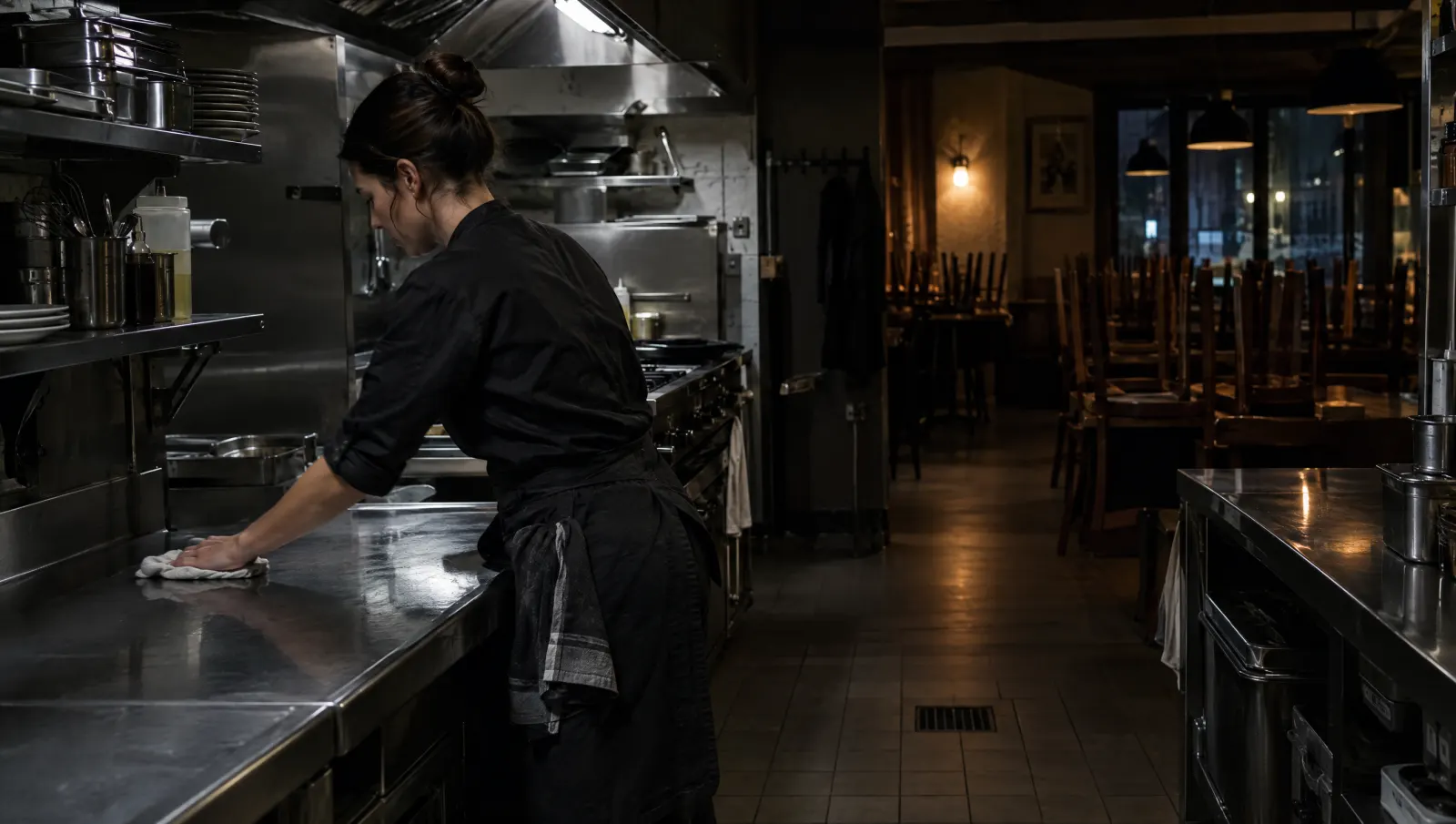
A fully ticked closing checklist does not prove the restaurant is ready for tomorrow: it proves that someone ran a finger down the list. A useful closing separates critical actions, which need proof, from comfort actions, which just get signed. It also brings every anomaly back into the morning briefing.
The walk-in left ajar
Saturday, 12:40 a.m. Service ran late, the dishwasher has gone home, the sous chef is closing the kitchen alone. He ticks every line on the sheet in one go: worktops, floors, bins, hot plates, cold storage, alarm. He is in a hurry and has a long commute. On the walk-in door, a tub of cream placed across the threshold prevents a proper latch. He does not see it, nobody looked.
On Sunday at 8 a.m., the morning cook finds an abnormal temperature and cream to throw away. The closing sheet is perfectly filled in, signed, dated. It protects against nothing: it has even removed the reflex of asking whether everything was really done.
Why closing gets ticked without being done
- The hour. Closing falls when concentration is at its lowest. Everything that requires thought is sacrificed.
- Every line weighs the same. Sweeping the floor and closing the cold storage take the same space on the sheet, so they look equally important.
- No reader. Nobody reviews the sheet the next day, so nobody knows whether it was accurate.
- Fear of blame. A miss is badly received, so people tick to avoid the discussion instead of reporting what was not done.
- A single closer. Without a second pair of eyes, the list turns into a sworn statement.
Sorting actions before writing the list
| Category | Examples | Useful proof |
|---|---|---|
| Safety critical | Gas off, fryers off, access locked | Signature + time |
| Food critical | Cold storage closed, temperature logged, opened products covered and dated | Reading or photo |
| Useful for tomorrow | Prep for the next day, laundry to wash, orders to place | Signature |
| Comfort | Final tidying, floors, worktops | Simple signature |
Limit proof to the first two rows. The more proof you ask for, the less each piece is worth.
A closing that produces information
- Identify the causes of next-day problems. Go through the last three difficult mornings: what was missing, what had been left undone.
- Move those causes to the top of the list. Critical actions first, while the closer still has energy.
- Specify who closes what. A line assigned to a station, not to "the team."
- Require a second look at sensitive points. A second employee, a photo, or a sensor reading.
- Allow and protect "not done." A "not done" box with a reason should be as simple as "done," with no reproach.
- Read the gaps out at the morning briefing. Two minutes: yesterday's anomalies, who takes them on.
- Remove lines that never have any effect. A line that is always ticked and never useful is noise.
Who closes, and with whom
Closing is often handed to whoever stays last, sometimes alone. Two simple practices improve control without weighing down the task. First, a pair on sensitive points: one does, the other checks, even briefly. Second, a rotation of closers, so that one person's habit does not become an unwritten rule. If a site always closes with the same person, ask what happens when they are away: the list must let any trained employee close correctly, without knowing the habits of the place.
Common mistakes
- Adding lines after every incident until the list is too long to read.
- Requiring a photo of everything. Photos become an empty gesture, with no one looking at what they show.
- Treating "not done" as a fault. Teams then tick falsely to protect themselves.
- Confusing closing with cleaning. Deep cleaning is a separate subject, with its own rhythm.
Three signs that show whether closing is real
- The number of anomalies reported per week. Zero anomalies for weeks is not reassuring: it is often the sign of bulk ticking.
- The signing time of lines: all in the same minute matches no physical route through the site.
- Morning problems whose cause was visible the night before (cold storage, uncovered product, equipment left on).
The morning briefing, two minutes
The whole value of closing is realized the next day. The manager or the first person in reads out the anomalies reported the day before, assigns each to one person and sets the time by which they will be closed. If there are none, they check the two most sensitive points in a minute: cold storage and opened products. This small ritual teaches closers that their reports are read, therefore useful, and that is what encourages them to write them.
Where Tsuno comes in
Tsuno passes closing on as tasks by station, with a time, a duration and the signature of the person concerned. Temperature readings are entered by hand or come from a sensor, and the source (measured, declared, proven) is kept. Incidents and tasks keep their history: an anomaly from the night before can be found in the morning with the question "What was not dealt with last night at site X?" Tsuno closes nothing itself and does not judge the closer: it recalls, the team acts. See the solution page.
To complete the picture
Read the twin article on the opening checklist people actually use, then why restaurant incidents keep repeating despite reports and compliance theater. The general frame is in digital HACCP: what software should actually remove.
Key takeaway
A reliable closing rests on few critical actions, targeted proof and a review the next day. Allow "not done," and bring every anomaly back into the opening briefing.
Frequently asked questions
Why is the closing checklist ticked without being done?
Because it comes at the end of service, when the team is tired, the list is long and nobody reviews it. Ticking becomes faster than checking, especially if nothing follows a miss.
Which closing points are truly critical?
Those where a miss costs you the next day or puts food safety at risk: cold storage closed and at the right temperature, opened products covered and dated, gas and equipment off, waste taken out, access locked.
Should you take photos at closing?
Only for sensitive points where doubt is possible (cold storage, storage of opened products). Photographing every line weighs down the end of service and encourages photos taken for show.
What should you do with an anomaly reported at closing?
It should become an assigned task, visible in the next opening briefing, with an owner. An anomaly written in a comment box nobody reads has not been dealt with.
Can the manager sign off the closing remotely?
They can review what was signed, but remote sign-off does not replace observation. It is better to review the anomalies and the proof for sensitive points in the morning than to countersign the whole list.
Keep reading
Hygiene and compliance
Digital HACCP: what the software should actually remove
Putting the binder on a tablet without changing the work gives you a binder on a tablet. Useful digital HACCP removes re-entry, searching and chasing.
Hygiene and compliance
Compliance theater: when everything is green but nothing is right
When the team ticks boxes to avoid reminders, the dashboard stays green and says nothing. Spot the signs of a window-dressing check and restore its meaning.

Hygiene and compliance
Restaurant opening checklist: a short template that works
An opening checklist prepares the shift; it does not document the whole business. A copy-ready template, task order and the right proof for each station.