
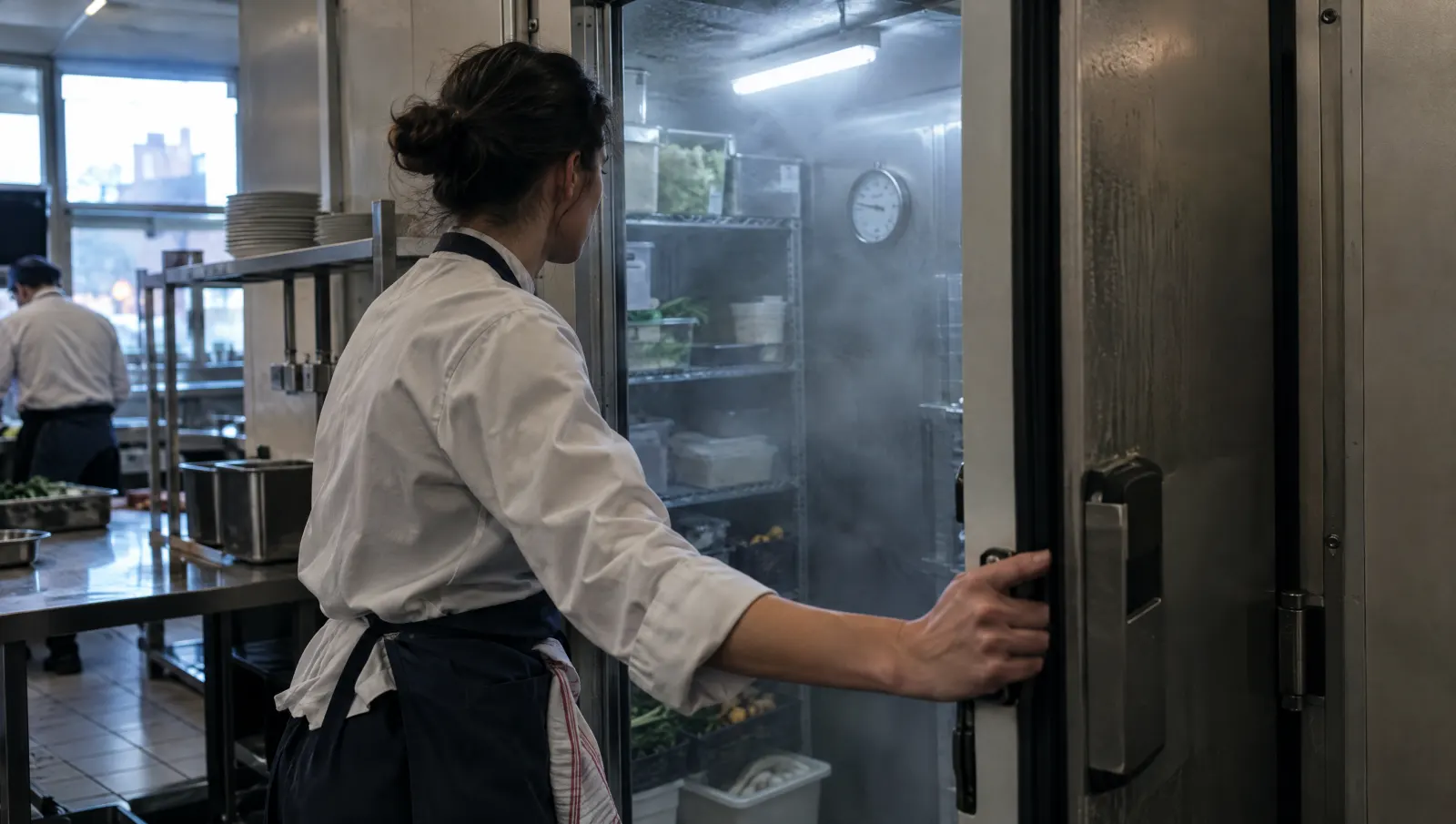
A temperature log is useful in only two cases: when an out-of-range reading triggers a reaction written down in advance, and when the history lets you see drift before the breakdown. A series of numbers ticked every morning, with nobody comparing them and nobody knowing what to do about an abnormal value, protects against nothing.
The same number, every day, for a month
The owner of a restaurant group goes through one site's temperature logs to prepare for an audit. Walk-in cooler: the same value every morning, in identical handwriting, down to the digit. Freezer: no variation. He suspects nobody of fraud: he wonders how a piece of equipment could be so stable. The cook explains that the reading is done in passing, reading the display from memory, or copying the previous day's when the unit is far from the workstation.
What the owner discovers is not an individual fault. The task was never designed properly: the display is far away, the sheet is at the other end, there is nobody to notify when a reading is off, so the log becomes a ritual.
The causes of a worthless log
- An out-of-range reading has no follow-up. If nothing happens when the value leaves the range, the employee learns that entering it has no consequence.
- The limit is not written next to the number. Knowing that a value is "good" requires knowing the limit for that equipment, which is rarely displayed.
- The task is badly placed. The display is in one spot, the sheet in another, and the log comes after prep.
- Nobody reads the history. A slow drift (a door that seals badly, a clogged evaporator) shows up only in the trend, not in an isolated value.
- Measurement and declaration are mixed. On a sheet, a value read from a sensor and a value copied from memory look the same.
The components of a log that works
| Element | "Decorative" log | Useful log |
|---|---|---|
| Value | A number alone | Number + expected range displayed |
| Source | Unknown | Measured by sensor or entered by a person, stated |
| Out-of-range reading | Noted or ignored | Linked corrective action and a named owner |
| History | In a binder | Searchable by unit and by period |
| Review | Never | Regular review of the trend |
Setting up a log that triggers something
- List the equipment to monitor. Cold room, freezer, display cases, blast chiller if you have one: one point per unit, not per corner.
- Set the acceptable range with your food safety plan. It is written on the unit or on the sheet, not in a folder.
- Put the log where the display is. A tablet or a sheet next to it, or a sensor that sends the reading.
- Write the corrective action in three lines. Who to notify, what to do with the products, who decides.
- Distinguish sensor from manual entry. Both are acceptable, but you must be able to tell them apart.
- Have the trend read every week. Ten minutes: which unit is moving away from its range, which deviation was handled, which is still open.
- Close the loop. A deviation is closed only when the action is recorded, not when the value returns to range.
Reading a trend without being a technician
You do not need a complicated dashboard to see drift. Look at three things: the average value of a unit this week against last week, the spikes during periods of heavy door opening (deliveries, rush), and the time it takes to get back into range. A cold room that takes longer and longer to come back down is warning you of wear before the breakdown. This reading takes a few minutes if the data is gathered in one place. It becomes impossible if it is scattered across sheets, binders and sites.
Common mistakes
- Multiplying logs to feel reassured. Beyond what is feasible, entry becomes mechanical.
- Treating a missing log as a fault. First find out why the task could not be done.
- Trusting apparent stability. A perfectly flat curve is a signal to check, not proof of good condition.
- Changing the medium without changing the task. A tablet far from the display reproduces the paper problem.
What you can measure
- The delay between an out-of-range value and the first recorded action.
- The number of units whose trend drifts away from the range over several weeks, before any alert.
- The share of logs whose source (sensor or manual entry) can be identified.
Where Tsuno comes in
Tsuno takes in HACCP logs entered by hand or coming from sensors, and keeps each value's source, date and history. Incidents opened after a deviation keep their follow-up, down to the action taken. You can ask Tsuno in plain language which deviations were left without follow-up at a site, and it answers with the elements it relies on, or says the data is missing. It does not decide what happens to the food: people decide and the decision is recorded. Details on the features page.
Further reading
To place these logs in the bigger picture, see digital HACCP: what software should actually remove. For what comes after a deviation, read why restaurant incidents keep repeating despite reports and compliance theater. The opening version is in the opening checklist.
Key takeaway
A log is worth what the reaction it triggers is worth. Put the task next to the display, write the corrective action, distinguish measurement from declaration, and read the trend every week.
Frequently asked questions
Why log temperatures if nobody reads the sheets?
A log nobody reads protects against nothing and serves only as a front. It has value if someone looks at the history, if an out-of-range reading triggers action and if the trend is visible before the breakdown.
How often should temperatures be logged?
It depends on your food safety plan and the equipment concerned. Set the frequency with your HACCP approach, then keep to it: a realistic rhythm beats a theoretical one nobody follows.
What is the difference between a sensor and a manual log?
A sensor measures continuously and timestamps each reading, while a manual log is declared, occasional and depends on the person. Both have their place, provided you can tell what is measured from what is declared.
What should you do when a temperature is out of limits?
Apply the corrective action planned in advance: isolate the products concerned, notify the person in charge, check the equipment, decide what happens to the food and record the decision. Without a written rule, everyone improvises.
How do you spot a fake temperature entry?
Values that are always identical, logs entered in the same minute for several units, or a series with no variation at all are signals. You are not looking for someone to blame, you are checking whether the task is feasible at the time requested.
Keep reading
Hygiene and compliance
Compliance theater: when everything is green but nothing is right
When the team ticks boxes to avoid reminders, the dashboard stays green and says nothing. Spot the signs of a window-dressing check and restore its meaning.

Hygiene and compliance
Digital HACCP: what the software should actually remove
Putting the binder on a tablet without changing the work gives you a binder on a tablet. Useful digital HACCP removes re-entry, searching and chasing.
Hygiene and compliance
Restaurant audit: from score to action plan, step by step
An audit with no corrective action gives you a score, not progress. Link every finding to an owner, a due date and a check that it is closed.