
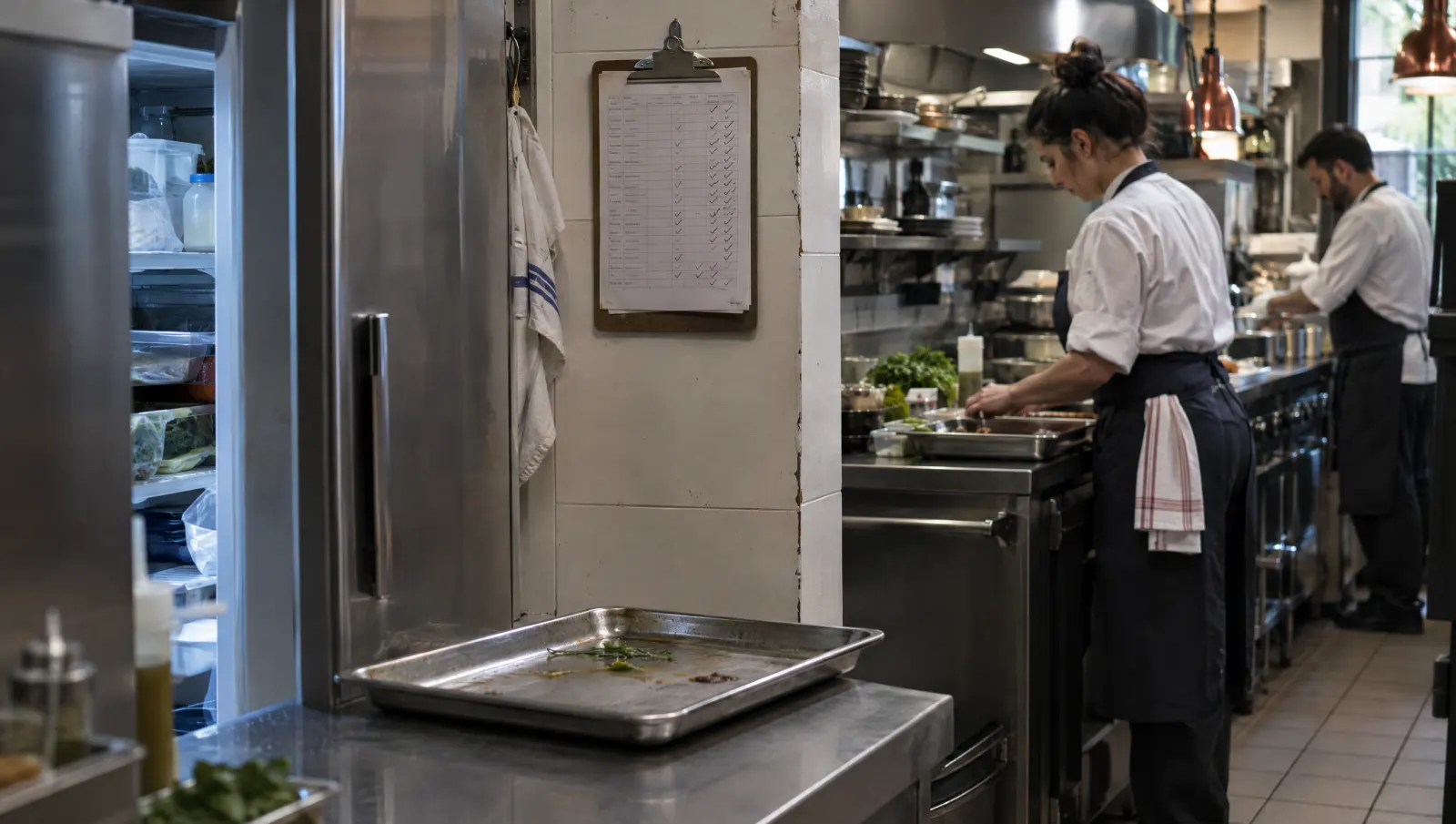
Compliance theater is a control system that has become excellent at producing green. The team ticks to avoid the reminder, the dashboard reassures, and nobody learns anything from the data anymore. The fix is not more control but more direct proof, deviations that are welcome and cross-checks on the floor.
Seven p.m., the dashboard is all green
A fictional example. On a Saturday night, the owner opens the compliance dashboard for their third site: everything is validated, readings, cleaning, labeling. On Monday, they stop by in person. The thermometer on the cold display shows a value nobody has bothered to read since the day before, and the open sauce container has no label.
Nobody lied out of malice. The rush hit, the tablet kept asking for validation, and validating was the fastest way to make the screen go quiet.
How green becomes a habit
- The reminder punishes the missing box, not the missing task. If the manager's only feedback is "some boxes are not ticked," the team learns to tick.
- Red has a cost. Reporting a deviation brings blame, paperwork or an investigation. The math is quickly done.
- The time slot does not exist. A long list of readings requested during service cannot all be done. The ones skipped get validated anyway.
- The data is never reread. If nobody goes back to the dashboard, the box has no reader, so no reason to be accurate.
- The check is self-declared from start to finish. The person who does the task ticks it, and nobody else looks.
Weak signals and how to verify them
| What you observe | What it may reveal | Check to make |
|---|---|---|
| All boxes validated in the same minute | Batch validation at the end of service | Compare the entry time with the planned time of the task |
| Identical values day after day | Value copied without reading | Read the device in passing, unannounced |
| No deviation or comment for several weeks | Fear of red, or reading not taken | Ask the team what makes reporting difficult |
| Complete readings on heavy service nights | Task ticked out of reflex | Look at the time slot actually available |
| Same employee late every time | Task badly placed in the typical day | Review the schedule and the station before talking about the person |
None of these signs proves a fault. They show where to look.
Giving the check meaning again, in six steps
- Choose few checks. Keep the ones that really protect food safety or quality, and remove the ones nobody uses.
- Make deviation normal. Tell the team, out loud first: "a red with a comment is a good reading." The manager says thank you, not a reprimand.
- Strengthen the proof. A value read on the device, a photo, a sensor reading: the more direct the proof, the less good faith matters.
- Cross-check. In the morning, the manager or another station verifies one of yesterday's checks at random, in front of the employee, with no show made of it.
- Put the task at the right time. If the slot is untenable, the task moves in the typical day, or disappears.
- Plan what happens when a value is off. Every check has a written response: who is informed, what happens to the product, who verifies afterward.
Mistakes that keep the show running
- Praising a one hundred percent completion rate as a result.
- Adding a check after every incident without removing any.
- Giving the check to the person who does the task, with no cross-checking.
- Treating a reported deviation more harshly than one that was discovered (the opposite should be true).
What the manager says changes everything
The reaction to the first red decides everything else. If the manager answers with a question ("what made this difficult?"), the team understands that a deviation is information. If they answer with blame, the team understands that red is a personal risk and green becomes a refuge again. Say it explicitly in a team meeting, then hold to it for several weeks: trust is built on repetition, not on an announcement.
What to measure
- The share of readings that have direct proof (value read, sensor, photo) compared with plain ticked boxes.
- The number of deviations reported by the team, compared with those found by the manager on their visits. If only the latter exist, reporting is not working.
- The gap between the planned time of the task and the entry time. It tells you whether the task happens at the right moment.
Where Tsuno comes in
Tsuno keeps food safety readings, entered by hand or by sensor, with their provenance: measured, declared, proven, observed. A value read by a sensor does not have the same status as a ticked box, and the tool shows it. When data is missing, it says so instead of filling the gap. You can ask "How did the week go at site X?" to see what was done, what is only declared and what is absent. Tsuno connects the facts, it never judges a person, and it triggers no automatic sanction. See the trust page for the doctrine.
Key takeaways
An all-green dashboard proves nothing. Remove useless checks, strengthen the proof of the ones that remain, and make a reported deviation a fact that is welcomed.
Going further: why temperature checks can be completed and still be useless, why incidents keep repeating, the opening checklist people actually use and the pillar article Digital HACCP.
Frequently asked questions
How do you spot a reading that was ticked but never taken?
Look for weak signals: every box validated in the same minute, identical values day after day, complete readings on the busiest nights. None of these proves a fault, but each deserves a check on the floor.
Should you sanction an employee who ticks without doing the task?
Start by looking at the process: a time slot that cannot be met, a task that takes too long, a vague instruction. A sanction without a diagnosis mostly teaches people to hide the gap better. Any reprimand remains the manager's decision, made with the facts in hand.
Is an all-green dashboard necessarily suspect?
No, but a dashboard that has not shown a single red or commented box in several weeks should raise a question. An honest system produces some red from time to time, because the reality of service is never perfect.
What kind of proof makes a check credible?
Proof that does not depend on the good faith of the person ticking: a value measured by a sensor or read on the device, a photo, a cross-check by another station. The more direct the proof, the less the box matters.
How can you lighten checks without taking a risk?
Remove the readings nobody reads and keep a few precise checks, with a clear rule on what to do when a value is off. One check fewer but really used beats ten ticked out of reflex.
Keep reading

Hygiene and compliance
Digital HACCP: what the software should actually remove
Putting the binder on a tablet without changing the work gives you a binder on a tablet. Useful digital HACCP removes re-entry, searching and chasing.

Hygiene and compliance
Why restaurant incidents keep repeating despite reports
A repeat incident was not forgotten: it was logged with no cause, owner or check. Here is how to close the loop, from the first note to the follow-up check.

Hygiene and compliance
Restaurant audit: from score to action plan, step by step
An audit with no corrective action gives you a score, not progress. Link every finding to an owner, a due date and a check that it is closed.