
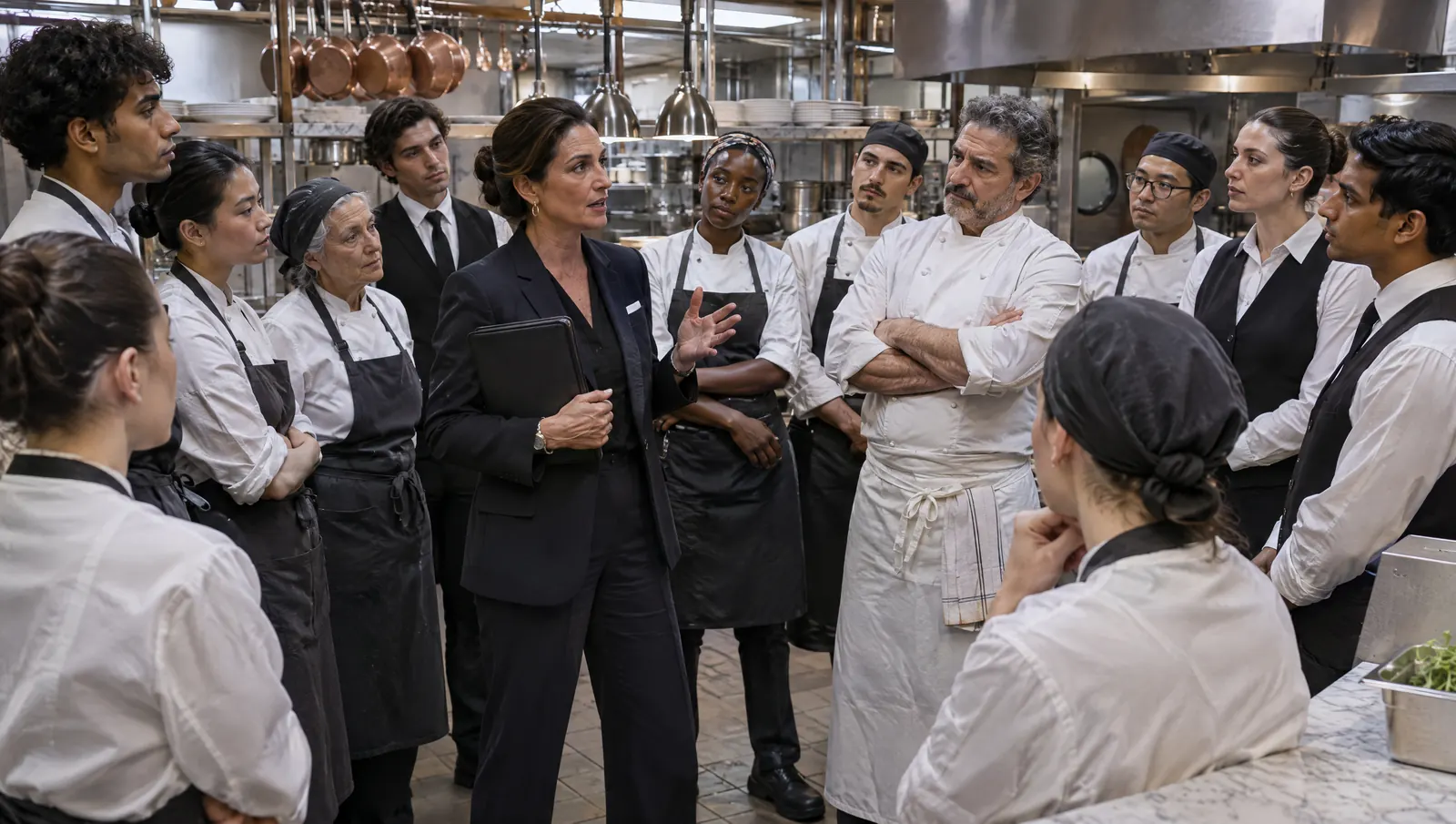
A good pre-service briefing takes five minutes and covers six points: the service in one sentence, what's missing, today's allergens, sensitive tables, one instruction, and who does what. AI helps prepare it by gathering the day's facts (overdue tasks, missing checks, delivery discrepancies, absences, last night's notes). The briefing itself is still delivered by a person, standing in front of the team, because it is as much about checking that people have understood as about passing on information.
Saturday, 6:52 pm, at the pass
Eighty-five covers booked, including a party of twelve at 8:30. At 6:40, Dorian, the head chef, found out the sea bass wasn't coming: the supplier sent pollock instead. Rosalie, the front-of-house manager, knows a guest with a tree nut allergy is booked for 9:00, and that the dessert recipe changed on Thursday. The server who started on Monday doesn't yet know who takes allergy questions on the floor.
At 6:55 the whole team gathers in a half circle. Dorian starts with the pollock, then moves on to fridge cleanliness, this week's breakages, last night's late arrivals. At 7:09 Rosalie still hasn't spoken. Nobody has mentioned the guest with the allergy. The new server goes back to his section with one certainty: the chef is angry.
None of the missing information was secret. Everyone knew something, but different people knew different things, in different places.
Why briefings go off the rails so often
Nobody prepared it
Most line-ups are improvised at 6:55 from whatever the chef has in mind. And what's on your mind at that moment is the latest problem, rarely the one that matters most for the service ahead.
The facts are scattered
The delivery is on the docket, the shortage in a text message, the allergy in the booking system, the absence on the rota, yesterday's incident in the sous chef's memory. Nobody has time to pull it together at 6:30, in the middle of prep.
Two meetings get mixed up
The briefing prepares tonight's service. Fridge cleanliness and the week's breakages belong in another meeting, at another time, with room to talk. When the two blend, service comes second.
The floor team just listens
When the kitchen talks and the floor listens, sensitive tables vanish from the briefing. Yet the floor team is the one that knows them.
The six-point structure
Keep the same order every service. The team learns to expect it, and a missing point gets noticed.
- The service in one sentence. Covers, the peak, what's different tonight ("big party at 8:30, starters go out in two waves").
- What's missing. Products that ran out, what replaces them, what the floor tells guests. One sentence per product.
- Today's allergens. Any dish whose recipe or supplier changed, and the rule said again: never answer from memory, check the current sheet or fetch the person in charge.
- Sensitive tables. An allergy declared at booking, a guest who was unhappy last time, a birthday, someone with reduced mobility, a group running late. This is the floor team's moment.
- One instruction, just one. Phrased so it can be checked: who, what, when, how you'll know it's done. If you have three, pick the one that matters tonight.
- Who does what. Stations, who covers the absent colleague, who handles allergies on the floor, who calls at the pass. Then one open question: "What isn't clear?"
Point 5 deserves a word. "Watch your cooking times" can't be checked. "Tonight the sauce cook tastes every sauce before it goes and flags anything off at the pass" can be checked at the end of the night. The full method is in clear, SMART instructions.
What AI changes in the preparation
The gain comes before the briefing, around 4 pm, when the chef has ten minutes. Instead of going through five sources, he asks a plain question: "What needs my attention for tonight?" A tool connected to daily operations can answer with dated facts:
- today's tasks still open or overdue;
- missing checks, and any temperature reading out of range;
- discrepancies between the order and what arrived that morning;
- logged waste with its reason;
- absences and late arrivals already recorded, and tonight's rota;
- logbook notes left after the previous service.
Each fact should come with its source: entered by whom, at what time, with or without a photo. And when data is missing, the tool should say so rather than guess. A theoretical stock count doesn't replace a look in the walk-in; it tells you where to look. What AI can gather for a manager, and what it should never compile, is covered in compiled facts and field feedback.
What AI doesn't do: choose tonight's instruction, sense that the team is tired after two doubles, decide that the guest with the allergy comes first. It prepares the material. Dorian and Rosalie sort it.
Why a person still delivers it, standing up
A briefing passes on information, and it also does three things no screen does. It shows that kitchen and floor agree, because the team sees the chef and the front-of-house manager speak one after the other. It lets you see who has understood: a blank look, a new starter who won't raise a hand, someone who isn't there. And it marks the start of service, like a whistle at kick-off.
Standing matters too. Sitting down, briefings stretch. Standing in a half circle, everyone sees everyone and nobody hides behind a colleague.
The tool can help with reminders afterwards. An instruction turned into a task, with an owner and a deadline, stays visible during service. But a sentence said out loud, in front of the others, carries more weight than a notification.
Before, during, after: who does what
| Briefing point | Before (preparation) | During (the briefing) | After (service) |
|---|---|---|---|
| Service in one sentence | Covers and tonight's rota checked | The chef says it in one sentence | Actual covers compared with forecast |
| What's missing | Delivery discrepancies and waste gathered by the tool | The chef announces shortage and substitute | Note of what ran out during service |
| Today's allergens | Changed recipes spotted, sheets checked | The "check the sheet" rule repeated | Any unanswered guest question noted |
| Sensitive tables | The front-of-house manager reviews bookings | The front-of-house manager presents them | What happened with those tables logged |
| One instruction | Phrased so it can be checked, turned into a task if needed | Said once, with the owner's name | Followed or not, checked in two minutes |
| Who does what | Today's absences and late arrivals known | Stations announced, "what isn't clear?" | Station changes noted for the next rota |
The "after" column is the one people forget, even though it feeds the next day's briefing. Two minutes at close, a dated note in the logbook, and tomorrow's line-up starts from facts instead of memories.
Common mistakes
- The sermon. Ten minutes of complaints about the week, and service starts tense. Criticism belongs in a one-to-one or a team meeting, not at 7 pm.
- Reading the screen. The chef reads the tool's list with his head down, and nobody remembers anything. The list is for preparing; the voice is for passing it on.
- Three instructions at once. None of them gets followed. One per service, checked at the end, works better.
- A silent floor team. If the front-of-house manager doesn't speak, sensitive tables don't get mentioned.
- The same briefing every night. Repeat the same lines and the team stops listening. Anything that needs repeating daily belongs on a sheet or a checklist.
- No final question. Without "what isn't clear?", the new starter won't ask.
What to measure
- The length of the briefing, timed over three services. Aim for five minutes.
- The number of questions during service that the briefing should have answered ("is there any bass left?"), counted by the front-of-house manager over a week.
- The share of daily instructions that were followed, checked after service: a yes or no noted each night.
Where Tsuno fits
Tsuno helps with the preparation. You ask it plain questions, from Tsuno or from the AI assistant you already use, with the same rights as in the app. It gathers the facts it holds (tasks, checks, deliveries, waste, rota, logbook), each with its source, and says when data is missing. If it drafts a task for tonight's instruction, it summarises the effect and nothing happens until you confirm, following the two-step rule. For sensitive tables, the briefing draws on a separate source: what your reservation system says, and what your front-of-house manager knows. For the team, Tsuno San lets people ask for their next task or a procedure by voice: San Voice is available as a demo. The full list of functions is on the features page.
Further reading
For point 3, read why no tool should answer allergen questions from memory. To shorten what you say, see shorter, clearer messages for your team. And for what can't be passed on in a briefing or on a screen, read passing on a skill: what no AI will replace. The framework is in the pillar page AI for frontline managers. For a group, see what San changes when you run several restaurants, and for actions decided at the briefing, deadlines and reminders: following up without a spreadsheet.
Key takeaway
Prepare the briefing at 4 pm with facts and deliver it at 6:55 with words. Six points, five minutes, one instruction, and two minutes after service so tomorrow starts better.
Frequently asked questions
What should a pre-shift briefing in a restaurant cover?
Six points, in this order: the service in one sentence, missing products and their substitutes, today's allergens, sensitive tables, a single clear instruction, and who does what. It fits in five minutes, standing up, with kitchen and floor together.
How long should a line-up before service last?
Five minutes is enough when it has been prepared. Past ten, people drift and the briefing eats into prep time. Time three briefings to see where you stand.
Can AI prepare the briefing instead of the chef?
It can gather the facts that feed it: overdue tasks, missing checks, delivery discrepancies, logged waste, absences, notes from the previous service, each with where it came from. Choosing what matters tonight and how to say it stays with the chef and the front-of-house manager.
Can you run the briefing by reading from a screen or tablet?
Better not. A tablet is for preparing the briefing beforehand. In front of the team, the person speaking looks at people, checks they have understood and answers questions. A screen read aloud makes everyone look at the floor.
Should allergens come up at every briefing?
Yes, whenever a dish, a recipe or a supplier has changed, and to repeat the rule: never answer a guest from memory, check the current allergen sheet or fetch the person in charge.
What should happen after service so the briefing helps the next day?
Two minutes is enough: check whether today's instruction was followed, note what ran out and what happened with any sensitive table. These dated notes feed the next briefing.
Keep reading

Team and management
Talking to your team: shorter, clearer messages
A useful team message fits in three lines: one action, one owner, one time. AI can help shorten and translate it; the manager reads it and sends it.

Team and management
AI and emotions at work: what has been banned since 2025
Since 2 February 2025, the EU AI Act has banned AI systems that infer employees' emotions in the workplace, except for medical or safety reasons.

Team and management
AI at work: what changes for employers in 2027
From 2 December 2027, EU rules on high-risk AI cover hiring and staff management tools: employers will have to inform staff, oversee and keep logs.