
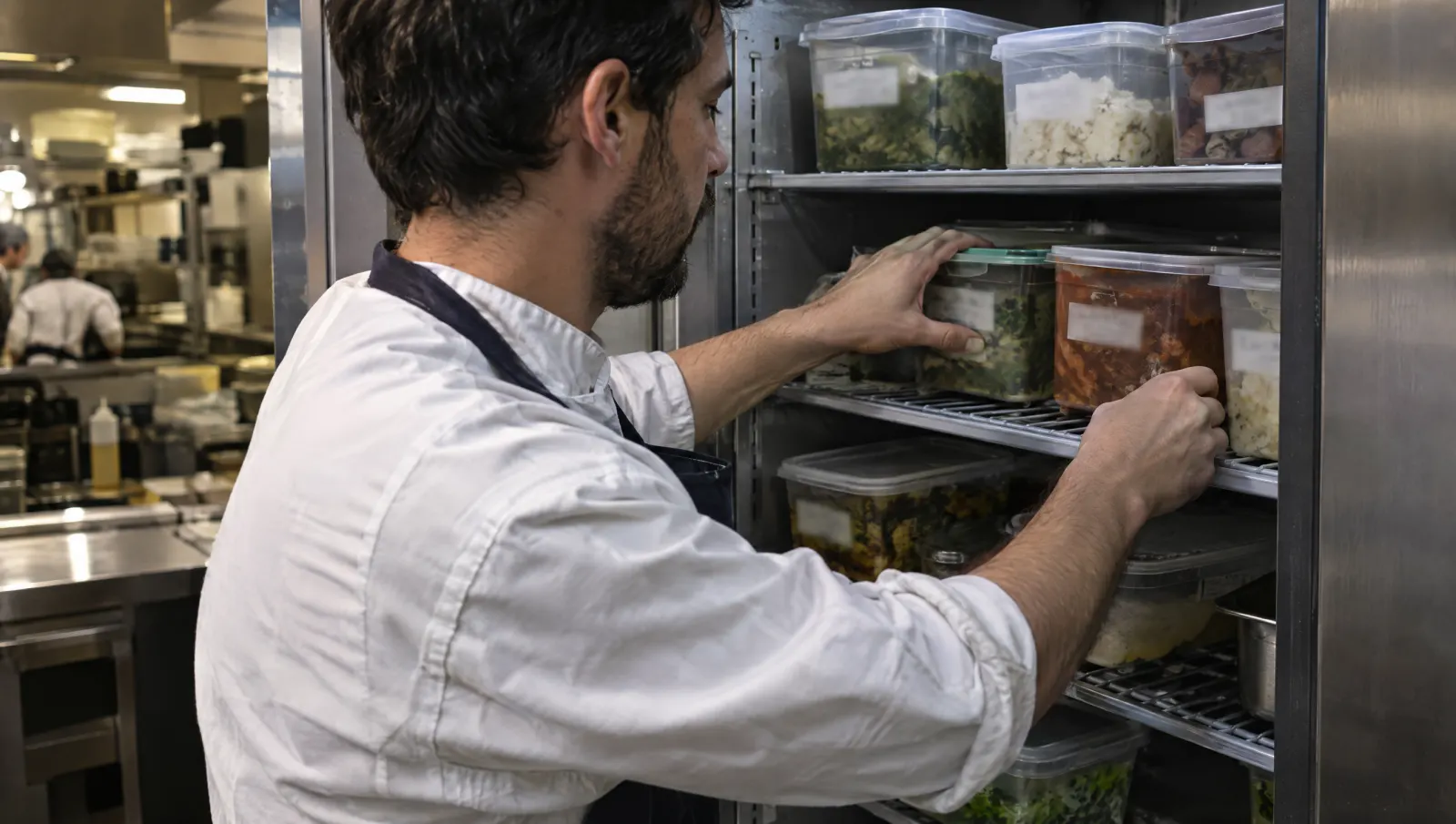
In a restaurant, use-by dates are not fixed with a label printer. The label is only the visible result of a chain: a written, current shelf-life rule, a product you can identify, a dating step done at the right moment, and a record that lets you find what was served.
The sauce that did not have the same life on two sites
A head chef at the second site opens the walk-in and finds a tub of sauce made the day before by the night crew. On the label, the production date is legible and so is the use-by date, but it matches the other site's rule, which stores the same sauce differently, in a different container. She hesitates: throw it out, or keep it and trust the label? She calls the manager, who calls the chef at the first site, who no longer remembers where the rule came from.
The date was printed correctly. What was missing was the rule behind it: who had set it, for which container, which version was in force.
Why use-by dates are a problem in the kitchen
- Three levels of product are mixed together. A raw product that has been unwrapped, an intermediate preparation and a finished recipe follow different rules, but are labeled the same way.
- The rule is written nowhere. It travels by word of mouth, with variations depending on the team and the mood of the day.
- The default and the exception get confused. A general rule exists, then each site invents exceptions without recording them.
- The history is missing. You know what is written on the tub, not which batch of raw material was used or when it arrived.
- Use-by and best-before dates are confused. A use-by date concerns highly perishable food; a best-before date a minimum quality. Treating them the same leads either to needless waste or to keeping food that should go.
Distinguishing three levels before dating
| Level | Example | Where the date comes from | What to keep |
|---|---|---|---|
| Raw product | Delivered fish, opened cream | Supplier date, then opening date | Supplier, batch, receiving date |
| Preparation | Stock, sauce, marinade | The establishment's rule | Production date, rule applied |
| Finished dish | Dish prepared in advance | The establishment's rule | Date, person, what became of it |
Putting the rule before the label
- Take inventory of your common preparations. A list of twenty lines at most to start, the ones that come back every week.
- Set the rule for each one with your HACCP approach. Container, temperature, time before consumption, starting point of the count.
- Write it in one place, versioned. With the update date and the person who approved it.
- Handle exceptions in writing. If a site must deviate, the deviation is recorded with its reason, not improvised.
- Put the rule near the task. A reminder posted at the prep station, or in the labeling task of the typical day.
- Train new hires on three real cases. A sauce, a cooked meat, an opened product: they label in front of a witness.
- Check by sampling. Every week, open the walk-in with the list of rules in hand and compare.
What to do when doubt arises during service
It happens: a tub labeled ambiguously, or not labeled at all, in the middle of the rush. The rule must be known to everyone and must not depend on the chef's mood: when there is doubt about identity or date, the product is not served, and the incident is noted to understand the cause (label fell off, step forgotten, ambiguous rule). The aim is to fix the process, not to point at whoever labeled it. A clear instruction also protects the team: nobody has to decide alone under pressure.
Common mistakes
- Focusing on the printer. Neat labeling applied to a bad rule gives an illusion of control.
- Letting everyone set their own durations. That is the source of gaps between sites and between teams.
- Mixing use-by and best-before dates. The two are not handled the same way.
- Not dating opened products. Opening is a starting point, often forgotten.
- Keeping a rule with no validity date. When the recipe changes, the shelf life must be reviewed.
Three things to check
- The number of containers found without a label or with a rule different from the one in force, during sample checks.
- The number of preparations whose rule is written nowhere.
- The ability to find, for a given preparation, the batch and arrival date of the raw material.
Where Tsuno comes in
Tsuno keeps procedures and standards in one place, with their history, and ties them to the stations that apply them: the labeling rule appears in the typical day's task, with time, duration and signature. The training modules let you show new hires real cases. If your rule lives today in PDFs, spreadsheets or binders, the team can start from those documents, propose a mapping and have a human validate it. Tsuno does not set your use-by dates: that is your responsibility as an operator. See La Mise au Carré.
Also worth reading
This logic ties in with digital HACCP: what software should actually remove. To keep a single living rule, read explain it once: how to make a standard live and how to replace procedure binders without creating a digital graveyard. For what follows a deviation, see why restaurant incidents keep repeating.
Key takeaway
A use-by date is a rule before it is a label: written, versioned, shared across sites, with a record of the product. Distinguish raw product, preparation and finished dish, and record every exception.
Frequently asked questions
What is the difference between a use-by date and a best-before date?
The use-by date applies to highly perishable food: after that date, the product must no longer be eaten or served. The best-before date shows how long the product keeps its quality; it may remain edible afterward under certain conditions.
Who sets the use-by date for a preparation made in the kitchen?
The operator, under their own responsibility, based on their hazard analysis, the recipe, the storage method and the applicable recommendations. The rule must be written and shared, not left to each person's judgment.
What should a kitchen prep label contain?
At a minimum the name of the preparation, the date it was made or opened and the use-by date set by your rule. Add whatever your food safety plan requires, such as the person who labeled it or the allergens.
Why is a different use-by rule from one site to another a problem?
Because the same preparation can be thrown away at one site and served at the other. Beyond the risk, it destroys trust in the rule: everyone relies on their own habit.
How do you trace what was served from a given batch?
You need to keep the link between the incoming product (supplier, batch, date), the preparation made and the date of use. A label with no history behind it does not let you trace back.
Keep reading

Hygiene and compliance
Restaurant opening checklist: a short template that works
An opening checklist prepares the shift; it does not document the whole business. A copy-ready template, task order and the right proof for each station.
Hygiene and compliance
Compliance theater: when everything is green but nothing is right
When the team ticks boxes to avoid reminders, the dashboard stays green and says nothing. Spot the signs of a window-dressing check and restore its meaning.

Hygiene and compliance
Digital HACCP: what the software should actually remove
Putting the binder on a tablet without changing the work gives you a binder on a tablet. Useful digital HACCP removes re-entry, searching and chasing.