
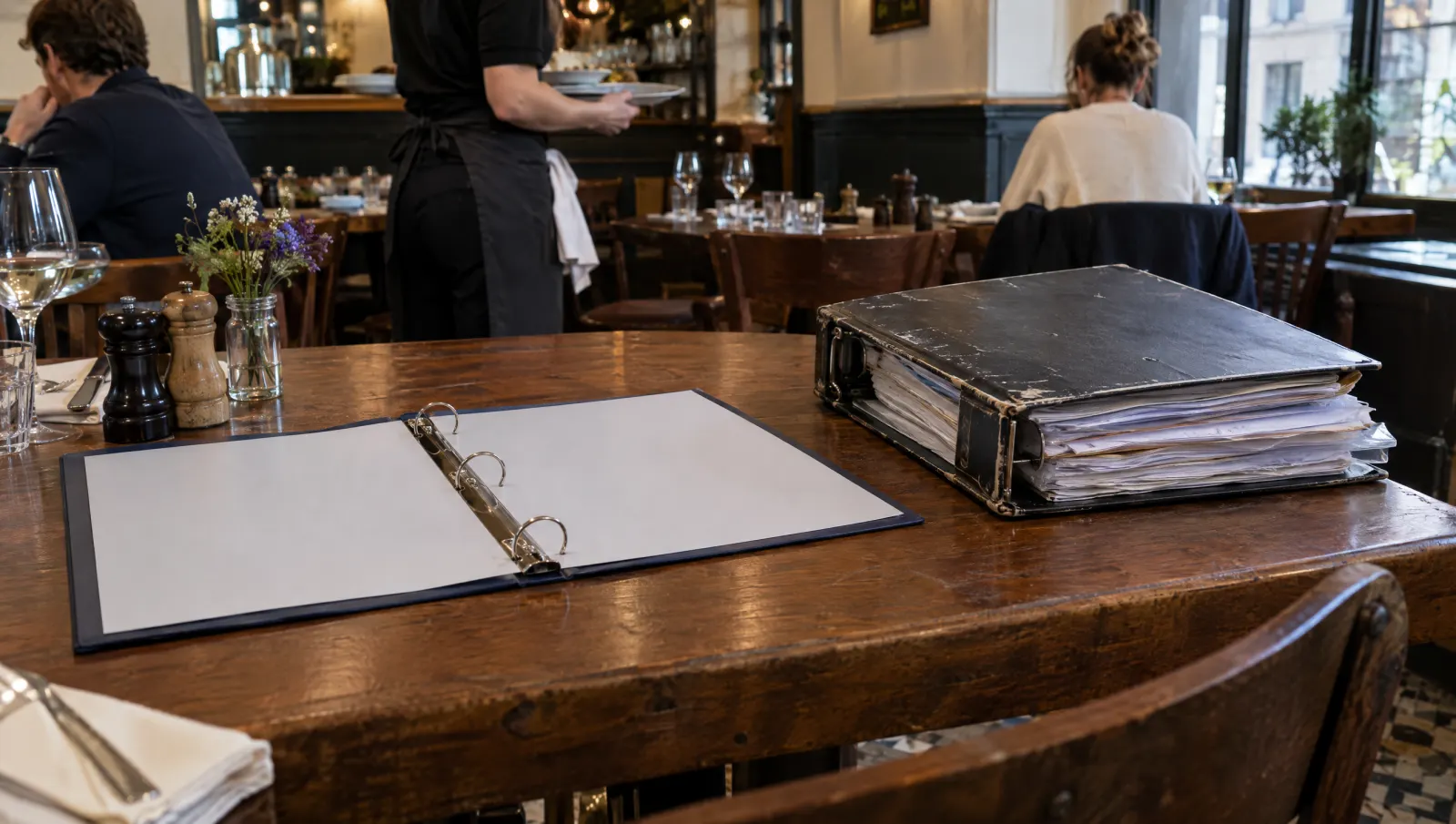
An empty free account can confirm the prospect's fear: "yet another tool to set up." For rich software, which has to know your roles, your procedures and your teams, the most useful proof is not a blank space to fill in alone. It is a result obtained from your own documents.
The Monday the account stays empty
A fictional owner creates a free account on a Sunday night. They log in on Monday morning. The interface suggests creating a location, adding roles, writing procedures, inviting users. They stay forty minutes, then lunch service arrives. On Tuesday, they do not reopen the tool. On Thursday, they get an automated message offering to pick up where they left off. They have no idea what the tool would have brought them.
They did not judge the product. They judged the effort. Their verdict, "another thing to fill in," is wrong about the product and right about the experience.
Why a free account works for some tools and not others
- A simple tool shows its value very fast. A single-purpose tool does not need context to convince.
- A memory tool needs material. Its value appears when it holds what you already know. Empty, it demonstrates nothing.
- The restaurant owner has no free time. A free trial happens in the evening, tired, or does not happen.
- The initiative is misplaced. The one who doubts is asked to make the effort to convince themselves.
- Empty looks like workload. A screen with no content shows what you will have to write, not what you will gain.
Two ways of getting to know a tool
| Criterion | Empty free account | Trial on your documents |
|---|---|---|
| Starting point | Blank page | Your real files |
| Effort asked | Configure alone | Provide a few documents |
| First result | After hours of entry | From the first output |
| Risk of dropping out | High, for lack of time | Low, the effort is shared |
| What you learn | The interface | The ability to understand your reality |
| Who it suits | Simple tools, individual use | Rich tools, team use |
The table is not a universal judgment. It is a reminder that the form of the trial should match the nature of the product.
How to design a trial that proves something
If you are a buyer, here is how to demand a useful trial. If you are a vendor, here is what you owe your prospects.
- Start from documents the restaurant owner already has. Procedure, recipe, checklist, schedule. Nothing to write.
- Choose non-sensitive documents. No payroll data, no contractual information, no personal files.
- Do the formatting work in place of the prospect. That work is what they fear, and it is what needs to be shown.
- Show the result on a concrete case. A question put to the tool on those documents, with the answer and its sources.
- State what is not understood. A good trial also shows the limits, especially when data is missing.
- Leave the exit open. The prospect must be able to stop and take back what they supplied.
One last point deserves to be said clearly: this reasoning does not condemn free access in itself. It observes that a product that has to know your organization cannot be judged without it. The question to put to a vendor is therefore simple: what will I see of your tool in the first week that is about my restaurant and not a sample restaurant?
Trial design mistakes
- Offering a multi-week trial with no support. A busy prospect forgets it before the first week is over.
- Believing that free signals confidence. For a restaurant decision-maker, confidence comes from precision, not from a zero price.
- Hiding limits behind a guided path. A limit found after commitment costs more than a limit admitted upfront.
- Collecting sensitive data too early. A trial should stay possible without taking any risk.
Three signs a trial has done its job
- The prospect asked a question from their daily work and got a recognizable answer. They say "yes, that's how it works here."
- They know what it would take to scale up: which documents, which team, how long.
- They identified what the tool would not do, and decided with full knowledge.
Where Tsuno comes in
Tsuno does not ask you to open a blank page. The entry point is "Try with 3 documents," nothing sensitive: a recipe, a procedure, a checklist or an anonymized schedule. From there, the extraction proposes a match, a person validates anything sensitive, and you see Tsuno working on your material. To go further, the "La Mise au Carré" service delivers the tool pre-filled from your existing documents, with an on-site review. When data is missing, Tsuno says so. Your data stays yours, with export possible. See the Mise au Carré.
To continue the thinking
Restaurant software delivered pre-filled explains why setup is the real product. Three documents that reveal whether software understands your restaurant details what to test. For the evaluation side, choosing without being fooled by a perfect demo completes the picture. The framework is in do restaurants really need another software tool.
Key takeaways
An empty free account asks the prospect to do the work before seeing the value. For a rich tool, a trial built from real, non-sensitive documents, where the vendor makes the initial effort, is better. The goal of a trial is not to charm, it is to enable an informed decision.
Frequently asked questions
Is a free account a good way to test restaurant software?
For a simple tool, yes. For rich software that has to know your roles, your procedures and your teams, an empty account only shows blank screens and a configuration job to do alone.
Why do free trials often fail in a restaurant?
Because the person who opens it is short on time, has no content to work with, and does not see the value until everything is filled in. The trial ends before the value appears.
What is the alternative to an empty free account?
A trial done with your own documents: a few real files, imported and formatted, that let you see the tool with your own material. That proves more than a generic walkthrough.
Which documents should you use for a risk-free trial?
Non-sensitive documents: a recipe, a procedure, a checklist or an anonymized schedule. Avoid employees' personal data or contractual information in a first test.
How do you check that a guided trial is not a disguised demo?
Ask that the result be based on your documents, that the steps be explained, that you can decline to continue with no commitment, and that the export of your data be planned from the start.
Keep reading
AI and tools
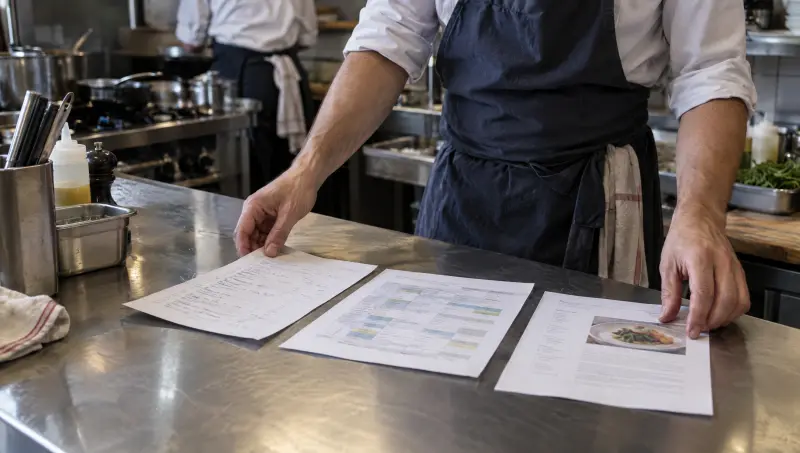
Three documents to test whether software understands your restaurant
One real procedure, one recipe and one schedule are enough to see whether software understands your restaurant or just fills in its own templates.
AI and tools
Choosing restaurant software without falling for the demo
A demo shows the best path. To choose, insist on your documents, your questions and your edge cases, and watch what the tool does when it does not know.
AI and tools
Measuring restaurant software ROI in 90 days: the method
To measure restaurant software ROI in 90 days, record five variables before launch, then compare at 30, 60 and 90 days using your own figures.