
The risk is real: an aid that guides every move can make people forget why they make it, and a skill wears away when it is no longer used. Research on automation, on GPS and, more recently, on AI in medicine shows it. What makes the difference is how the tool is designed and how managers use it. If the sheet gives the reason for critical steps, if a chef signs off the technique at the station and if experienced staff keep their role as trainers, the assistant helps a commis learn instead of steering them blind.
Tuesday, 10 a.m., before prep
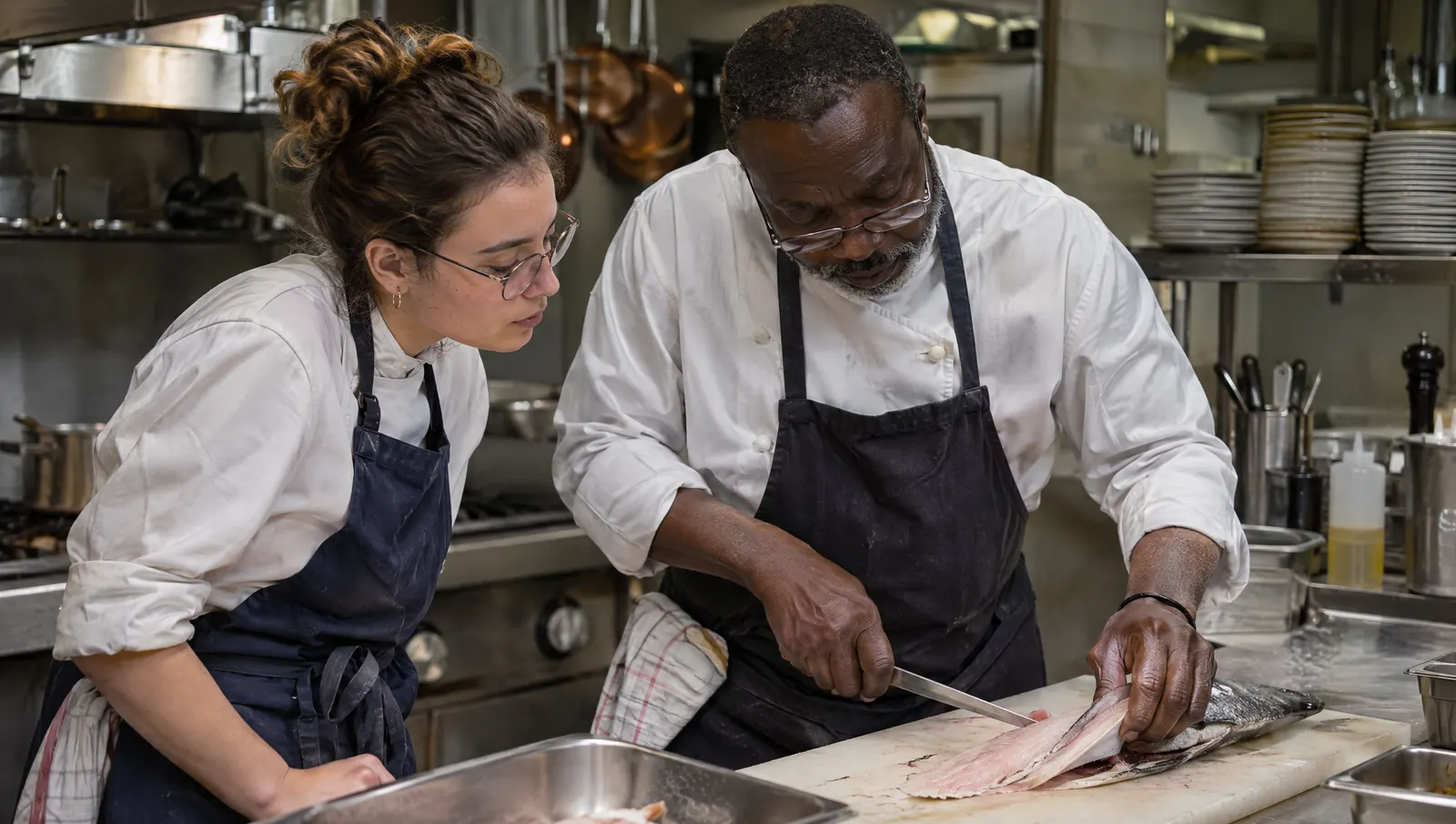
Célia has been a commis for two months. She can follow a sheet to the letter: the step comes up, she does it, she ticks it. This morning, Jean-Pierre, the head chef, puts a sea bass on the board and tells her to watch. No tablet.
He takes off the first fillet while talking. Why he starts at the head. Why the blade stays flat against the bone. Why he does not force it at that spot. Célia does not look at a screen, she watches his hands. Then it is her turn with the second fish, and the chef corrects the angle of her knife.
From the sheet, Célia had the order of the steps. From Jean-Pierre, she now knows what happens if the blade lifts: next time a bigger bass comes in, she will be able to adjust.
(Scene and characters are fictional.)
The risk is real, and it is documented
The irony of automation
In 1983, researcher Lisanne Bainbridge published "Ironies of Automation" (Automatica, vol. 19, no. 6). Her point: when you automate the easy parts of a job, you leave people the hard parts, the ones where the machine fails, at the very moment they have had less practice. The better the aid, the less people train for the day it is not there.
Too much trust in the aid
In 2010, Raja Parasuraman and Dietrich Manzey reviewed the research on automation complacency and automation bias (Human Factors, vol. 52, no. 3). They found that people monitor an automated aid less when they are juggling several tasks, and that the bias affects novices and experts alike, with training or instructions not enough to prevent it. In a kitchen, juggling several tasks is the norm.
The GPS effect
In 2020, Louisa Dahmani and Véronique Bohbot published a study of 50 drivers in Scientific Reports: those who used GPS the most had weaker spatial memory when they had to find their own way. Among the 13 people retested three years later, heavier use went with a steeper decline. The sample is small and the study correlational. But everyone knows the mechanism: you follow the arrow, you get there, and you could never retrace the route.
What we are starting to measure with AI
In 2025, a study in The Lancet Gastroenterology & Hepatology (Budzyń et al.) followed 19 experienced endoscopists at four centres in Poland. After an AI detection aid was introduced, their adenoma detection rate in procedures done without AI fell from 28.4% to 22.4%. The study is observational, and experts urged caution about causation. But it is one of the first measured signals among highly skilled professionals.
The same year, a survey by Microsoft Research and Carnegie Mellon University of 319 knowledge workers (CHI 2025 conference) found that the more people trust generative AI, the less critical thinking they report applying to the task. These are self-reports, not measurements, but they point the same way.
Why hands-on jobs are concerned
You might think these risks are for office work. The OECD estimated in its Employment Outlook (July 2023) that occupations at highest risk of automation made up about 27% of employment, with low- and middle-skill jobs most at risk. The ILO, in its index published in May 2025, judged that transformation of jobs is the most likely effect of generative AI, more than replacement. Both figures describe exposure, not a forecast of job losses. In restaurants, that transformation mostly runs through how people access information and how they learn. That is where deskilling happens, or does not.
Deskilling depends on design and management
The same tool can help people progress or help them unlearn. It comes down to three questions. Does the tool explain, or only instruct? Who decides that someone knows how to do the job? Does the manager check whether the aid is needed less over time?
A good workstation assistant should be asked about the same task less and less. If a line cook asks the same question in month three as on day one, the tool has not helped them learn: it has excused them from learning.
How to prevent deskilling
- Explain the why with the step. "Blade flat against the bone" is forgotten. "Blade flat, or you leave meat on the bone" sticks. A useful sheet gives the reason for critical steps, and a good assistant gives it when asked.
- Have a person sign off the skill, on the job. Reading the sheet or passing a quiz does not mean you can do it. Sign-off happens at the station, by a trainer or manager who has seen the move. AI should not decide that someone is competent: that is a human assessment, based on facts.
- Build in reflection. France's AFEST framework for on-the-job training (Labour Code, Article D6313-3-2) requires an analysis of the work, a named trainer, reflective phases separate from the work itself to compare what was expected with what was done, and assessments. Wherever you operate, those reflective moments are exactly what guided execution removes.
- Track whether repeated questions go down. At a station, the questions that come back week after week show what has not been learned, or what is badly written. Read this by station and by procedure, never as a file on a person.
- Give experienced staff recognition. The dishwasher who knows how to restart the machine, the sous chef who knows every supplier: their knowledge should not become a sheet nobody credits them for. Make them trainers, recognised and on record.
- Keep some moments without the aid. Now and then, have someone redo a task from memory, then compare with the sheet. It is the equivalent of driving the route without GPS.
The tool that deskills and the tool that builds skill
| Criterion | Tool that deskills | Tool that builds skill |
|---|---|---|
| What it gives | The step, always the same | The step and the reason for it |
| Who says "they can do it" | Nobody, or the quiz | A person who saw the task done |
| What gets measured | Time spent in the tool | Fewer repeated questions per station |
| Role of experienced staff | Replaced by the sheet | Recognised trainers |
| When the tool is unavailable | The station stops | The work carries on |
| When the tool is wrong | Followed without noticing | Caught, because people understand |
Common mistakes
- Confusing answers with skill. Célia could recite the filleting steps long before she took off a clean fillet.
- Measuring adoption by usage. Usage that never drops on the same task is a warning sign, not a success.
- Letting the tool sign off training. A ticked box in a learning path does not replace a trainer's eye. On that limit, read interpreting without judging: the limit of AI in people management.
- Leaving experienced staff out of writing the sheets. They know why things are done; without them, sheets only say what.
What to measure
- Repeated questions on the same task, by station, month after month. They should go down.
- The time between someone's start date and a person signing off their key skills on the job.
- The number of experienced staff recognised as trainers on at least one skill.
Where Tsuno fits in
In Tsuno Compétences, skill levels are signed off and dated by a manager, and the "can train others" level is earned through on-the-job training. Sign-off stays human, and passing on the craft stays with the people who have it. Learning paths combine theory, practice, observation in real work situations and assessment.
Tsuno San gives access, at the station, to what the team has written: procedures, tasks, checklists, checks. It does not assess anyone and does not decide who is competent. Whether it helps people understand rather than just execute also depends on the sheets: a sheet that gives the reason for critical steps makes an assistant that can explain it. An assistant that is needed less and less on the same task is the goal we are building San towards, and we check it in real kitchens before calling it done.
Further reading
For the wider picture, read our pillar article on the future of work in hands-on jobs, then learning on the job: AFEST and a workstation assistant. To know when someone can really do the job, see how to know when a new restaurant employee is actually ready. And to turn experienced staff into trainers without burning them out, train people without turning your best employee into a full-time trainer.
Key takeaways
AI deskills when it hands out steps without explaining them and is allowed to decide what a person can do. With sheets that give the reasons and a chef who signs off the technique at the station, it becomes a way to learn instead.
Frequently asked questions
What is AI deskilling?
It is the loss of skill that happens when an automated aid does the thinking for the person. After being guided long enough, people carry out steps without understanding them, and can no longer do the job when the aid is missing or wrong.
Is there research showing that AI erodes skills?
Yes. A study published in 2025 in The Lancet Gastroenterology & Hepatology found that experienced endoscopists detected fewer lesions without AI after getting used to working with it, dropping from 28.4% to 22.4%. The study is observational and does not prove causation on its own.
Does GPS really ruin your sense of direction?
A 2020 study in Scientific Reports (Dahmani and Bohbot, 50 drivers) linked heavy GPS use to weaker spatial memory when people had to find their way without it. The sample is small and the study correlational, but the mechanism looks a lot like guided execution at work.
How can teams use an AI assistant at work without losing their craft?
Ask the tool to give the reason along with the step, have a person sign off skills on the job, track whether repeated questions at a station go down, and put experienced staff in charge of passing on the craft.
What is AFEST and does it help prevent deskilling?
AFEST is France's legal framework for on-the-job training (Labour Code, Article D6313-3-2). It requires a named trainer, real work situations, reflective phases to compare what was expected with what was done, and assessments. That is the opposite of guided execution with no step back.
Keep reading

Future of work
10 changes in the restaurant of tomorrow
Information at the station, dated procedures, checks logged during the task, AI for managers: ten changes already under way, and what can go wrong with each.

Future of work
A companion, not a supervisor
A good frontline tool helps the person doing the work first: answer, remind, report. Once it makes numbers about them for someone else, it turns into control.

Future of work
Conversational assistant or job assistant: where is the line?
A conversational assistant answers anyone with no context; a job assistant knows your location, acts within your permissions and asks for confirmation.